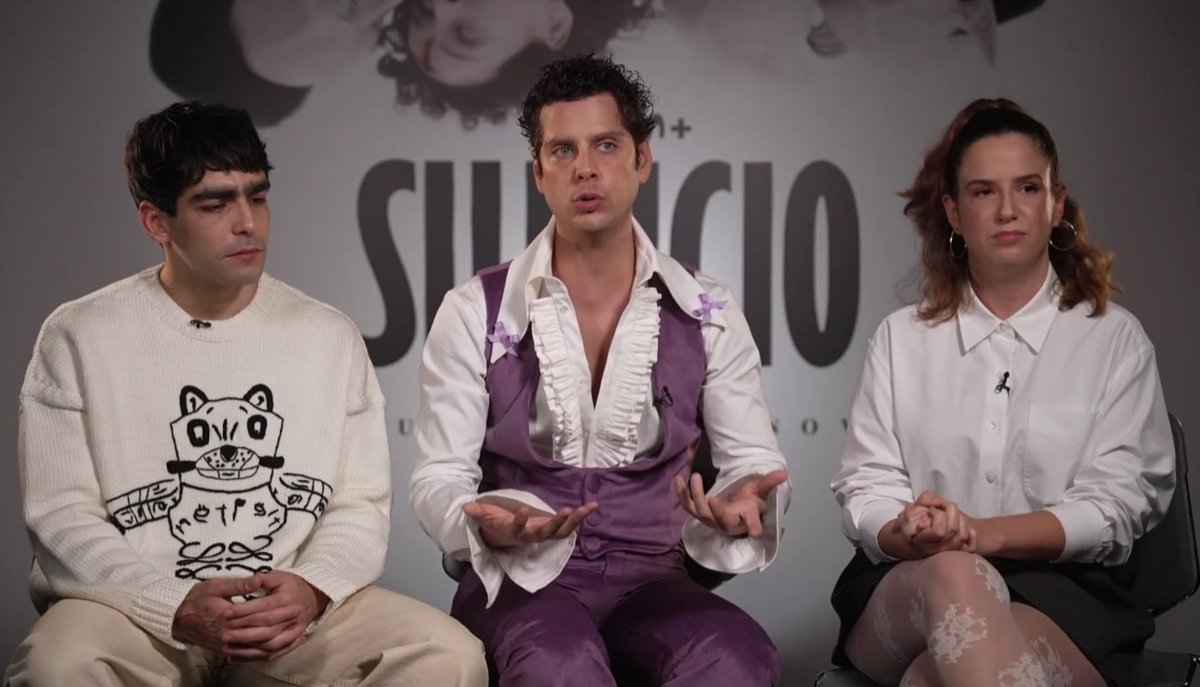
This Monday, December 1, Movistar Plus+ arrives ‘Silence’ miniseries created, written and directed by Eduardo Casanova (‘Skins’, ‘Pity’). Throughout three episodes where A family of vampires lives in centuries marked by plague and AIDS this black comedy denounces, with “humor and hooliganism”, that the stigma around HIV and the fear of reprisals for “expose your own voice” persist as forms of “structural violence by the system“.
“There is a certain fear that we public figures are developing to break the silence and take a stand on things that are obvious such as the genocide in Gaza.“says Casanova in an interview with Europa Press, where he emphasizes that the decision to remain silent in the face of “extremely obvious” problems has a structural nature. The filmmaker attributes this to the “fear of cancellation“, which in turn “is panic about job loss”, which in turn is only “It’s terror of losing money.”
For the person responsible for ‘Silencio’, this collective fear of speaking out arises from “a Machiavellian trick of the system to convert us in people with extremely white speech”. Casanova defends that in a society with dynamics that seek to “take away our personality and silence us, we must break the silence regarding what torments or disturbs you.”
María León expands on the idea presented by the director indicating that she conceives the series as a call to “expose your own voice for not only individual, but global good”: “I hope that society gets the message that we should not be silent.” Casanova points out that the actress’s character is not one of the vampires who hide their condition due to possible rejection, but rather a human with AIDS who also reflects that a stigma that forces you to “be silent makes you a very sad person.”
For Mariola Fuentes, staying silent is not always the cause of external pressures, it is also a sign of the indifference of a world that suffers from “loss of empathy.” “There has come a time when people see a dead child on the shore of a beach or in a war and they don’t care.“condemns the interpreter, who is more concerned about cases of “people who not only don’t care, but also say that the child should be killed because he is a future danger.”
VAMPIRES OUTSIDE THE CLICHE
“Socially, and throughout the history of cinema, there is a preconceived idea of what vampires have to be like.“, reflects Carolina Rubio, who gives life to one of these creatures in ‘Silencio’. To demonstrate how deeply rooted the patriarchal image of the vampire woman is in society, the actress tells an everyday anecdote far from any type of pretension: “I told my father that I was going to play a vampire and the first thing he said to me was ‘so, what are you doing, a sexy vampire?’“.
Faced with this norm, Rubio celebrates that fiction takes one of the most objectified figures of horror to capture that “we really can be much more than bad and sexy.” Fuentes shares her co-star’s joy at the decision to distance herself from simple eroticism: “We are not just inflatable dolls with fangs and a super sexy splash of blood falling, making an allegory of a little bit of semen.“.
“No, honey, we have life and things happen to us“claims the actress, who does not forget the effort of ‘Silencio’ to give depth to these raised creatures. León believes that this complexity is achieved thanks to some “very earthly vampires with a lot of real humanity and a desire to live.”
Casanova was clear about his lack of predilection for “male vampires, who are already widely seen”: “I’m interested in a female vampire and, furthermore, without her breasts out, but rather talking about her problems.” Among these obstacles, ‘Silence’ addresses why certain characters have always been narrated as a threat. “It is interesting to try to empathize or try to understand that people who say they are bad may not be.“, observa.
HIV STIGMA
That is, according to those responsible, one of the clearest bridges with the central metaphor of ‘Silence’, where the rejection suffered by people with HIV and AIDS dialogues with humanity’s hatred of vampires. And, although Casanova defends that ““Silence is a condemnation” in most areas, specifically that the miniseries talks “about the stigma and silencing of people with HIV.”.
During the documentation phase, the author came across a parallel between diseases that “caught his attention”: In its beginnings, the AIDS pandemic was called the Pink Plague, directly establishing a connection with the Black Death.“For Lucía Díez, that humanity has repeated patterns of stigmatization in diseases so far apart in time is a sign that “there is structural violence on the part of the system.”
Casanova regrets that, even if they want to, many people with HIV “can’t talk about it” because it entails “many limitations” in life. Among them, the actor also names “very strong” structural exclusions such as ““They cannot travel to more than 48 countries” without having complications regarding work visas.study or residence or how in Spain “it was not legalized until 2023 that having HIV” could not be an automatic reason for ineligibility to obtain a weapons license.