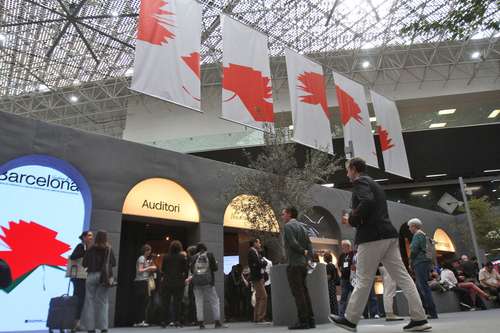
Guadalajara, Jal., With a message focused on cultural fraternity and the defense of books as a common territory against extremism, Salvador Illa Roca, president of the Generalitat of Catalonia, yesterday inaugurated his government’s stand, with Barcelona as the guest city of honor, at the Guadalajara International Book Fair (FIL).
The day was marked by calls to strengthen the historical ties between Mexico and Catalonia and to promote the internationalization of the publishing sector.
Accompanied by institutional representatives and by more than a hundred participating labels, Illa stressed that his presence at the fair symbolizes “the beginning of a renewed fraternity between Catalonia and Mexico, between Catalonia and Latin America,” and that this edition offers the opportunity to recover “all the cultural ambition” that has distinguished his country.
“Some governments intend to build walls. We open books. Faced with the hatred that wants to separate us, we invite us to unite in this magnificent fair,” he stated before editors, authorities and visitors.
The Catalan president defined Barcelona as “double cultural capital: Catalan and Spanish,” and highlighted that 80 percent of the literary production of the Spanish State is generated there.
For this reason, he said, the presence in Guadalajara is conceived as “one of the greatest opportunities on the calendar” to project talent, innovation, scientific dissemination, gastronomy and cinema.
He thanked the FIL for having chosen the city as a guest, the Barcelona City Council “for exercising its capital status for the benefit of the entire country,” and the entire Catalan cultural sector “for working to show the best image and generate prosperity.”
Marisol Schulz, director of the FIL, celebrated the consolidation of the Catalan pavilion, which is celebrating 11 years of sustained presence, but which this year reached an unprecedented scale.
“The fair is dressed in lights. It is a multilingual festival with the luminous and avant-garde presence of Barcelona, which has come with everything,” he indicated. He underlined the importance of the historical relationship with Catalonia for Guadalajara, “an intrinsic part of our DNA,” and highlighted that this bond is also reinforced by the memory of the Republican exile.
“We are united by deep sentimental and cultural ties; this meeting should be a watershed to strengthen them even more,” he added.
Representing the editorial guild, Patrici Tixis Padrosa, president of the Gremi d’Editors, spoke of the unprecedented growth of the delegation. “Normally, between 40 and 50 publishers participate. Today we have tripled the presence: we are around 120, plus those who accompany us from the international level.”
He defended the importance of internationalization in a sector made up mostly of small and medium-sized companies, “but which, thanks to public-private collaboration, has managed to remain the largest Spanish cultural industry.” This impulse, he stressed, allows “books to travel beyond our borders.”
The mayor of Barcelona, Jaume Collboni, recognized the efforts of the Catalan authorities and the curatorial teams to ensure the diversity of voices. He also announced that on December 6, a special celebration of the popular festival of Sant Jordi will be held in Guadalajara, “a symbolic gesture to thank the extraordinary reception.”