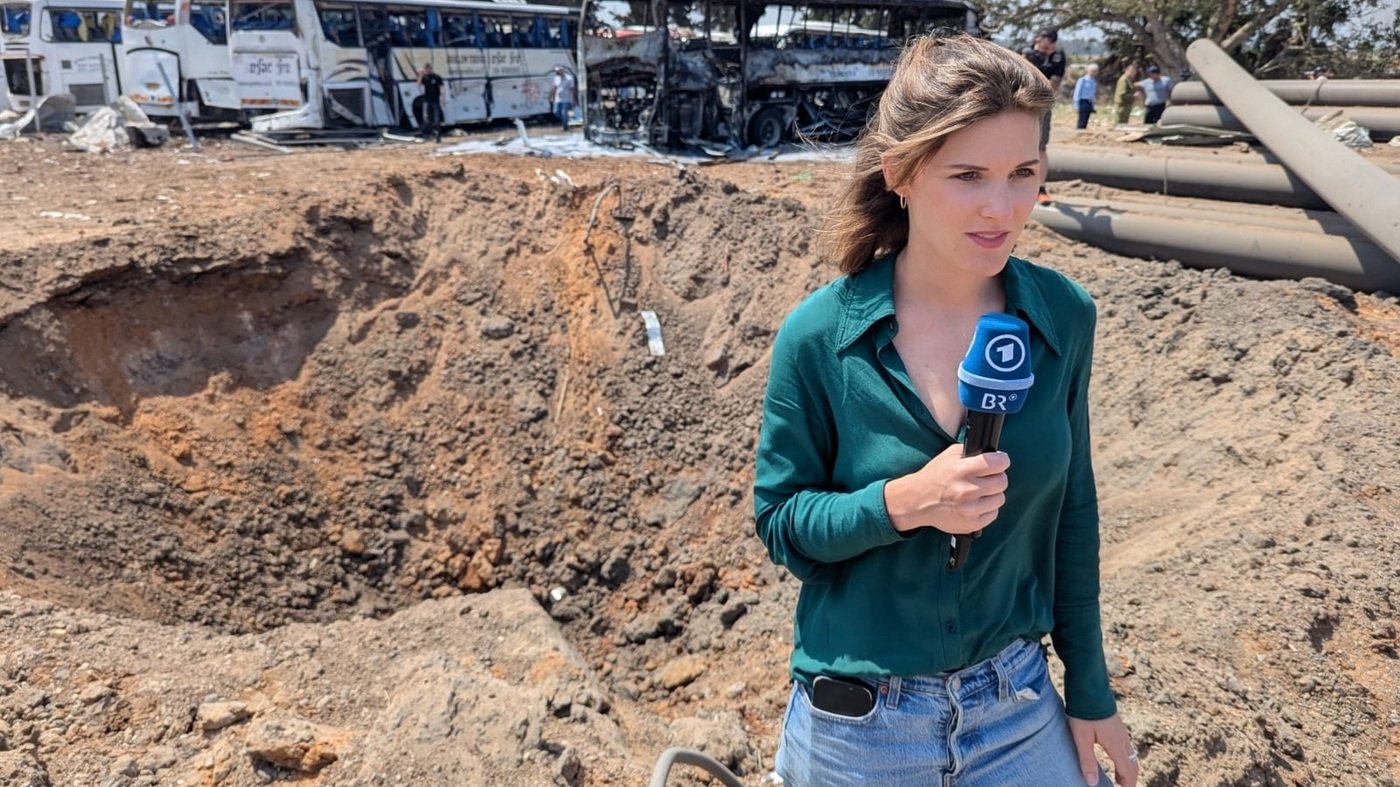
The planned award of the ARD correspondent Sophie von der Tann with the Hanns Joachim Friedrichs Prize for her Middle East reporting is causing controversy. There is criticism from the pro-Israeli side because von der Tann allegedly does not report in a balanced manner.
The journalist also receives support, not only from her broadcaster Bayerischer Rundfunk (BR), but also from the German-Israeli historian and educator Meron Mendel.
Von der Tann is to receive the prestigious award for outstanding achievements in television journalism on Thursday in Cologne together with her BR colleague Katharina Willinger, head of the ARD studio in Istanbul and Tehran. The 34-year-old von der Tann is a correspondent in the ARD studio in Tel Aviv, from where she has been reporting on the Middle East since 2021.
Schapira accuses ARD and ZDF of distorted reporting
Most recently, she was criticized as biased by pro-Israel groups, among others. A guest article by journalist Esther Schapira, who is the daughter of a Holocaust survivor, appeared in the “Frankfurter Allgemeine Zeitung” on Tuesday under the title “Why Sophie von der Tann’s contributions to the Middle East are not worthy of an award”.
Von der Tann is representative of the distorted reporting on the Middle East conflict that ARD and ZDF provide, writes Schapira. The Israeli ambassador to Germany, Ron Prosor, had previously publicly criticized von der Tann and accused her of activism.
BR program director Thomas Hinrichs stood firmly in front of the correspondent: “We practice independent journalism with a constant awareness of our responsibility. The work of my colleagues under difficult conditions is praised and criticized. We are dealing with that,” he said.
“However, defamation undermines democratic discourse and prevents constructive discussion. We resolutely oppose this.”
“Professional journalist who does good work”
The director of the Frankfurt Anne Frank Educational Center, Mendel, sees Middle East reporting in a dilemma anyway. “Both the pro-Israeli and the pro-Palestinian side are arrested in their echo chambers,” he told the Evangelical Press Service (epd).
If something doesn’t fit into one side’s bubble, there is immediate outrage. “We can’t get this problem solved.”
Against this background, he sees the debate about the awarding of the Hanns Joachim Friedrich Prize as a symptom of the current situation. He believes the allegations against the journalist are unjustified: “I know Ms. von der Tann personally and respect her as a professional journalist who does good work.”
Mendel refers to a study by the Munich communications scientist Carsten Reinemann, according to which only one in four Germans believes what is reported in the leading media.
With regard to the Middle East conflict, the strange situation arises in which one part of the people does not believe the mainstream media because they side with Israel too much, and another part because they report too much in a pro-Palestinian manner.
“Journalists who have the difficult task of reporting from the Middle East will therefore never be able to completely satisfy these people,” said Mendel.