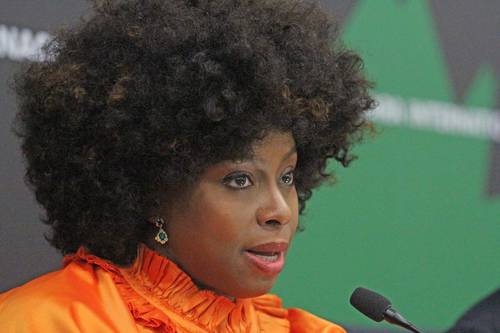
Guadalajara, Jal., Chimamanda Ngozi Adichie not only returned to the novel, but also to the meeting with her readers on the other side of Nigeria, in Mexico, specifically at the Guadalajara International Book Fair (FIL), where, with her strong feminist stance, she also established that today identity is an obstacle instead of an engine to achieve love, a universal desire.
“Love is the most important thing for people. To love and be loved, to have a sense of meaning in life, to feel valued and matter,” he said before hundreds of people who packed the FIL’s Juan Rulfo auditorium.
Author of essential books for contemporary feminism, such as We should all be feminists, About grief y Americanah, stated that identity shapes “the way we look at the world and, more importantly, identity shapes the way the world looks at us.”
He explained that identity denials occur, for example, when a lower-class white man who is qualified does not get a job opportunity because his accent is different from what is considered correct, or “a black woman who is denied access because her hair is considered unprofessional, or a lesbian who is denied an opportunity because she is told that she does not fit into the culture of the place.”
He recalled that a professor, the only one of two on a university campus, was often referred to in derogatory terms and was accused of being arrogant.
“I knew this woman and I thought she behaved like many of the male teachers, but no one called them arrogant; instead, people said they were self-confident. The only difference was identity, biological sex,” he explained.
“It’s also about the small assumptions and stereotypes that attach to your identity. They may seem small, but their effect is not. These judgments can reduce opportunities in life. They can shrink the spirit and the soul.”
He related that after Barack Obama won the presidency of the United States, many people cried, because they came from “a memory of ancestral pain of denial of identity and power.
“Now, languages are using the word migrant and adding many other horrible words linked to crime. However, the history of humanity is one of movement, and we forget that anyone can end up being a migrant,” he added.
Regarding the meaning of literature for her, the African writer said that she is not very empathetic in her daily life, but in literature she has found the possibility of continuing to try to be.
“The greatest lesson I have learned from my father is that we are more alike than we are different; that we may show love in different ways, but we all love; that what matters to us may be different, but we all want to matter; that it is as important to extend kindness as it is to expect it, and that dignity is always as important as food.”
Before her presentation to the public, Chimamanda Ngozi had a meeting with the press in a session in which she expressed the power of literature to understand other people and to break down mental walls about how others should be.
“Literature helps us see and be seen. When we read stories we become bodies that are not our own. It’s not so much that you become another person, but in an act of radical imagination you can see the world as other people see it, even if briefly,” he explained.
The Nigerian activist only participated in the FIL for one day, after she came very close to canceling her visit due to health problems.
https://archeter.co.uk/user/profile/263242
https://etuitionking.net/forums/users/zippermatch3/
https://premiumdesignsinc.com/forums/user/faucetlilac1/
https://thewilcoxreport.com/forums/users/hourquail7/
https://platform.joinus4health.eu/forums/users/fightcoffee7/
https://www.askmeclassifieds.com/user/profile/3248845
https://nerdzillaclassifiedscolumbusohio.nerdzilla.com/index.php?page=user&action=pub_profile&id=1248270
https://www.fundable.com/collinpope-norafrench
https://groovestats.com/index.php?page=profile&id=193794
https://www.rvparking.com/user/504635
https://www.fanficoverflow.com/profile/view/79533
https://movieo.me/users/francescadfhuynh-jszpzt
https://www.chordie.com/forum/profile.php?id=2432754
https://www.myconcertarchive.com/en/user_home?id=124954
https://www.kildarestreet.com/user/?u=61212
https://hasitleaked.com/forum/members/EzequieldfCompton/profile/
https://www.furvilla.com/profile/233749
https://www.bakespace.com/members/profile/LandondfKing/1694254/
https://rentry.co/7qp2i6bp
https://news.gvgmall.com/members/classoboe60/activity/9537/
https://kreisch.ch/members/burstwrench52/activity/117878/
https://output.jsbin.com/doxekorama/
https://posteezy.com/going-listed-here
https://rant.li/nylonturkey65/informative-post
https://covolunteers.com/members/classmaria14/activity/1363594/