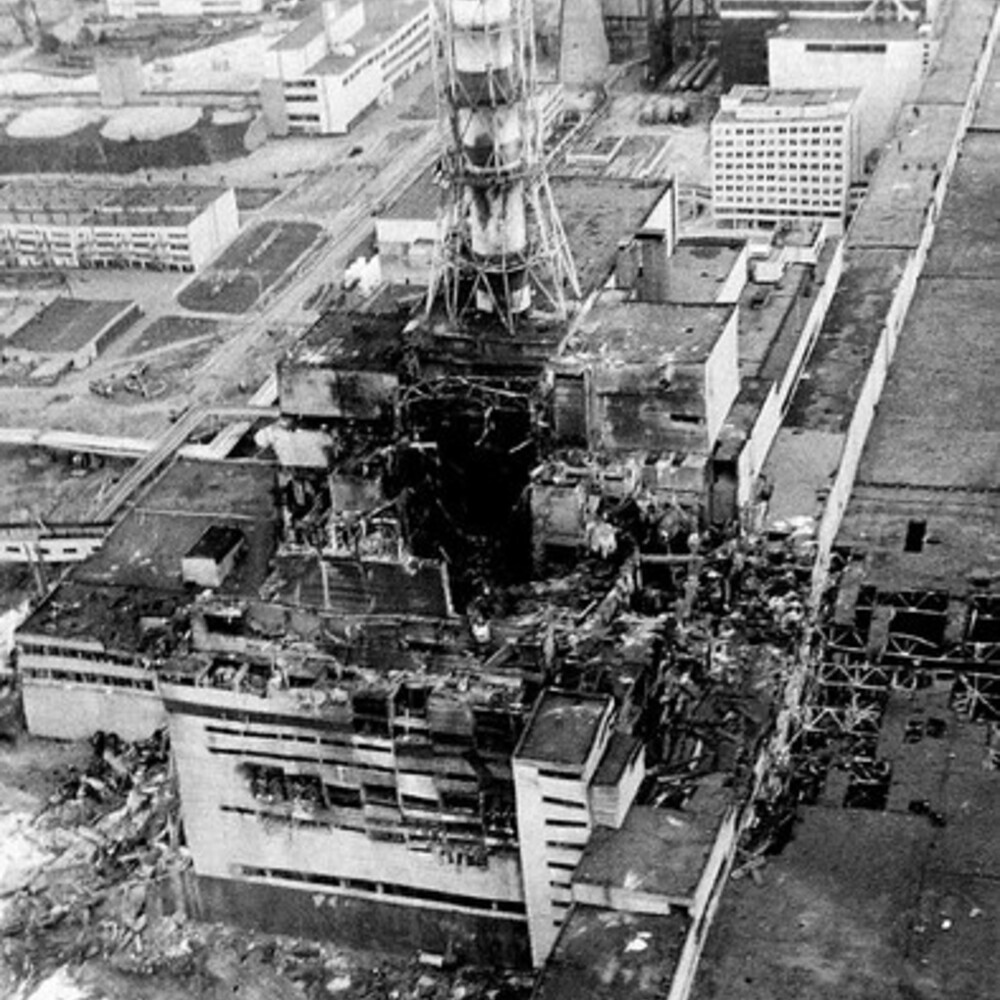
By activating a simple switch on 15 December 2000, reactor no. 3 of the Chernobyl atomic power plant was definitively shut down, which remained in operation to ensure the supply of electricity for fourteen years after the disaster, the last of the plant whose name is linked to the level 7 catastrophe: the maximum on the international scale of nuclear and radiological events (INEA) of the International Atomic Energy Agency (IAEA).
The Soviet project of the largest plant in the world
The “very small star” that seemed forever buried in metal and instead had been freed by man, as Pablo Neruda wrote in verse, revealed its “diabolical fire” after Hiroshima and Nagasaki on 26 April 1986 in Ukraine, in the former Soviet Union. The plant had been built starting in 1972 with Rbmk-1000 technology (high power channel reactor), modern but certainly not advanced also because it was designed to save money compared to Western standards and safety requirements. The complex, named after Lenin, produced electricity with nuclear fission and came into operation in four phases starting in 1978, four years late compared to the timetable established by the Council of Ministers of the USSR in 1966. The location was chosen about a hundred kilometers from Kiev on the border with Belarus, due to the characteristics of the land which could not be used for agriculture or other economic activities. The name Chernobyl was assigned in 1967. The construction work on the plant proceeded hand in hand with that of a city to house the workers, technicians and managers with their families, called Prypyat after the river. If all the reactors of the initial project, which included twelve, had been built, it would have been the largest power plant in the world, thus demonstrating to the outside world Soviet scientific excellence and its technological capabilities.
The catastrophe of April 26, 1986: human errors and structural defects
What the Soviet authorities did not say, but knew and had put on paper already in 1983 in a report kept secret for decades, was that Chernobyl left much to be desired in terms of safety, and was classified among the most dangerous power plants in the country. But the USSR, on matters at home, was proverbially impenetrable. Not even the quality of the managerial and operational staff, often designated for political reasons and not for real technical-professional preparation, moreover with a rigid separation between civil and military aspects, was such as to be able to manage an emergency competently and quickly. Which occurred during a power increase test that lasted from April 25, 1986 until the early hours of the next day, in a perverse mixture of technical and human errors, unpreparedness and amateurish management, which caused an epochal tragedy; also due to the lack of materials and structural defects in the construction, some of which are known but kept quiet. Reactor No. 4 first released superheated steam, then at 1.23am it exploded due to a clumsy attempt at instantaneous shutdown, projecting the steel and concrete covering weighing over a thousand tons upwards, leaving the fusion core exposed. And it was hell, in the form of an apocalyptic fire and a giant, menacing radioactive cloud.
The Kremlin’s reticence and the emergency faced by denying reality
The Soviet authorities were taken completely by surprise by the emergency, and acted according to consolidated tradition: ignoring, remaining silent, denying, operating without restraint and without respect for human lives. The firefighters were already on site at 1.30 am without equipment and without specific protection as if it were a routine intervention: they heroically put out the fires but remained subjected to violent contamination, completely unaware of what had happened, but they could do nothing about the core, already partially disintegrated with the explosion which had not been nuclear but thermochemical. And then Moscow sent helicopters to “bomb” the area with sand and boron, also condemning the pilots, operating in the center of the cloud, to lethal radiation. He then ordered a mass evacuation from the entire area involving over 330,000 people. The West learned of the catastrophe only because Sweden had recorded a worrying increase in nuclear radiation in the air. Two days had already passed since the explosion and the Kremlin still persisted in denying the accident hypothesis. Only on the evening of the 28th will the Tass agency issue a note speaking neutrally about the “deactivation” of a reactor and assistance to the population. At Chernobyl the radioactivity values were so high, almost 5,000 times the tolerance limit, that at first it was thought that the detectors were faulty. Over Northern Europe the radioactive cloud would have been much more eloquent than the Soviet communications, which were sparse and reticent despite the trust Westerners had in Mikhail Gorbachev and his policy of glasnost. But there was very little transparency. The diseased fruits from Chernobyl will reach France, Great Britain and Italy, triggering various psychoses such as on the consumption of broad-leaved vegetables and dairy products.
The city of Pripyat evacuated after 36 hours with a thousand buses
No one had told the workers who were building power plants No. 5 and No. 6 not to go to work on April 26, and they too were condemned to contamination. The city of Prypyat will be evacuated suddenly and with almost no warning on April 27, with an exodus involving over a thousand buses. The population had been told that it was a precautionary and temporary measure. Everyone left everything and Prypyat would become a ghost town, a postcard of the catastrophe illustrated by abandoned everyday objects, where no one would ever return. Once the incandescent core had been tamed, it was desperately possible to cover reactor No. 4 with a sarcophagus of steel and reinforced concrete which caused many structural problems, with collapses, infiltrations and contamination. It had never been considered permanent, so much so that a new roof structure will be built in 2016 costing over a billion dollars.
The effects, the consequences in Europe and the definitive closure
At least four hundred thousand people, but perhaps even double that number, called “liquidators”, were charged with the recovery and decontamination of the disaster area. The first victims of the rescue operations were the bravest ones who faced the consequences of the explosion without protection of any kind, and tried to limit the lethal consequences, sacrificing themselves despite knowing that this was a suicide mission. After two weeks, the plant workers, firefighters and pilots began to die one after the other, as did those who had handled rubble, debris and metals (750,000 tons). Official data speak of 65 deaths and approximately 4,000 deaths from cancer and leukemia. The effects of exposure to radiation have affected approximately five million people, but with all the problems in ascertaining the cause-effect link of tumor manifestations over time. In the emotional wake of what had happened in Chernobyl in 1987, Italy, with a referendum, renounced the need to equip itself with civil nuclear plants for the production of nuclear energy. As for the other Chernobyl reactors, number 2 was decommissioned in 1991 due to the consequences of a fire, number 1 was shut down on 30 November 1996 and twenty-five years ago there was the total closure of the plant with number 3.
https://www.inspiredtraveller.in/how-essay-writing-services-balance-quality-and-affordability/
https://usof.gov.mn/ensuring-timely-delivery-from-essay-writing-services-2026/
https://usof.gov.mn/what-to-do-if-you-need-to-write-a-marketing-essay-last-minute/
https://usof.gov.mn/why-essay-writing-services-are-a-smart-choice/
https://usof.gov.mn/why-reddit-loves-this-essay-writing-site/
https://exhibitor.y-expo.ru/2025/12/07/can-i-trust-uk-business-essay-writing-websites/
https://exhibitor.y-expo.ru/2025/12/10/tips-for-writing-essays-when-youre-pressed-for-time/
https://exhibitor.y-expo.ru/2025/12/08/can-i-communicate-directly-with-writers-from-the-best-essay-writing-services-on-reddit/
https://www.megadispara.ma/how-to-find-affordable-essay-writing-services/
https://saltlakequinceanera.com/the-reddit-formula-that-saved-my-gpa/
https://www.mpricotti.it/how-to-avoid-scams-when-paying-for-an-essay/
https://www.mpricotti.it/writing-services-for-thesis-and-dissertation-assistance/
http://hiwell.my/whats-the-best-essay-writing-website-for-research-papers/
http://hiwell.my/why-reddit-communities-are-revolutionizing-essay-writing/
https://edwardevan.com/i-tried-a-reddit-essay-service-heres-what-happened/
https://sman1belitang.sch.id/what-are-the-top-essay-writing-services-in-the-usa/
https://www.kobac-elektriska.se/what-reddit-can-teach-you-about-essay-writing-services/
https://www.kobac-elektriska.se/what-do-reddit-users-say-about-customer-support-for-the-best-essay-writing-services/
https://www.kobac-elektriska.se/top-reddit-essay-writing-service-for-easy-ordering/
https://tecnovenstore.com.ve/the-most-effective-essay-writing-tips-from-reddit-users/
https://demo.simpkb.id/professors-found-my-essay-thanks-reddit/
https://gasfireplaceservices.com/what-writing-services-are-best-for-helping-with-stem-science-technology-engineering-math-assignments/
https://www.drobne.fm/do-reddit-reviews-mention-essay-services-that-provide-free-revisions/
http://beautyline-wetzlar.de/how-to-choose-reliable-essay-help-on-reddit
https://rate2rate.co.in/best-reddit-essay-writing-service-for-unique-paper-topics/