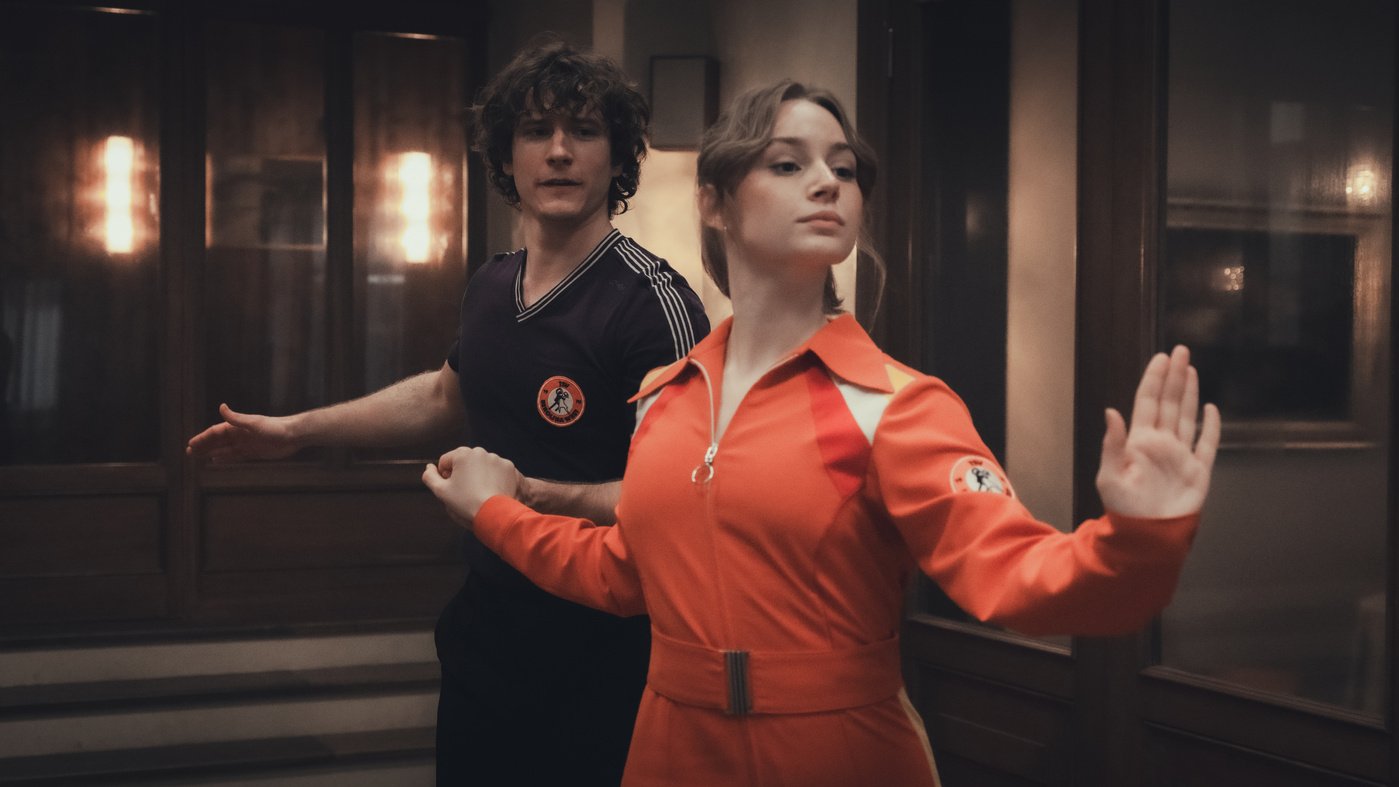
For ten years now, the Schöllack women have been dancing through the stately rooms of the Galant dance school on Berlin’s Kurfürstendamm in what is now their fourth three-part series, “Ku’damm 77”. And although mother Schöllack, who once again gives Claudia Michelsen the aura of an ice queen with a heart and a tanned attitude, is now presiding as the dance school grandma, the daughters Monika, Helga and Eva, along with the granddaughters Dorli and Friederike, continue to dance to her tune. At least when it comes to emotional dependence on the parent.
In the 14 years that have passed since “Ku’damm 63” (from 2021), the ensemble – as is the case in the illusion machine television – has hardly shown any signs of aging. And the digitally renovated Kurfürstendamm looks even more structurally restored.
I agree that the external content can be displayed to me. This means that personal data can be transmitted to third-party platforms. You can find more information about this in the data protection settings. You can find these at the bottom of our page in the footer, so you can manage or revoke your settings at any time.
In order to avoid lengthy dialogues in which the protagonists describe their experiences of the last few years to each other, Hess boldly made a cut. The three parts of “Ku’damm 77” are designed as a film within a film.
Whenever Linda Müller, who is filming a documentary about the traditional dance school for the broadcaster Freies Berlin, interviews the Schöllack women or observes their everyday life, the images jump to a grainy 16-millimeter film format. Although it seems increasingly strange over time that the filmmaker is glued to the Schöllacks around the clock, there are no longer any exposition problems thanks to this dramaturgical trick.
© ZDF/Conny Klein
Linda Müller (Massiamy Diaby), the new member of the Schöllack ensemble, is Afro-German. What Caterina Schöllack commented on at the first meeting at the dance school with the cutting sentence: “You sounded completely normal on the phone.”
The brown German primordial mud
And you’re right back in the middle of the contemporary color, in the brown German primordial mud of National Socialism and the war and post-war years, which was already bubbling under the events of the first three seasons. Back when daughter Monika (Sonja Gerhardt) married the depressed arms manufacturer’s son Joachim Frank (Sabin Tambrea) and before that she had daughter Dorli (now grown up: Carlotta Bähre) from a Jewish musician and former concentration camp inmate. And mother Caterina was confronted with the fact that the dance school had by no means “been owned by my fallen husband’s family for generations,” as mom claimed, but was “bought” by her husband from the Jewish Krohn family in 1936 for one Reichsmark. An exemplary injustice that is now creeping up on the Schöllacks in the form of London lawyers who are reclaiming the property on behalf of a Jewish foundation.
© ZDF/Conny Klein
In addition to the central perspective of Monika, who – as a widow and single mother who has run down a music club owner and has moved back in with her mother – Hess has placed the other two mother-daughter combinations. Monika trains her daughter Dorli, a promising competitive dancer, and displays the severity of an ice skating mother. And Monika’s sister Helga (Maria Ehrich), who has been back home since her gay husband moved over to East Berlin, tries to get her rebellious daughter Friedrike (Marie Louise Albertine Becker) to graduate from high school and study. But Ricky would rather graduate with secondary school and become a police officer.
© ZDF/Conny Klein
The moose’s biggest critics later become critics themselves. This is a sacred generational rule that can also be seen in this family saga as a variation on FW Bernstein’s saying. Mistakes in upbringing are perpetuated and in Annette Hess’s case, the women who are forced into role models are victims, but also perpetrators. Dorli also sees it that way, shouting at her mother and trainer: “You’re a control mother!”
© ZDF/Conny Klein
It’s amusing how boldly Hess establishes old and new personnel in serial storytelling in “Ku’damm 77”. Why is Sabin Tambrea back? Didn’t he go into the Baltic Sea suicidal in the role of Joachim Franck? Well. And what does Linda Müller really want from Mother Schöllack? Well. And it is astonishing how elegantly Hess weaves in contemporary history such as the death of Elvis Presley and incorporates the themes of the seventies.
© ZDF/Conny Klein
For example, in the form of a catalog published in 1976 that German men used to “order” women in Thailand. The thing is suddenly on the table when the women go to Uncle Heiner’s funeral in the village, where the inheritance that was hoped to save the dance school is promptly claimed by Heiner’s Thai wife. An episode that also gives Caterina Schöllack a tragic backstory.
© ZDF/Conny Klein
She has daughter Eva (Emilia Schüle), who was in prison for manslaughter and – as soon as she returned – wants to convert “Galant” into a Rolf Eden nightclub, anyway. As brutal as she appears, you think she is on her way to the Red Army Faction, which, like the West Berlin drug swamp of the 1970s, is part of the violent crash atmosphere of those years.
“Ku’damm 77” is also dedicated to male violence in a new way. And the fact that Berlin in the 1970s was already a city of Arab immigrants is demonstrated by a Lebanese musician who introduces Monika to playing the oud and her first kebab (!). The multi-ethnic cast brings a modern touch to the once again chic costumes and sets.
In view of the abundance of motifs and the group of women that have grown into a gang, you’ll want to throw your hands up over your head every now and then and ask Annette Hess whether she didn’t have one too many Cokes while writing the script.
But the ensemble grounds the story with a down-to-earth, nuanced performance, from which Michelsen’s mother Schöllack mannerisms sparkle like fool’s gold. Despite countless TV and series heroines, it is still unusual to see a women’s saga that so unabashedly and charmingly makes the men part of the cast. The Schöllack women have long been part of the German television family. And you can’t choose your family, no matter how crazy it is.
https://it-academy.az/
https://pin-up-yukle-az.com/
https://pinup-online-yukle.com/
https://pinup-casino-yukle.com/
https://pinup-yukle.com/
https://pin-up-azerbaycan.info/
https://chaussures-adrien.com/
https://pin-up.chaussures-adrien.com/
https://mennonerds.com/
https://pin-up-casino.mennonerds.com/
https://romanovka.com/
https://pinup-az.romanovka.com/
https://pinup.romanovka.com/
https://pin-up-az.romanovka.com/
https://pinup-casino-az.romanovka.com/
https://pinup-casino.romanovka.com/
https://isaozbay.com/
https://pin-up-az-giris.com/
https://pinup.isaozbay.com/
https://pinup-casino-resmi.com/
https://pin-up-az.ru/
https://pinup-casino.cc/
https://pinup-casino-official.com/
https://pin-up-casinoaz.com/
https://pinup-yukle.org/