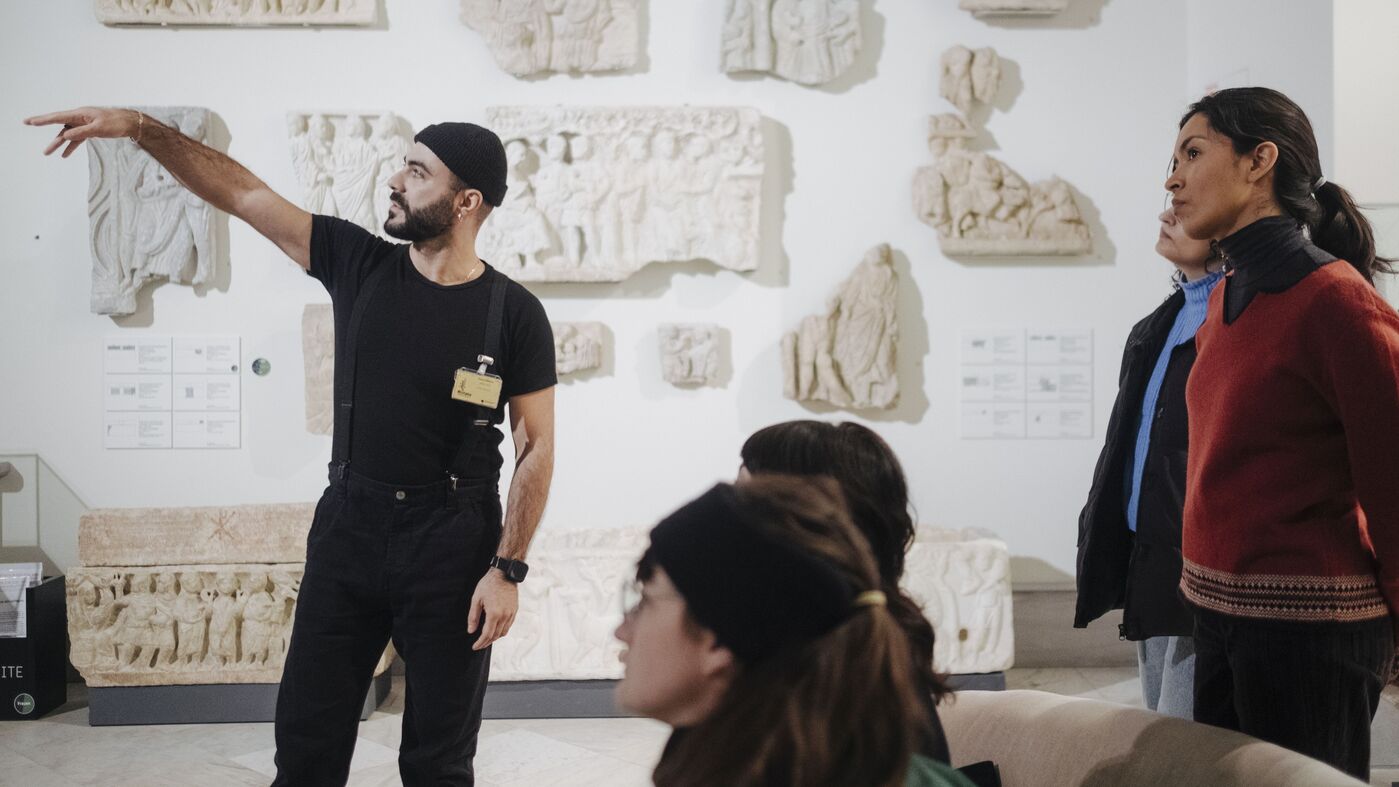
When Mohamed Al Subeh leads people through the hall of the Byzantine Museum in the Bode Museum in Arabic, he feels a little at home. There are three objects from Syria here, including a basalt slab depicting Simon the Pillarer from the 6th century. Before the civil war in Syria, Al Subeh was a restorer and specialist in Byzantine art at the Maaret al-Naaman Museum in Idlib province.
In Berlin, he became one of the first guides of Multaka, a special program that started in December 2015 at the Museum of Islamic Art. The project is currently financed by the Saudi organization Alwhaleed Philantrophies, which promotes education, equal opportunities and humanity, the museum itself and the support association.
The idea behind it was to involve refugees from Syria and Iraq more closely. Young people from Syria and Iraq should go to the museum together and get a free tour in Arabic. Ten years later, the question is: How are the guides who have volunteered doing today? Where is the project?
© Rolf Brockschmidt
Mohamed Al Subeh came to Germany from Turkey across the sea and the Balkans in 2015. “Too many refugees came to Germany at once,” he says looking back, “but many Germans helped us a lot back then. I will never forget that.” For him, the tours represent a bridge between Germany and Syria, which helped him to persevere.
Today the 55-year-old works as a logistics specialist at the Charité. He has to earn money for his family in Syria. During the conversation, he shows a disturbing video of his old house: a pile of rubble. “The Syrians can’t go back yet,” he is convinced. “It’s too unsafe.” The German government is now making the wrong decisions.
The Germans don’t know enough about us. We need bridges that lead in both directions.
Kefah Ali Deb, Syrian writer and museum guide
The former restorer has had a German passport since 2023. “We are making our contribution in Germany,” he says and dreams of one day returning to his colleagues in the museum or helping them from Germany, for example with documentation of damage. He knows from his home country that the museum needs help from outside in order to be able to work again.
© Rolf Brockschmidt
When Kenan Melhem came to Germany in 2016, he was offered a scholarship to study architecture at the TU Berlin. To do this, he had to pass a German exam at C1 level within eight months. “It was very hard, but I worked a lot because I had a goal,” is how he describes his first time in his new home.
Before he came to Multaka, he was fascinated by the Bode Museum simply because of its architecture. “It was especially difficult to learn the technical terms,” remembers the 36-year-old. But the presentation techniques he learned through Multaka also helped him with his studies. Like Mohamed Al Subeh, the young architect also emphasizes that he worked everything out himself. Since completing his master’s degree at the TU, he has been working for a large construction company. He was naturalized two years ago: “I am now part of Germany, the Federal Republic is now part of home for me.”
Have a playful conversation with each other
But the world has changed and the tone has become harsher, Kenan Melhem notes in retrospect. “You live in a wonderful, diverse city,” he shakes his head. In addition to his tours, he works with the “Toolbox” of the Museum of Islamic Art in schools to playfully show children and young people that migration, movement, hiking, exchange and social diversity are a historical constant and therefore “normal”. The toolbox contains, among other things, cards on topics such as borders, exclusions, buildings and food. With their help, the players should enter into a dialogue about the origin of food, for example. The aim is to awaken understanding for other cultures.
Writer, artist and activist Kefah Ali Deeb also emphasizes the importance of active dialogue. She received political asylum in Germany in 2014 and found her way to Multaka a year later. First she took us through the Near Eastern Museum, which also represents a piece of home for her, and later through the Egyptian Museum, where she taught Arab visitors about Mesopotamian and Pharaonic culture. Now is the time to approach German groups, says the 43-year-old: “The Germans don’t know enough about us. We need bridges that lead in both directions.”
When Assad fell, she would have liked to return immediately, says Kefah Ali Deeb. But reason told her that it was still too early. The author is concerned about the rise of the extreme right in Germany, as well as the German government’s attitude towards the Palestinians. Despite her German passport, she is determined that she does not want to stay in Germany permanently.
What does the future of Multaka look like? “The reality of people’s lives has changed in ten years,” says project manager Sarah Fortmann-Hijaz. “Today it’s about bringing Germans and the communities of former refugees into conversation with each other.” This is one of the reasons why the tours are only offered upon request.
But what makes her particularly happy is that Multaka has broadcast internationally. There is now a network of seven projects at 30 museums in Europe that have taken up the Berlin idea and developed it further.