It’s the ‘Holy Grail’ of Ancient Roman architecture and archaeology: the Basilica of Vitruvius, whose remains were found in Fano, was one of the greatest mysteries of antiquity. Vitruvius, theoretical father of Western architecture, was originally from Fano.
In his ‘De Architectura’, the only Latin treatise of its kind that has survived intact, he said that the Basilica was the only building whose construction he had personally supervised (“conlocavi curavique”) and attributed to it great dignity and beauty (“summam dignitatem et venustate”).
Until now, however, despite centuries of hypotheses and hundreds of drawings that ‘reconstructed’ it, no one had managed to precisely identify the remains of the sober and majestic public building, intended for the administration of justice and business in the 1st century AD Augustan. It was first hypothesized that they were part of the ruins beneath the convent of Sant’Agostino and in 2023 it was thought to have found them in the five rooms with elegant floors found under a house during a renovation. However, that colonnade of a ‘giant order’ that would have covered the two floors of the basilica, rising from the ground to support the roof trusses, was always missing.
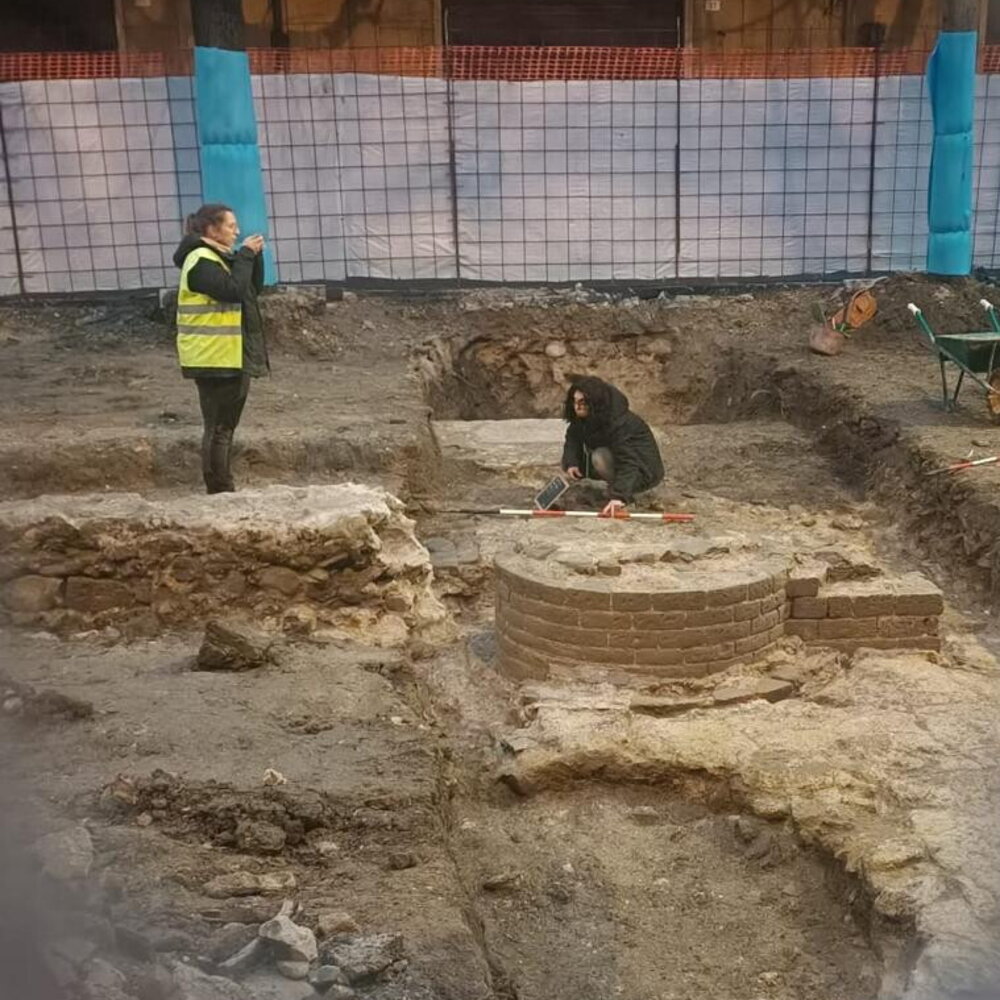
Now the announcement has arrived that there is finally a certain location, in thecurrent Piazza Andrea Costawhere ongoing excavations have brought to light unequivocal finds. In particular, five sandstone columns, arranged according to a precise alignment, whose distances and proportions are consistent with the technical prescriptions indicated by Vitruvius, thus offering a precise correspondence between the written source and the archaeological evidence.
An archaeological discovery of immense importance, a “discovery of global importance, which will end up in the history books, comparable to the discovery of the School of Pythagoras, in Crotone“. Thus the Minister of Culture Alessandro Giuli during a press conference at the Mediateca Montanari in Fano announced the discovery in the city in the province of Pesaro-Urbino, of Vitruvius Basilicathe one that scholars consider to be the Roman architect active in the second half of the 1st century BC the most famous architectural theorist of all time, it is the largest archaeological discovery in the world.
It is a legendary building, searched for two thousand years, whose discovery changes the history of the city, of Italy and of architecture. The excavations for repaving dthe Via Costa, financed by the Pnrr, have brought to light finds that superintendent judges “unequivocal” and some columns cited in the Vitruvian bibliography.
Giuli: there will be a ‘before’ and an ‘after’ this discovery
“Today a fundamental piece of the mosaic was found in Fano it preserves the deepest identity of our country. The history of archeology and research, with the current tools available, is divided into a before and an after: before the discovery and after the discovery of the Basilica of Vitruvius”, declared Minister Alessandro Giuli.
“History books, and not just newspaper reports, they will historicize this day and everything that will be studied and written about this exceptional discovery in the coming years. The scientific value is of absolute caliber, the elements found demonstrate in a plastic way that Fano was and is the heart of the most ancient wisdom architecture of Western civilization, from antiquity to the present day”,
The rediscovery of the Vitruvian basilica and Clini’s studies
This discovery brings to completion thirty years of studies on Vitruvius, confirming, according to Professor Paolo Clini, thatVitruvius was born in Fanoand here he built the city walls, the Temple of Jupiter, the theater and redesigned all the bridges of the Via Flaminia. Fano thus becomes the only city in the world to have been planned bygreatest architect of all time.
The history ofVitruvian Basilicaunderground in the center of Fano it re-emerged in 1992, after falling into silence, completely obliterated. Professor Paolo Clini, professor of the Polytechnic University of Marche and scientific coordinator of the Vitruvian Studies Center, fell in love with this project and decided to further his studies, seeking that basilica that no one believed in anymore. He did this through surveys of all the underground structures of Fano and, in particular, of what is now the Temple of Jupiter, where theconstruction techniquesand the measures of Vitruvius.
A doctorate, a post-doctoral degree, a master’s degree: Clini has pursued this intuition for thirty years, the last six almost full time. “I was convinced, even more so today – he says – that this basilica had to be found because it canchange the world“. And in 2013, on the occasion of a large survey campaign directed as Politecnica su Fano, he hypothesized the location of the Basilica exactly onPiazza Andrea Costain the precise position where it came to light today. Today it is Clini himself who is the only one in the world who knows all about thishistoric building.
The future of archaeological excavations and PNRR constraints
Questa archaeological discoverywas born from a PNRR intervention intended to redo the pavements right on Piazza Andrea Costa. Thus the Roman basilica described by Vitruvius was identified with certainty, with a rectangular plan and perimeter colonnade: eight columns on the long sides and four on the short sides.
The final confirmation has arrived with a final survey, which returned the fifth corner column, confirming the position and orientation of the building between the two squares. The columns, about five Roman feet in diameter (147–150 cm) and about 15 meters high, they were placed against pillars and load-bearing pilasters to support a higher floor. The planimetric reconstruction, based on the Vitruvian description, found a correspondence to the centimetre.