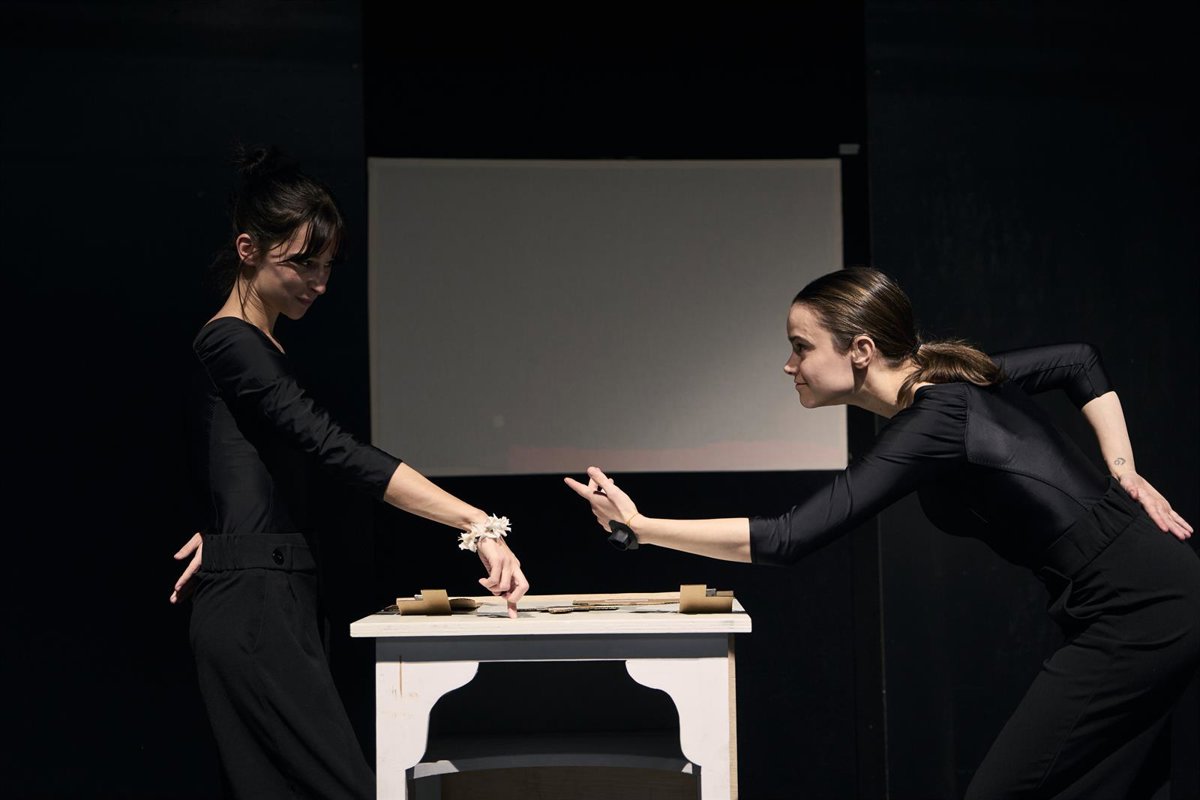
The María Guerrero Theater of the National Dramatic Center puts on stage this Friday, January 23 ‘Scream, wedding and blood’a proposal that revisits Lorca’s ‘Blood Wedding’, from a perspective that places sign language at the center of the scene by having two deaf actresses as protagonists.
“It is a very important step for the deaf community because it is the first time that the national theater does a show in sign language.. I hope that it is not the only proposal and that in the end it becomes normal so that deaf people can access the theater,” claimed the deaf director Ángela Ibáñez at the press conference, in which she indicated that the Sign language is a “minority and minority” language, For what we intend to claim with this proposal that will be on display until March 1.
Ángela Ibáñez, who has had the associate direction of Julián Fuentes (a hearing person), has assured that it is a “pride and a privilege” to work with Lorca because for the deaf community he is a figure who has “things in common.” “His homosexuality was not well regarded and he did not care, he was always proud and created works about it, with discretion but without shame. The same thing happens to us, we are proud of our language and we don’t want to change it,” he stated.
The director has highlighted that ‘Scream, wedding and blood’ is a show “accessible to anyone”, so the listening public also has a place in a work. “The work is designed so that we can all enjoy it, although it is designed in sign language for deaf people. There is music and visual elements so that hearing people can enjoy it on equal terms. In this show everything is possible, the impossible does not exist,” explained Ángela Ibáñez.
“THE VOICE OF DEAF PEOPLE MUST BE HEARD”
Likewise, he commented that the show demonstrates that there is also “diversity” within the deaf community by showing in the proposal that there are people who speak, others who speak or people who use both. “We must also respect the voice of deaf people, we must not change it, we must accept it. It is the voice of the deaf person and it has to be heard,” has emphasized.
For his part, Julián Fuentes has defended that the deaf culture and community have “a lot” to contribute to the visual arts and has explained that his work has consisted of helping listeners reach the emotional heights of deaf people. “We have composed music so that listeners can intuit what deaf people are seeing and feeling when they are passing through the scenes,” has pointed out.
The show follows two deaf teenagers who decide to stay alone in their high school’s theater classroom while the rest of the group attends a non-accessible performance. There, among dusty trunks and desks, they begin to improvise with texts by Lorca.
Through the symbolic universe of ‘Blood Wedding’, the protagonists explore desire, loss and the tragedy of truncated youth: death, not only of the body but also of dreams, when one grows without references or spaces to imagine a future.