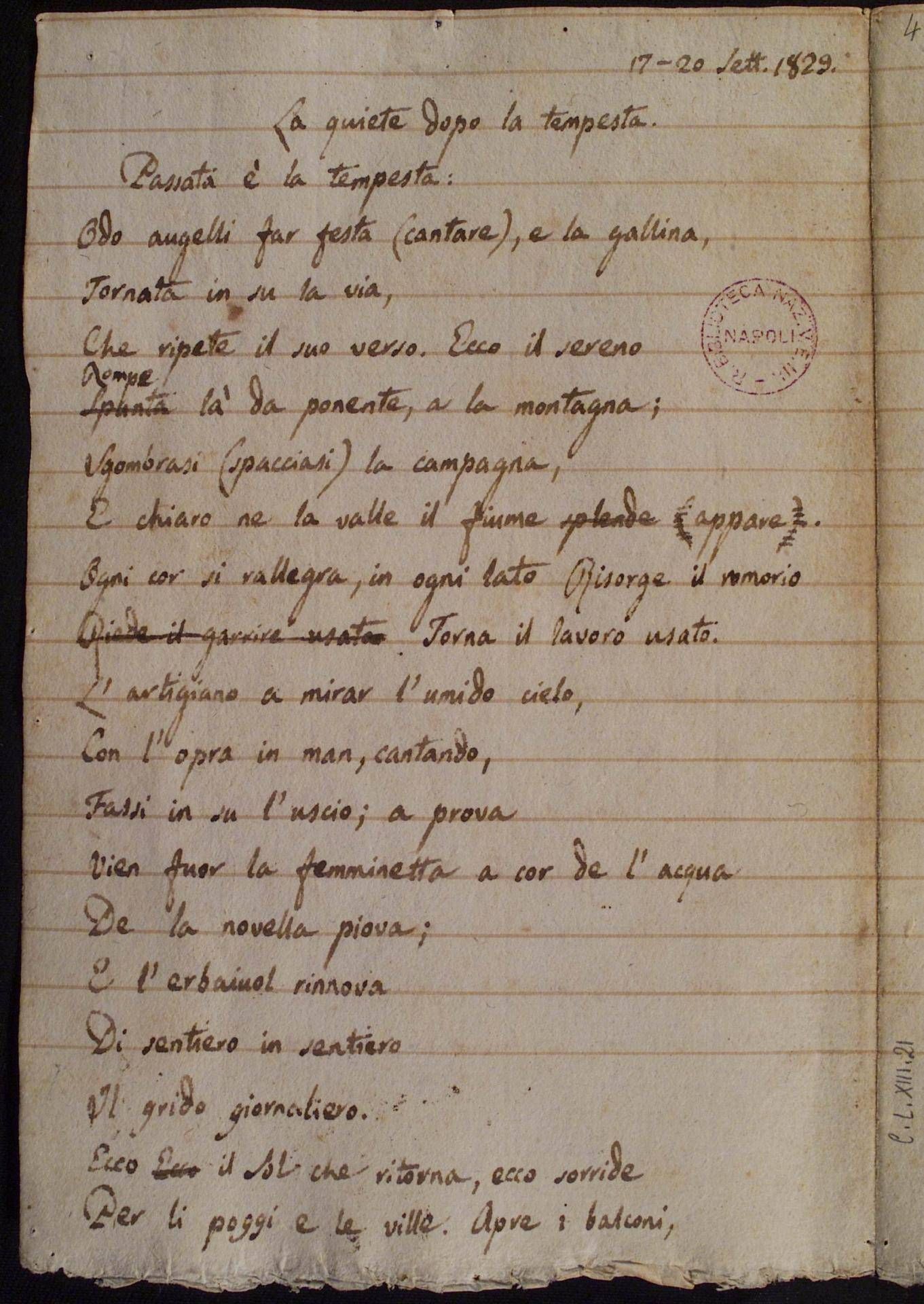
How are the great classics of Italian literature born? What hesitations, corrections, second thoughts are hidden behind works that today we consider definitive and untouchable? These questions are answered by the exhibition “How classics are born. The autographs of Italian literature”, which will open to the public from 27 January to 25 April at Villa Farnesina in Rome, home of the Accademia Nazionale dei Lincei.
The initiative, created by the Accademia dei Lincei in collaboration with the Sapienza University of Rome and with the support of the Changes Foundation, accompanies an international conference dedicated to the “Autographs of Italian men of letters” project, directed by Matteo Motolese and Emilio Russo (‘La Sapienza’ University of Rome). A twenty-year project that involved hundreds of scholars – paleographers, philologists, historians of language, literature and books – leading to the discovery and cataloging of over eight thousand autographed and annotated manuscripts by authors, from the Middle Ages to the Renaissance.
The exhibition invites the visitor to overcome the image of the masterpiece as a “still and perfect” text to get to the heart of the creative process, made up of attempts, erasures and rewritings. A way of making literature which, in the digital age, appears increasingly distant and destined to disappear. The exhibition itinerary, created thanks to the collaboration of prestigious Italian and foreign institutions, brings together testimonies of extraordinary value: from the codex on which Giovanni Boccaccio copied the Decameron to the autographed sheets of Ludovico Ariosto for the last cantos of Orlando furioso; from Giacomo Leopardi’s work notebook for the Operette morale to the pocket notebook in which Eugenio Montale wrote down, with a simple ballpoint pen, the lines of “I went down, giving you my arm, at least a million stairs”.
The scientific framework for the exhibition will be the international conference scheduled from 26 to 28 January between the Accademia dei Lincei and Sapienza. The meeting will offer an assessment of twenty years of research of the “Autographs of Italian literati” project and will open new perspectives for the study and valorization of autograph testimonies, particularly in the digital environment.
The organizing committee of the exhibition includes Roberto Antonelli, Lina Bolzoni, Marco Cursi, Marco Mancini, Matteo Motolese, Emilio Russo, Carlo Vecce and Alessandro Zuccari.