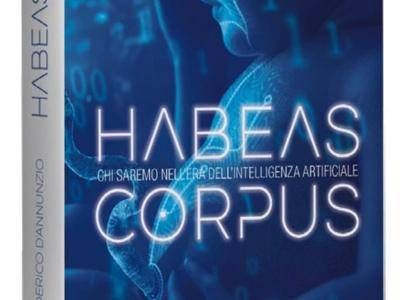
Artificial intelligence “is a path through which man rediscovers his beauty which takes him towards the absolute”. It is a positive tool, if used well, which however must not be left unchecked: it must be subjected to a governance that contemplates both human rights, preserving them, and those of artificial identity. This is the thesis supported by Federico D’Annunzio, great-grandson of the Pope and high-tech entrepreneur in the digital innovation industry, author of ‘Habeas corpus’ for Edizioni San Paolo. Who will we be in the era of Artificial Intelligence’, in bookstores from January 21st. An essay in which D’Annunzio, interviewed by AdnKronos, reflects on the possibilities and risks that the rampant diffusion of AI imposes with ever greater urgency, elaborating the fundamental elements of a new ‘digital humanism’. “Artificial intelligence – says D’Annunzio – is nothing other than man’s return to himself. Man, with all his behaviour, has anticipated the search for artificial intelligence over time and history. In short, we have been preparing for millennia to reach this stage”. In this key “artificial intelligence is another representation of man in his own identity of beauty”. A representation that also coincides with the search “for one’s own dignity and beauty”, says D’Annunzio, nephew of Gabriele D’Annunzio’s son, Ugo Veniero, the only one who had children unlike the other two brothers, Mario and Gabriellino, with his only wife Maria Hardouin di Gallese. “I am the direct descendant of Gabriele D’Annunzio and also the fourth prince of Montenevoso. Gabriele was one in 1924. I discovered that I was the great-grandson of the Pope thanks to the DNA test. Gabriele’s was compared with mine thanks to the techniques of the Ris of Cagliari. Doing the DNA test was Giordano Bruno Guerri’s idea. This is because D’Annunzio doubted whether he was the father of Ugo Veniero”.
At the center of the essay stands the legal principle of Habeas Corpus which establishes the inviolability of personal freedom and physical and psychological integrity. Today, however – the author points out – the extension of human individuality, through interaction with the digital world, goes beyond the boundaries of the biological body: a true ‘Extended Body’ is taking shape, made up of the set of data that represent us and our continuous interactions with technological ecosystems and Artificial Intelligences. From this perspective, therefore, the protection of the rights of the ‘Extended Body’ requires new legal instruments, new conceptual categories and a shared awareness. Alongside the concept of the ‘Extended Corps’, D’Annunzio introduces the Alias Corpus, a sort of responsibility license that attributes clear, verifiable and sanctionable duties to Artificial Intelligences. “Artificial intelligence – underlines D’Annunzio – must be disciplined, we must not fear it but we must govern it”. To achieve this objective “we must establish some key principles: the first is that man has new rights that come from interaction with the digital world which can – and must – be part of his heritage. It is man’s extended body that must be governed just as Alias, or artificial intelligences, must be governed. The boundary between them, or between man with his extended body and aliases, must be very clearly distinguished through an insurmountable wall that does not allow artificial intelligence to penetrate the human body which is our great source of beauty and dignity”.
This is because “man’s ability to feel, to sympathize and be empathetic cannot be shared with artificial intelligence. We must not allow any hybridization between the body and artificial intelligence”. In this logic, the ‘Impassable Wall’ is a regulatory proposal that prohibits any form of combination between man and machine and any AI interference in organic life, to protect the physical and symbolic integrity of the human species. The revolution introduced by artificial intelligence is changing our world. But where will we get to? “Now man considers himself – replies D’Annunzio – as the center of the world. We are in the anthropocene, the era in which man dominates the planet and its life forms to the point of affecting geological processes. The landing point of the revolution triggered by AI, assures D’Annunzio, will be the birth of a new era which will be called neurocene. A world in which three intelligences will coexist: the human, the artificial and that of nature. In short, we are moving towards a world in which collaboration between humans, the environment and artificial intelligence will take place.”