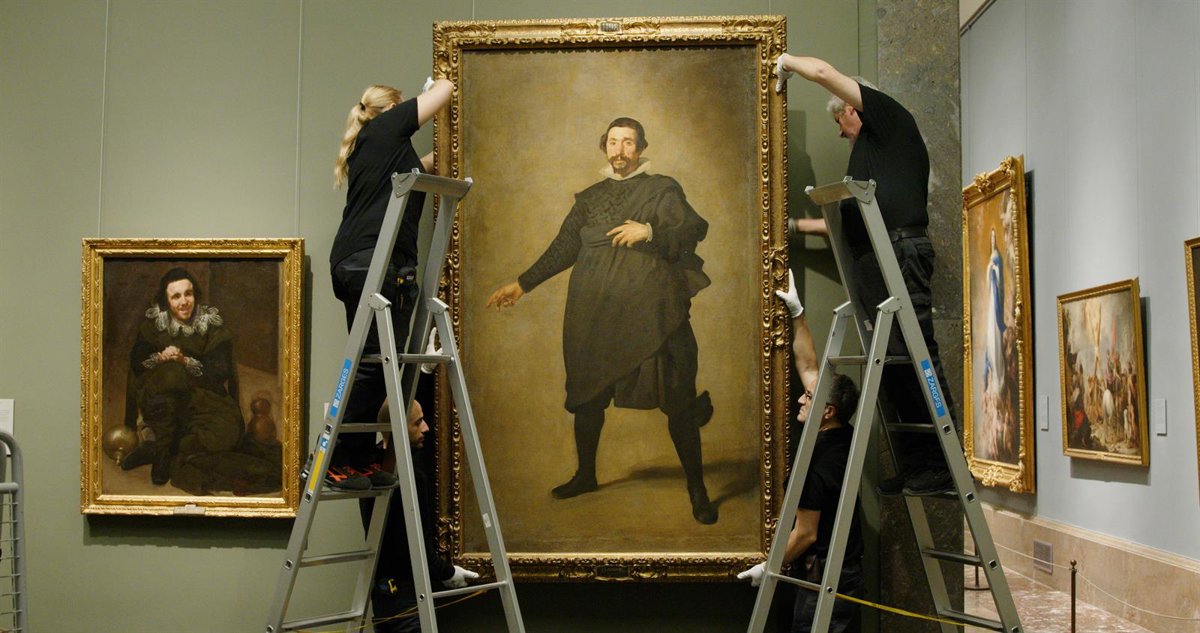
The Prado Museum will move the canvas this Wednesday ‘Paul of Valladolid’ by Velázquez, to the restoration workshop to begin its technical analysis and subsequent intervention, thanks to the sponsorship of the Iberdrola Spain Foundation as ‘protective member’ of its Restoration Program.
Before starting the restoration, the Prado reports, A series of technical analyzes will be carried out that will allow us to expand the material information that is already known about this portrait.. The recent incorporation of new research equipment to the Prado Museum makes it possible to deepen the study of the work from two complementary approaches: material analysis by XRF scanning and examination by multispectral infrared reflectography.
Among the most unique portraits of Diego Velazquez Those dedicated to the jesters and men of pleasure at the court of Philip IV stand out, a group of works in which the painter achieved some of his most audacious solutions. One of these examples is the portrait of Pablo de Valladolid, a documented character in the service of the Court between 1632 and 1648 whose function would respond to his interpretive skills or his burlesque character.
Velázquez portrays him as an isolated figure, firmly established in an indefinite space, constructed solely through the shadow cast by his body. This radical simplification of the setting, without clear precedents in the painting of the time, turns the work into a true exercise in artistic innovation.
The neutral background focuses all attention on the character’s gesture, captured in an attitude that has been interpreted as declamatory. The painting is done with a mixture of confidence and ease typical of Velázquez’s mature style, and stylistic analysis allows it to be dated between 1632 and 1635. during the artist’s first years in the service of the Court.
The portrait of ‘Pablo de Valladolid’ has had a lasting influence, as shown by the fact that Goya was inspired by it for his portrait of Francisco Cabarrús, and decades later, in 1865, Édouard Manet described this work as the best of all the paintings. “It is perhaps the most amazing piece of painting ever made. The background disappears; It is air that surrounds the man, dressed all in black and full of life“said the artist.
Manet had traveled to Spain seeking to escape the harsh criticism he received in Paris and upon arriving at the Prado Museum, he was absolutely dazzled by the technique of Velázquez, whom he baptized as the “painter of painters“.