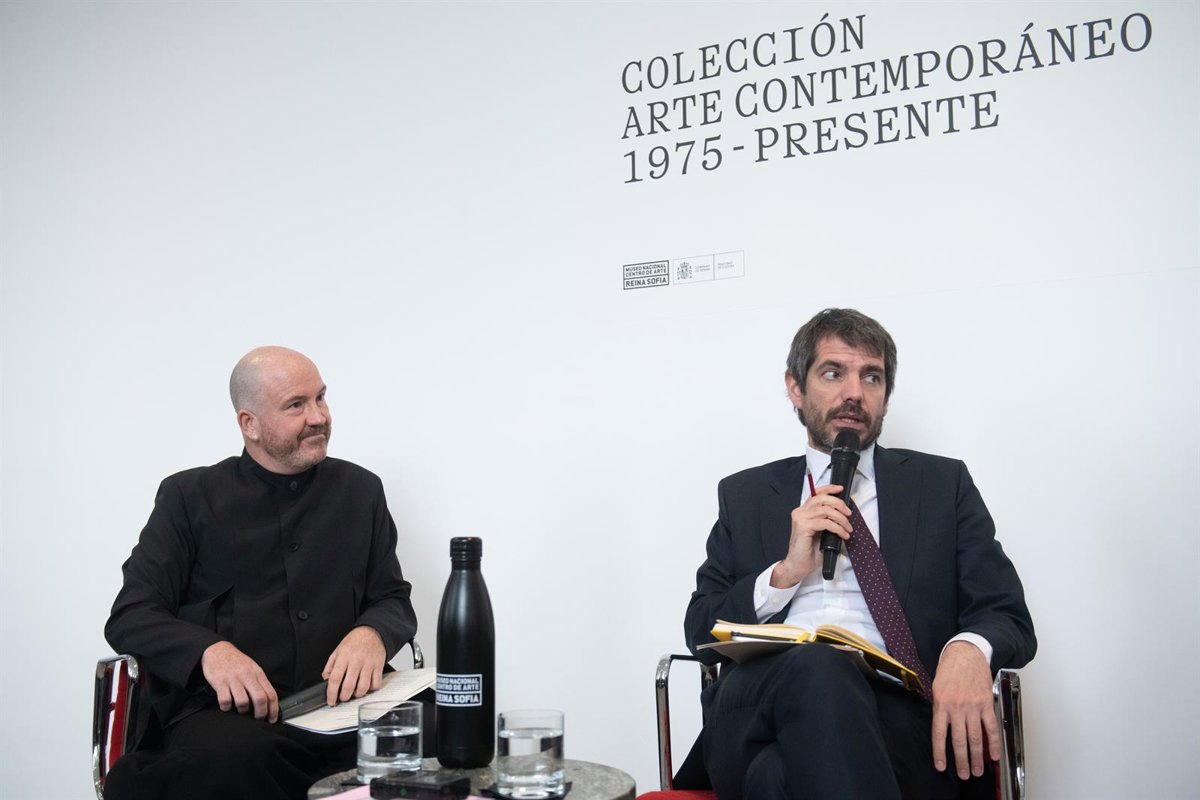
The Reina Sofia National Museum has presented the new arrangement of its permanent collection located on the fourth floor of the Sabatini building, a route of more than 3,000 square meters which proposes a review of contemporary art in Spain from the Transition to the present and which has an important presence of works by women as well as pieces by Latin American artists.
Through 403 works by 224 artists this proposal structured in 21 chapters and three itineraries, inaugurates the comprehensive reorganization of the art gallery’s collections that will end with two other rearrangements in 2028.
Under the title ‘Contemporary art: 1975-present’the story begins in 1975 with the work ‘Documento nº…’ (1975) by Juan Genovés. For the Minister of Culture, Ernest Urtasun, this choice “is not trivial”, since it places the beginning of the debates on “the conquest of democracy and what contemporary art means” at this stage, as he said this Monday at the presentation of the collection.
“I think that the year 1975 is a very important year in Spain, it is a frontier year, but a year at the same time where all kinds of questions arise about the future of the country.about the hopes of Spain, about how it unfolds and begins to access more rights. I think it is a good way to start this journey because it is, let’s say, also the way to put forward the great debates about what the conquest of democracy meant then,” the minister emphasized.
Urtasun has defined this reorganization as a “cultural event of the first magnitude” and has highlighted the “transcendence” of a plant that offers, in his opinion, “a unique look at the country and its circumstances” over the last 50 years. “It is not a simple reorganization, it is a broadening of perspectives,” he insisted.
64% OF WORKS NEVER EXHIBITED IN THE MUSEUM
The minister has also highlighted that the 64% of the works on display – 258 pieces – had not previously been shown in the museum’s rooms. Likewise, he highlighted that 70 of them have been acquired in recent years and more than half of these additions, 36, correspond to female artists.
Along these lines, the museum has reported that of the 224 artists exhibited on this floor, 69 are women, which translates into 35% of the total. “It is the highest proportion that the Reina has shown, whose collections have less than 15% of female artists”the art gallery has pointed out.
Regarding origin, 77% of the artists are Spanish and 23% international, with a special weight of Latin American creators, who represent 31% of the international ones (16 artists of the 51 who are not Spanish). For Urtasun, this combination turns the plant into “an open window” to the intersection of cultural manifestations between Spain and Latin America.
“I think we are facing a very important point, incorporating new perspectives that we have never seen before, from new artists, with a more feminine perspective.“, highlighted the minister.
The director of the museum, Manuel Segade, explained that this is the first of three major interventions that will completely reorganize the collections on the upper floors of the Sabatini building. As specified in the presentation, the objective is “to answer the question of how to reach the past from the present.”“.
AVOID A “SINGLE AND CLOSED STORY”
The itinerary is not chronological and proposes anachronisms and temporal coexistences. In fact, in the three major itineraries proposed, we return on different occasions to the seventies to “tell the same thing in a different way”, avoiding the construction of a “single and closed story.”
“It is not about establishing a definitive narrative, but about opening it and socializing it,” has pointed out Segade, who has defended that this first rearrangement opens the door for the Reina Sofía collections to be “permanently reviewable.”
The floor opens with three dedicated spaces that function as a conceptual prologue, as the museum has indicated. They address the “disenchantment and emotional fragility” that began with the Transition, as well as the emergence of new subjectivities and attempts to internationalize Spanish culture.
The first itinerary, focused on affects, explores how emotions such as grief, desire or community have operated as political and social forces in contemporary art. The tour has chapters dedicated to feminisms, sexual dissidence and LGTBIQ+ struggle, crises such as AIDS or the attacks of 9/11 and 3/11. In this first part, works by Esther Ferrer, one of the pioneers of performance in Spain, Juan Luis Javier Marí – known as JULUJAMA – or Eulàlia Grau, “one of the fundamental voices of critical feminism and social denunciation”, as explained by the Reina Sofía, are exhibited.
The second proposed route focuses on sculpture, new materialisms and relational aesthetics, focusing on “the relationship between bodies and objects”, as explained by the art gallery. Many of the works that make up this space are unpublished and “physically coexist” with the visitor, such as ‘Éxtasis, statu, statue’ (1994) by Juan Luis Moraza or ‘Untitled. Cavall Bernat Mountain, Cala Sant Vicenç, Mallorca’ (1995) by Susy Gómez.
For its part, in the last section the Reina Sofía “looks at its navel”, as Segade has said, by incorporating for the first time the genealogy of the museum itself and the Spanish artistic system, while analyzing the relationship between institution, market and artistic practices.
BREAK EXPOSURE NEUTRALITY
The deputy artistic director, Amanda de la Garza, has highlighted the effort to build a “more didactic” museum story that works “as an introduction to contemporary art” for diverse audiences. In this sense, he pointed out that they wanted to transform the visitor’s experience, placing them at the center of the route and moving away from the traditional “white cube” in the exhibition design to make way for a “more dynamic” one.
As the deputy director has explained, the museum design, by the artist Xabier Salaberria together with the architect Patxi Eguiluz, breaks the exhibition neutrality and proposes new spatial routes, with works that come to occupy the center of the rooms.
PAPER SIGNS AND LED LIGHTS
As highlighted by De la Garza, sustainability has been another of the axes of the reorganization project. The gussets have been produced on paper instead of vinyl and the plant has completed its transition to “more efficient” LED lighting.
The reorganization will continue in 2027 with the review of the period 1950-1970 and will culminate in 2028 with the floor dedicated to the avant-garde, thus completing the comprehensive transformation of the museum’s collections.
https://hanoverrecords.us/property-records
https://hanoverrecords.us/divorce-records
https://androscogginrecords.us/
https://androscogginrecords.us/criminal-records
https://androscogginrecords.us/court-records
https://androscogginrecords.us/inmate-search
https://androscogginrecords.us/arrest-records
https://androscogginrecords.us/warrant-search
https://androscogginrecords.us/property-records
https://androscogginrecords.us/divorce-records
https://bastroprecords.us/
https://bastroprecords.us/criminal-records
https://bastroprecords.us/court-records
https://bastroprecords.us/inmate-search
https://bastroprecords.us/arrest-records
https://bastroprecords.us/warrant-search
https://bastroprecords.us/property-records
https://bastroprecords.us/divorce-records
https://potterrecords.us/
https://potterrecords.us/criminal-records
https://potterrecords.us/court-records
https://potterrecords.us/inmate-search
https://potterrecords.us/arrest-records
https://potterrecords.us/warrant-search
https://potterrecords.us/property-records
https://potterrecords.us/divorce-records
https://flatheadrecords.us/
https://flatheadrecords.us/criminal-records
https://flatheadrecords.us/court-records
https://flatheadrecords.us/inmate-search