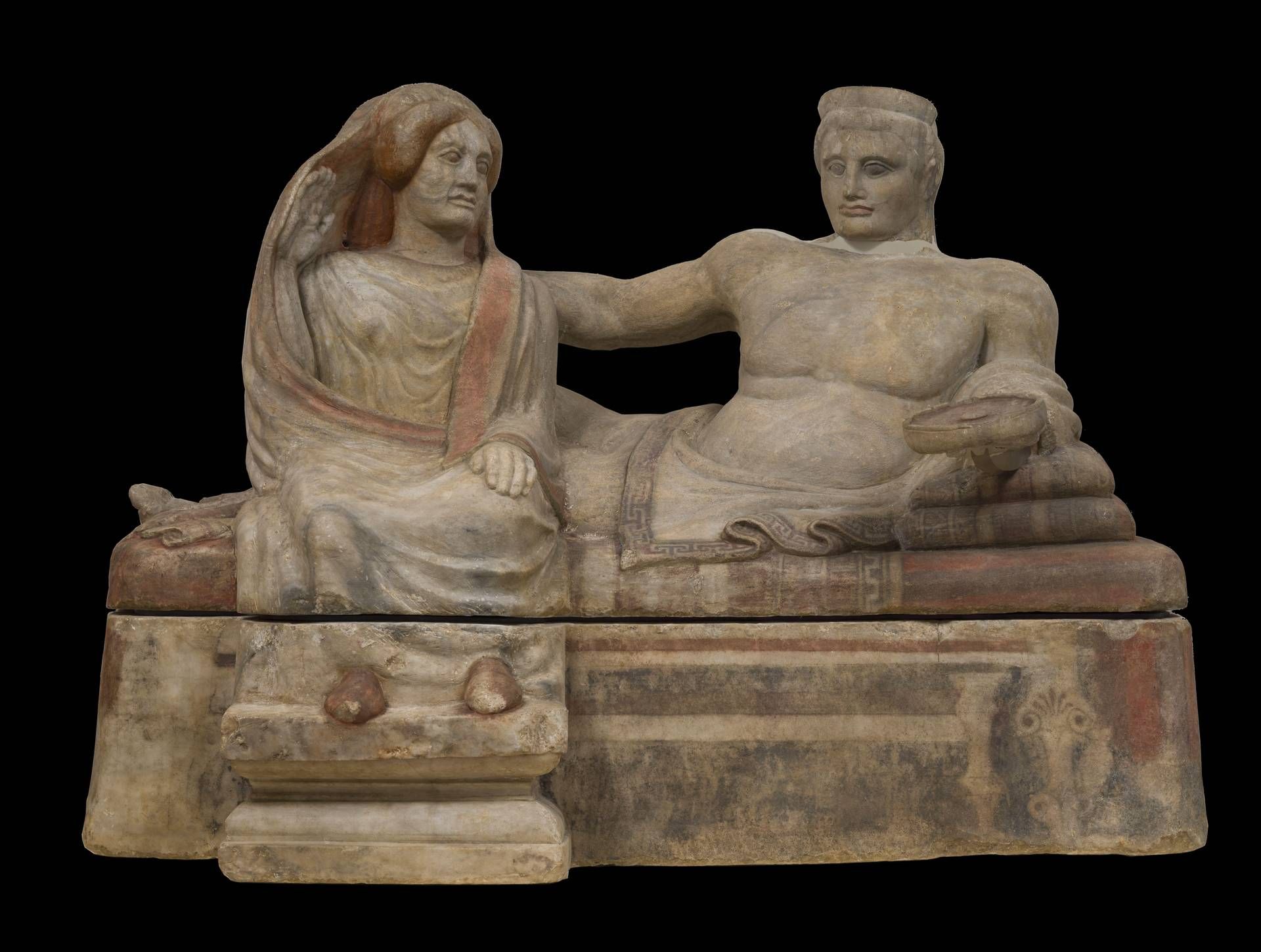
Sixty years ago the mud from the Arno flood invaded Florence and the National Archaeological Museum was not spared from the fury of the water with serious damage to the rooms of the section of the Topographical Museum of Etruria. The water and mud rose above two meters in height, overwhelming the restoration laboratory, the photographic archive and the remains of the Etruscan civilisation. Now, as part of tourismA 2026 – Archeology and Cultural Tourism Exhibition, organized by the magazine “Archeologia Viva” (Giunti Editore), the Archaeological Museum presents as an absolute preview at the Palazzo dei Congressi in Florence the exhibition “The colors of alabaster. The restoration of the Bottarone Urn sixty years after the flood of Florence”, which can be visited from Friday 27 February to Sunday 1 March from 9 am to 18 free entry.
The exhibition celebrates the completion of an important conservative intervention which restored brightness and intensity to the original colors of the alabaster urn, bringing the timeless embrace of the Etruscan married couple sculpted over 2400 years ago to its ancient splendor.
The restoration, carried out by Daniela Manna on a scientific project and under the supervision of Barbara Arbeid, Giulia Basilissi and Mario Iozzo, was possible thanks to the support of the Swiss Federal Office of Culture. The exhibition at the tourismA spaces is curated by Daniele Federico Maras, Barbara Arbeid and Giulia Basilissi, created with the support of the Swiss Embassy in Italy, and set up by the Deferrari+Modesti studio with the collaboration of neo.lab who designed a space capable of enhancing the work and the story of its recovery.
“The Bottarone urn was a successful restoration experiment with collaboration on multiple levels, collaboration of professionals and public resources and with the use of international funds. An excellence that sends a positive message for the future of the cultural heritage entrusted to us: from the catastrophe of the flood to a new life for the Etruscan urn and for the Museum”, says Daniele Federico Maras, director of the National Archaeological Museum of Florence.
Made between 425 and 380 BC in white alabaster with gray veins, the urn was discovered in 1864 under unknown circumstances in the locality “Bottarone” (or “Butarone”) near Città della Pieve, passed into the collection of Giorgio Taccini – as the English traveler George Dennis recalls – and later purchased by the Florentine collector Giuseppe Pacini, before arriving in the collections of the Archaeological Museum in 1887 National of Florence where it was preserved with the inventory number 73577.
The sculpted lid represents a husband and wife couple, a unique fact in the panorama of Chiusi funerary sculpture of the time, which usually sees the deceased accompanied by a female demon with wings “here the woman is the wife, it is the gesture of unveiling that confirms this” claims Barbara Arbeid, Archaeological Official – Curator of the Etruscan Section, highlighting the exceptional iconography of the work and the expressive strength of that embrace.
After the flood, the Bottarone Urn was the subject of a first restoration intervention between 1969 and 1970, directed by Francesco Nicosia, in a decisive phase for the history of protection in Florence. In those same years, in the premises of the MAF, the Archaeological Restoration Center of Tuscany took shape: a structure equipped with cutting-edge equipment, created to respond in a systematic and scientifically advanced way to the very serious damage suffered by the archaeological heritage.
After this first intervention, limited to cleaning the statue from the mud, the surfaces of the urn are progressively grayed and the male head presents problems of structural stability which make a new restoration necessary. The moment arrives in 2022, when the find is selected among the winners of the tender for financial aid for the restoration of movable cultural assets, as part of the international agreement between the Government of the Italian Republic and the Swiss Federal Council. The contribution allows us to start a new study, diagnostic and restoration campaign on the urn, but also to create a permanent restoration laboratory within the Museum, named after Erminia Caudana.
A result that confirms the excellence of the National Archaeological Museum of Florence in the field of archaeological conservation and a record that has its roots precisely in the scientific and organizational response developed following the 1966 flood.
“The restoration of the Bottarone Urn is part of a broader commitment by Switzerland to promote joint projects with Italy in the cultural sector. Culture is an experience that is shared and I am pleased to be able to admire this work also in the context of tourismA”, says Roberto Balzaretti, Swiss ambassador to Italy.
Among the most significant results obtained from the restoration are the identification and mapping of Egyptian blue, together with ochres and cinnabar, which allowed the original chromatic impact of the work to be reconstructed with greater precision. «The imaging investigations gave exciting results: we identified the Egyptian blue and were able to map the polychromy, imagining the urn in its original appearance», says Giulia Basilissi, Conservator Restoration Officer of the Museum.
The installation of the exhibition by the Deferrari+Modesti studio in collaboration with neo.lab is conceived as a sober and immersive narrative device in which the Etruscan masterpiece is the material witness of a sixty-year-long story: from survival in the mud to the first post-flood interventions, up to the restoration started in 2022 and thus accompanies the visitor on an essential journey that intertwines collective memory, history of the Museum and restoration practice.