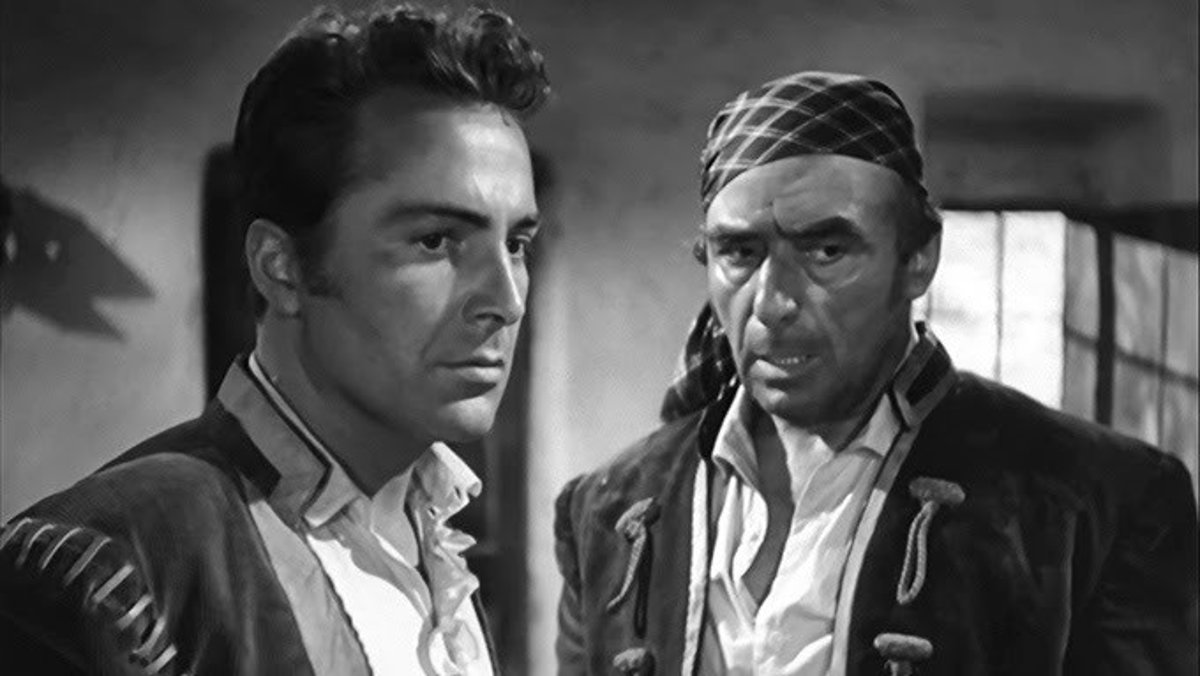
It is now available on FlixOlé ‘Gallows meat’1953 film directed by the Hungarian filmmaker with a Spanish passport Ladislao Vajda. The film, a forgotten title of bandit cinema, heads a collection that brings together fundamental Spanish films of the genre. Among them, three new additions to the platform’s catalog stand out: ‘The scaramouche mask’, ‘The Falcon of Castile’ y ‘The Knight of a Hundred Faces’.
‘Carne de horca’ is a kind of Andalusian western set in the 19th century and with a plot centered on the figure of the bandit, romanticized and feared in equal parts by the society of the time and very present in popular Spanish romances. And precisely that is how the film begins, with a blind man recounting the exploits of the Lucero, “that he robbed the rich and helped the poor.”
In the film, Vajda tries to demystify those bandit heroes through a story in which not everything that is told is necessarily true. The libretto is signed by José Santugini, regular pen of the filmmaker and screenwriter of classics such as ‘The Tower of the Seven Hunchbacks’ by Edgar Neville. ‘Carne de galca’ is not a story of Andalusian Robin Hoods: it is the adventures of a group of villains, mercenaries and traitors to their people.
DEATH AND REVENGE IN ‘GITCHFEAT’
Co-produced between Spain and Italy and with a cast led by Rossano Brazzi, Fosco Giachetti, Emma Penella and José Nieto, ‘Carne de horca’ follows the conceited and womanizing Juan Pablo de Osuna, son of a powerful landowner. Devoted to a libertine life and gambling as his only dedications, the protagonist begins to see his money dwindle due to the fatigue of his father, who refuses to continue supporting him.
After contracting a debt with a stranger, he is seduced by stories about Lucero, who kidnaps the rich for high ransoms. Thus, he decides to fake his father’s kidnapping in order to pay the debt. However, a fatal turn of events occurs: the bandits have actually kidnapped his father and, after not receiving the loot, they kill the eldest Osuna.
From that moment, Tormented by guilt and thirsting for revenge, Juan Pablo will “throw himself into the mountains” to finish off Lucero. Meanwhile, in the town, justice is looking for him because they deduce that he has intentionally killed his father to keep the money.
‘Carne de galca’ was classified as a film of National Interest by the regime. His vision of the phenomenon of bandits confronted that romantic memory of social justice that part of the town still had. In the film, Lucero and his gang kill for money, to maintain power beyond all law, or simply for enjoyment.
Filmed in locations such as the Serranía de Ronda or Jerez de la Frontera, ‘Carne de horca’ is a fundamental title in the filmography of Ladislao Vajda, director of films such as ‘My uncle Jacinto’, ‘Marcelino, Pan y Vino’ or ‘El Cebo’.
‘ADVENTURE TIME’ IN SPAIN
in your collection ‘Adventure Time’FlixOlé brings together films whose themes connect with ‘Gallows meat’like ‘Adventures of Juan Lucas’ (Florian Rey, 1949), ‘Notify Curro Jiménez’ (Rafael Romero Marchent, 1978) o ‘The Coyote’ by Mario Camus, with José Coronado as the protagonist.
Sword duels will also have their place in this cycle with the three remaining releases on the platform: ‘The scaramouche mask’ (Antonio Isasi-Isasmendi, 1963), ‘The Falcon of Castile’ (José María Elorrieta, 1965) and ‘The Knight of a Hundred Faces‘ (Pino Mercanti, 1960). They complete the collection ‘The golden one’ by Carlos Saura, ‘The Captain Ship’ by Florián Rey and European titles such as ‘The fox’ (Duccio Tessari, 1975) o ‘Pirates of Malaysia’ (Umberto Lenzi, 1964).