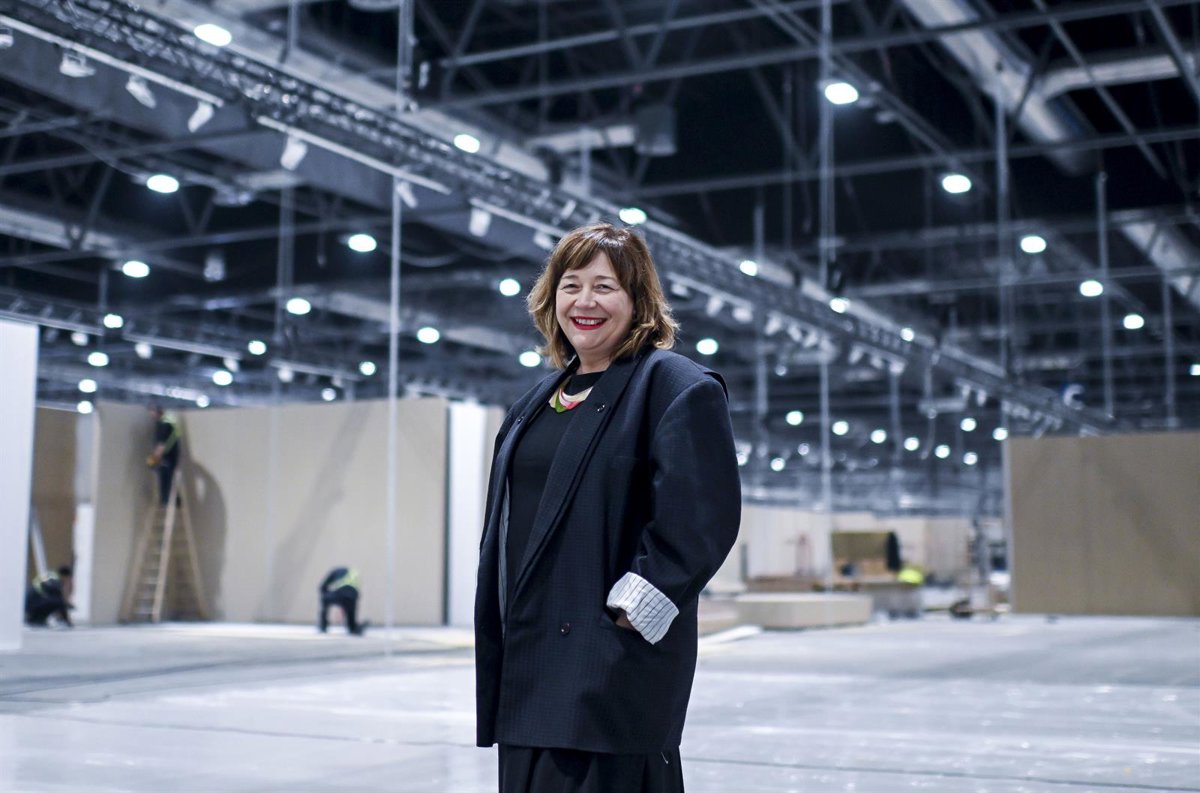
The director of ARCOmadrid, Maribel López, considers that the fair, which will be held at IFEMA from March 4 to 8, should not be “the one that places limits on the use of Artificial Intelligence by artists.”
The director has indicated that, to date, “none of the 211 galleries participating in ARCO work with non-human artists”, and that the use of tools such as ChatGPT or video generation software are “creative strategies, like using a brush, like using a chisel, like using a screen print.”
“It happened when video art appeared in the sixties. Surely we think that the camera is going to do everything, but without an artist behind it there is no work, there is a recording. Without an artist behind it, artificial intelligence is nothing more than a gadget, a technology,” the director pointed out in an interview with Europa Press.
Asked if AI can put artists at risk, López answered no. In this sense, he explained that, although “visually attractive images, with a good rhythm, with an even attractive aesthetic” can be generated, the work of art “is much more than that.” “In the work of art there is the intention, there is the intuition, there is the work, there is the knowledge of history, there are a lot of things that artificial intelligence can contain, but not reflect, for now,” he added.
FEMALE AND LATIN AMERICAN REPRESENTATION
Female representation in this edition is around 40%, according to data from the fair. López has pointed out that in the artist projects – spaces that the fair allocates to higher risk proposals – the proportion improves: of 38 projects, 20 correspond to women. “We are already above in that small area, which I think is symptomatic as well,” he pointed out.
In this sense, he has stated that the general percentage of women could surpass men at some point. “Why not? If we see how there are more and more women in fine arts schools, I think it would be reasonable to think about it.”
Even so, he has pointed out that the artistic field where there is the most room for improvement is that of creation. “If we think about curating, about the management of institutions, traditionally many of our great Spanish curators are women. In management, there are many of us art directors. It is in creation where we can improve,” the director clarified.
Regarding the Latin American presence at the fair, in this edition they represent 30% of the international galleries. López has contextualized this data in a process that started systematically in 2011, with a section dedicated “either to a country or to Latin American art”, and that has made possible “a very real investigation based on the contents that are produced from the continent, from the different scenes.”
DECOLONIZATION PRESENT IN SOME ARTISTS
Regarding whether this presence can contribute to paying off the debt with decolonization, the director stated that, although “she does not dare to answer completely”, the objective of the fair is “to hear the voices that in the creation of each moment have the most relevant message to share.” Regarding whether there will be an explicit decolonial theme in the edition, López has pointed out that “absolutely not”, but it will be present in some artists.
Regarding attendance forecasts, López expects figures similar to those of previous editions. He highlighted that this year none of the nearly 600 international guests – including professionals and collectors – have declined their participation. “We noticed that the desire to come to ARCO is enormous,” he noted.
He also explained that to attract young audiences, the fair has reached an agreement with the Youth Card of the Community of Madrid to offer tickets at half price. “There is no future if young people are not interested in art,” López stressed.
“ART IS THE MOST FRONT EXPRESSION OF THE MOMENT WE LIVE”
The director of Arco has assured that contemporary art is “the most frontal expression of the current historical moment” and has defended that the 45th edition of the fair, whose central theme is the future, does not intend to offer answers but rather to “accompany” and “ask other questions in a less literal way.”
López has assured that he does not perceive “fear” in the artists, but rather a “willingness to help understand.” “To be an artist you have to be very brave. To face this idea of expressing those thoughts, those contents with conviction,” he stated.
He has also pointed out that there are artists who “make speculative fiction”, who “pose universes that do not yet exist”, and others who “look back” to ask how they got here. “What they are sharing with us are our current concerns,” he stressed.
“If we try to say we are going to answer or we are going to ask the questions, we can only fail,” López stated. For this reason, he explained that what the fair proposes is “to open that space of doubt, that space of consultation” in which the future “is nothing more than the second immediately after the immediate present in which we live.”
The central project is part of this framework, which according to the director “has to look back from the present and try to think about the future”, but also incorporate “the capacity for action.” López has acknowledged that predicting what art will be like is “impossible” and that artists are “in no hurry” to do so. “They have slower, more deliberate, more complex reflection processes, so the idea of thinking about the future is almost paradoxical from this point of view.”
“THERE IS A GENERATIONAL RELEASE” IN THE GALLERIES
Regarding the closure of Helga de Alvear’s gallery in Madrid, López has rejected that her legacy be “reduced” to the Cáceres museum. “Helga was a person who was a gallerist and a collector at the same level,” he noted, while expressing that at the fair “a memory of her will always be left,” since one of the collecting prizes bears her name.
In this sense, regarding the generational change in the gallery industry, López has pointed out that there are galleries with careers of fifteen or thirty years that “are perfectly prepared” and that participate in the main international fairs. “I think there is a change. As a fair, I am very calm about the health of the art and gallery scene in Spain,” he emphasizes.
On the other hand, López has positively valued that the first part of the process of reorganizing the collection of the Reina Sofía Museum has been inaugurated days before the fair. “The museum has taken into account that the fair is coming, that the fair is going to bring a lot of international and professional collectors, and is putting on a gala to receive them,” he stated.
Furthermore, he stressed that the presence of Spanish artists in this reorganization – some of whom will also be present at ARCO – represents “a common appreciation of the relevance of Spanish art in an international context.”