The TBA21 Foundation and the Thyssen-Bornemisza National Museum presented this Monday ‘Pedagogies of war’the first solo exhibition in Spain of Roman Khimei and Yarema Malashchuk, central figures of the new generation of Ukrainian visual artists.
Curated by Chus Martínez, the exhibition that can be visited from March 3 to June 21 proposes four audiovisual installations created since the beginning of Russia’s large-scale invasion of Ukraine.
The pieces analyze how, in a context where war is omnipresent and increasingly mediated by screens, algorithmic systems and remote technologies, systemic violence infiltrates everyday experience. This violence reconfigures perception, behavior and collective life, operating even before it can be named or understood.
The artists flee from the idea of war as a singular historical event and break with the visual constant that comes from the media: conflict as spectacle. The exhibition conceives war as a training system that silently shapes bodies, reorganizes attention and alters the very experience of everyday reality.
“The exhibition can be read through the paradox formulated by Bertolt Brecht, who distinguished between Erlebnis – the immediate and immersive lived experience – and Erfahrung, the experience processed, reflected and transformed into knowledge. For Brecht, art does not directly transmit lived experience; turns it into a form of understanding,” said Chus Martínez.
The artistic practice of Roman Khimei and Yarema Malashchuk develops at the intersection between cinema, performance and social observation. Its methodology goes beyond documentary recording and resorts to the creation of fictional situations to reflect on how violence itself is staged and internalized in contexts of war.
“From our perspective as civilians, our work offers a time different from that of the media, which allows us to slow down our gaze and invites reflection. We are interested in how war infiltrates daily life, how it alters perception and how memory is formed when, as is our case, proximity to the conflict and the distance that we must take as artists coexist,” the artists explained.
VIDEO INSTALLATIONS
The four video installations, created from staged cinematographic images and records of real people living the reality of the war in Ukraine, blur the boundaries between documentary and fiction. The works, as a whole, try to combat the clichés of a city at war and invite the viewer to experience what daily life is like in the city of Kyiv – and other Ukrainian territories – between one bombing and another; trying to erode the safety distance that, as spectators, we generate in the face of a televised war.
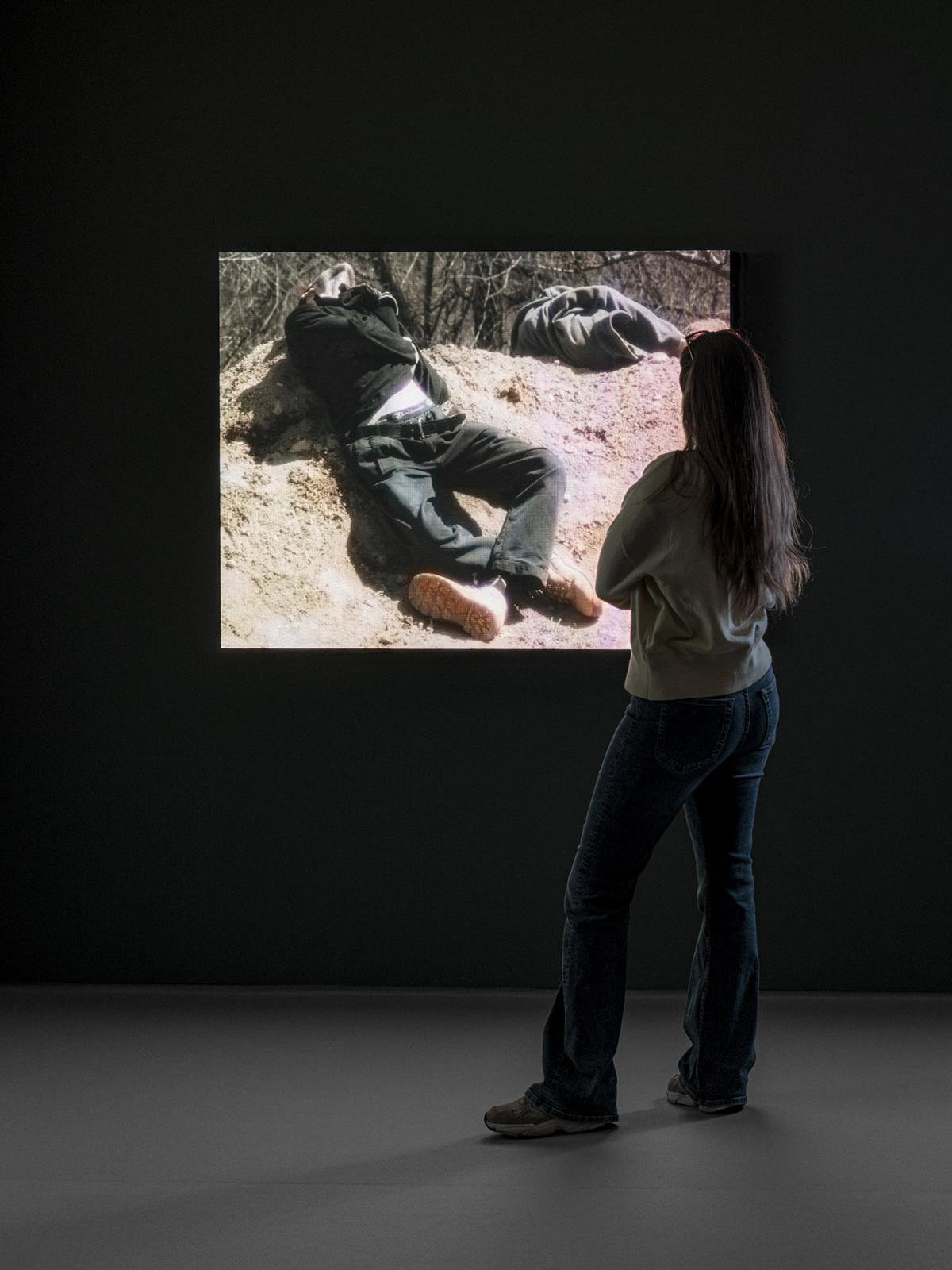
The video installation that opens the exhibition is The Wanderer [El caminante] (2022), a piece produced shortly after the start of Russia’s large-scale invasion of Ukraine and part of the TBA21 Collection.
In it, the artists use their bodies to stage the postures of the corpses of fallen Russian soldiers that blend into the natural landscape of the Carpathians. The video installation refers to the famous romantic painting The Walker on the Sea of Fog (ca. 1817), by Caspar David Friedrich, and, in general, to the tradition of appropriation of the landscape that defines colonial aesthetics.
Faced with the real horrors of war, artists question the romantic representation of death as something sublime. The project also establishes a nod to the work of the Ukrainian artistic collective Fast Reaction Group – formed by Sergiy Bratkov, Boris and Vita Mikhailov, Sergi and Solonsky -, known for their satirical and provocative actions. His photographic series If I Were a German (1994) recreated the actions of German soldiers during the occupation of Kharkiv in World War II. Khimei and Malashchuk want to reread the scene with the German and European position in the current conflict.
On the whole, The four video essays vindicate the capacity of art to sustain collective reflection at a time when violence risks becoming a routine phenomenon.. The exhibition is committed to direct experience and dialogue between cinema and contemporary social realities. A place from which to reclaim art as a shared political space, where people appear as equals and peace can continue to be thought of as a daily collective practice.