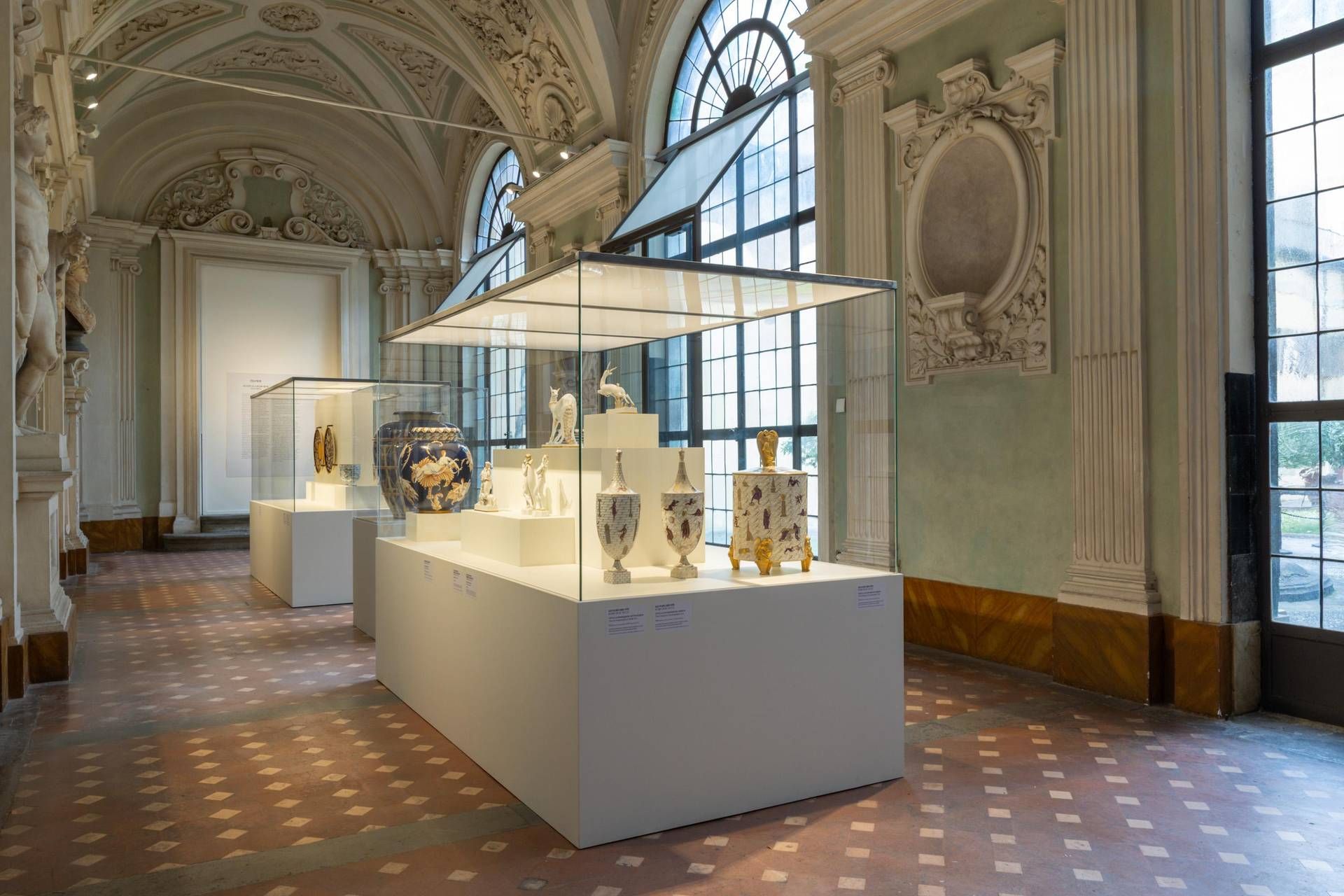
In the 1920s, Florence was one of the liveliest centers of Italian artistic culture, a laboratory of decorative arts, fashion, graphics and design capable of communicating with the great capitals of international taste. The exhibition “Florence Déco. Atmospheres of the Twenties” is dedicated to this climate of extraordinary creativity, scheduled from 2 April to 25 August 2026 at Palazzo Medici Riccardi.
Promoted by the Metropolitan City of Florence and organized by the MUS.E Foundation, in collaboration with New York University Florence, the GP Vieusseux Scientific Literary Cabinet and the Richard Ginori Archive Museum of the Doccia Manifattura, the exhibition – curated by Lucia Mannini, supported by a scientific committee chaired by Carlo Sisi and made up of Francesca Baldry, Giovanna Lambroni, Vanessa Gavioli, Lucia Mannini, Oliva Rucellai and Valentina Zucchi – tells the story of a decade of extraordinary creative ferment, which saw Florence as the protagonist. Ceramics, furnishings, jewellery, fabrics, clothes, advertising posters and more reconstruct the cultural climate of the 1920s, bringing together artists and manufacturers who were able to renew tradition with an eye open to the avant-garde and international taste. From Gio Ponti’s contribution for Richard-Ginori to the ceramics of Galileo Chini, from the creations of Thayaht to the jewels sought after by international high society, from the dawn of the Florentine production of Salvatore Ferragamo and Gucci, from the magnificent silks appreciated by D’Annunzio to the captivating advertising posters: the exhibition itinerary offers a broad and non-localistic reading of Florentine Art Deco, highlighting its national and international relevance. A journey into the atmosphere of an era that left a lasting mark on the city’s modern identity.
“Florence was also one of the liveliest and most brilliant centers of the avant-garde in the arts a hundred years ago – said the mayor of the Metropolitan City of Florence Sara Funaro -. Thanks to the sensitivity of the city’s artists, institutions and manufacturers, ready to grasp its innovations and become innovative interpreters of them, Florence was an important creative centre, in the wake of its participation in the universal exhibition in Paris. New aesthetic values were expressed by the world of fashion, advertising and Florentine artisanal production, including tailors and textile manufacturing, leather goods and ceramics, helping to found the language of modernity. Thanks to this exhibition we retrace an important artistic trend that made history and the profiles of the artists and creative people, we would say today, who offered original and important contributions during that period in Florence, from Umberto Brunelleschi to Balsamo Guido Stella, from Gio Ponti to Thayaht”.
“Visiting the exhibition we feel like we are going back a century; suddenly we are surrounded by works, tastes and styles that permeated the 1920s and which we still feel are particularly similar, elegant and persuasive”, declares Valentina Zucchi, scientific director of Palazzo Medici Riccardi. “In the 1920s, Florence was in fact able to welcome the innovations of European decorative arts and interpret them in an original and powerful key, in a wise balance between tradition and modernity. The exhibition envelops and enchants us, bringing – thanks to the careful work of Lucia Mannini and the scientific committee – the general public to the knowledge of a happy period for all the arts. The collaboration with many prestigious institutions in the area is proof of this, enhancing the cultural and social fabric which the city gave life to in that period and showing how exhibitions can be precious opportunities for research and study on the one hand, and for sharing and pleasure on the other.”
“It was real fun working on this project – said the curator Lucia Mannini – to find among public and private collections the works and art objects that could best bear witness to the vitality of Florence in a crucial decade for Italian creativity such as the 1920s. The panorama presented in the exhibition is extremely rich and varied, including works fully attributable to the Deco way of designing and the system of signs, but also others that demonstrate sensitivity of more elusive definition, but always fully “to fashion”: all contribute to evoking the fascinating atmospheres typical of the 1920s. In fact, sculptures, paintings and graphics, but also furnishings, clothes, photographs, videos and ceramics reconstruct the dynamic climate of that moment and tell compelling stories of our recent past”.
The itinerary is placed in the international context which finds one of its central moments in the Exposition Internationale des Arts Décoratifs et Industriels Modernes in Paris in 1925, an event which sanctioned the success of a new modern taste based on elegance, luxury and collaboration between decorative arts and manufacturing. Italian artists, including numerous Florentines, also took part in the Parisian event, confirming the city’s active role in the artistic production of the period. The 1920s were a period of great cultural ferment for Italy. After the end of the First World War, a renewed interest in the applied arts emerged, considered not only an expression of new aesthetic values but also an economic and productive resource. In this climate, Florence proposed itself as an important creative center, thanks to the presence of artists and manufacturers who were able to make the most of their technical skills by dealing with the languages of modernity.
The first section is dedicated to the relations between Florence and Paris and to the theme of the masks of the Commedia dell’Arte, a recurring subject in the visual culture of Deco. Artists such as Umberto Brunelleschi, Alfredo Müller and Gino Carlo Sensani developed a language inspired by the gallant eighteenth century and the characters of the Italian theatrical tradition, themes that became particularly widespread in the graphics, illustration and decorative arts of the 1920s.
A large core of the exhibition is dedicated to ceramic production, with particular attention to the Richard-Ginori manufacture, which achieved important international recognition in the 1920s. The renewal of production was linked to the activity of Gio Ponti, who introduced new forms and decorations inspired both by Italian artistic culture and by the modern languages of the period.
Alongside the Richard-Ginori, the experiences of other factories active in the Florentine territory are also presented, such as Cantagalli and the Fornaci San Lorenzo led by Galileo Chini, who were able to combine tradition and stylistic renewal.
A section is dedicated to the participation of Florentine artists and manufacturers in the Biennials of decorative arts in Monza, fundamental events for the definition of a modern language of Italian applied arts. The Monza exhibitions in fact represented an important moment of confrontation between artists, artisans and industries, helping to define new aesthetic and production orientations.
The itinerary continues with a section dedicated to advertising, an area in which the influence of Futurism contributed to the development of new forms of visual communication. Among the protagonists are poster artists such as Lucio Venna and Nerino, authors of posters and graphic projects that testify to the growing importance of advertising in the Italian visual culture of the 1920s.
The last part of the exhibition concerns the world of fashion and Florentine artisanal production, including tailoring, textile manufacturing and accessories, such as an elegant travel set by Gucci. In this context, the figure of Salvatore Ferragamo emerges, who in the 1920s chose Florence as the headquarters of his business, contributing to the development of footwear production aimed at an international clientele. Among the most significant episodes of the period is also the famous Tuta designed by Thayaht in 1920, a garment conceived as a universal and functional dress, promoted through a revolutionary diffusion campaign that illustrated its methods of creation and use.
Guided tours of the exhibition are scheduled every Saturday and Sunday at 3pm, while on Sunday morning there is a workshop for families with children aged 4 to 9. Artist’s creations, in deco style, reservations [email protected] 055-2760552.
Furthermore, thanks to the collaboration with Art e Dossier and Giunti Odeon, it will be possible to visit an exquisitely deco place, namely the Savoia theater cinema, inaugurated in 1922 and today known as Giunti Odeon: the visits, with free participation, are scheduled for 18 April, 16 May, 13 June, 11 July and 22 August at 10, 11 and 12 (reservations are active starting from from the previous Monday). The rich catalog of the exhibition is also curated by Giunti, containing a series of contributions from experts and specialists in the sector, a precious tool for retracing the dynamics and artistic relationships of those years, as well as deepening our knowledge of the main protagonists and the works on display.
https://transfur.com/Users/jacquelinegonzal
https://www.ewebdiscussion.com/members/jacquelinegonzal.126749/#about
https://www.bonback.com/forum/topic/360931/clear-mechanics-and-steady-progression
https://www.openstreetmap.org/user/jacquelinegonzal
https://coderwall.com/Sirena
https://dapp.orvium.io/profile/sirena-kkasd
https://tamilculture.com/user/arsavzs-avzs
https://listen.hubhopper.com/episode/chicken-road-2/32994372
https://app.hellothematic.com/creator/profile/1135314
http://anibookmark.com/user/carriewatson.html
http://teletype.in/@carriewats
https://www.equinenow.com/farm/carriewats.htm
http://bikeindex.org/users/bgqbmov23intdqq19qpnra
http://poliscirumors.com/topic/chicken-road-2?replies=1#post-2789373
https://www.vevioz.com/ffbfb50bb
https://www.twitch.tv/carriewatson6?lang=ru
https://github.com/carriewatson
http://designspiration.com/carriewatson66822/saves/
http://forum.446.s1.nabble.com/Chicken-Road-2-td198916.html
https://cannabis.net/user/218230
https://bsky.app/profile/carriewats.bsky.social
https://fueler.io/carriewats
https://tawk.to/7b1a0d5349a2e203d72cb31fe5b96c73b463c6a8?_gl=1*1lujn8*_ga*NzQ3MDA2NjE1LjE3NzQ4Njg3Mjc.*_ga_ZJL9LF36Z8*czE3NzQ4Njg3MjYkbzEkZzEkdDE3NzQ4Njg3NDMkajQzJGwwJGgw
http://inside.volleycountry.com/core/user/69504-carriewats/
http://lost-places.com/forum/wcf/index.php?user/15237-carriewats/