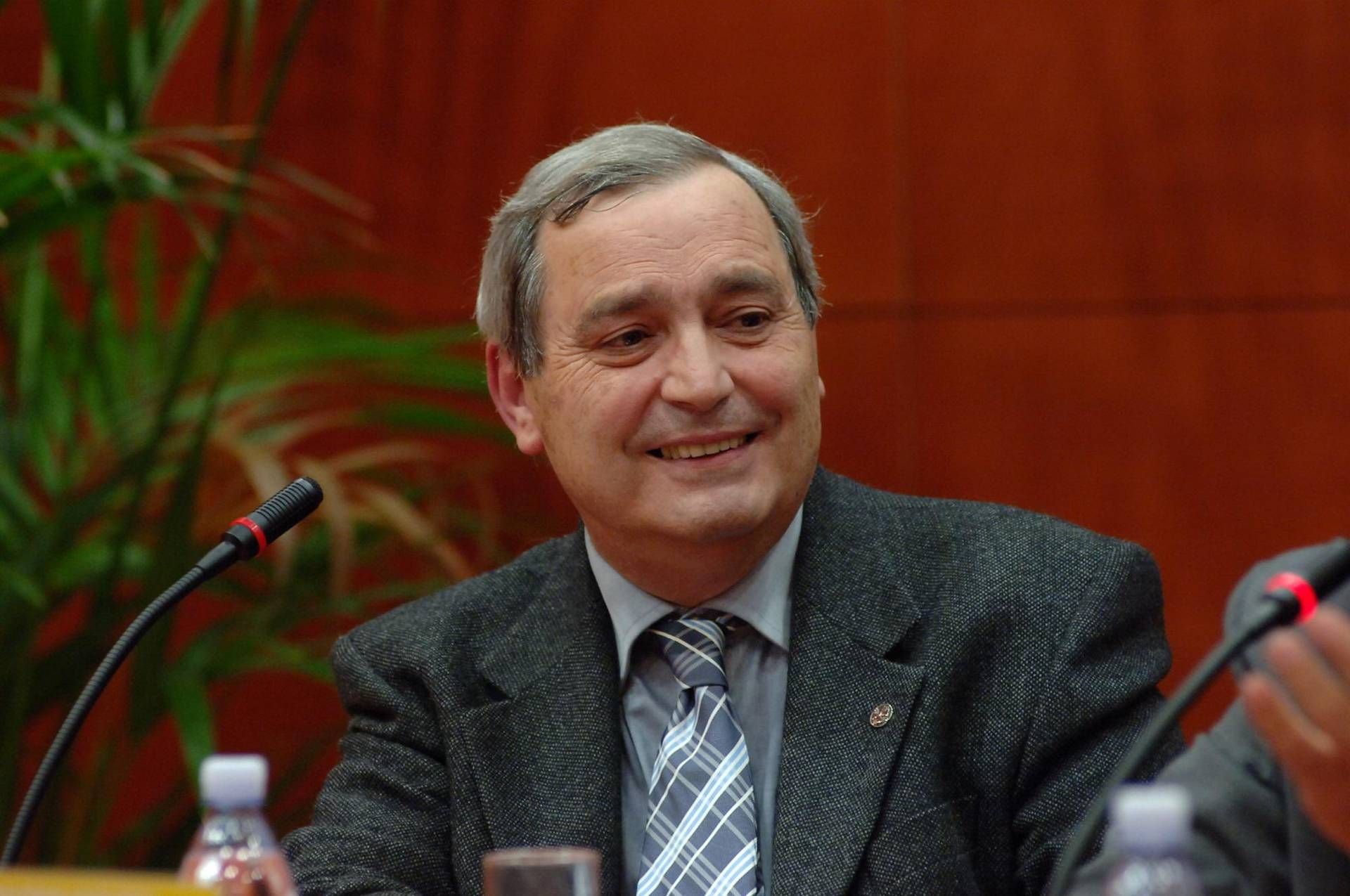
The writer and journalist Vittorio Messorithe best-known Catholic apologist of the second half of the twentieth century, who with the book “Hypothesis on Jesus” (Sei, 1976) brought Christianity to the center of Italian and international cultural debatedied at the age of 84 in his home in Desenzano sul Garda (Brescia).
“His heart died at 9.45pm on Good Friday,” Rosalia Bontà, Messori’s personal assistant, announced to Adnkronos. For years Messori had been living with a pacemaker and a heart attack was fatal. The writer’s wife, also a journalist and writer, Rosanna. Brichetti, died four years ago, on Holy Saturday.
Independent intellectual, secluded, resistant to fashion. Messori he has spanned more than half a century of ecclesial and civil life questioning the relationship between reason, history and revelation. He was the first journalist to interview a prefect of the former Holy Office, at the time Cardinal Joseph Ratzinger (“Report on the faith”, Edizioni San Paolo, 1985), and the first and only one to write a book-interview with John Paul II (“Crossing the threshold of hope”, Mondadori, 1994), which was among the major bestsellers in publishing history.
From anticlericalism to conversion, Christianity at the centre
Vittorio Messori was born in Sassuolo (Modena) on 16 April 1941, into a family marked by the anti-clericalism typical of Emilia at the time. After the Second World War, the family moved to Turin, where Messori attended the D’Azeglio classical high school before enrolling in Political Science at the University of Turin. Here he was a pupil of Luigi Firpo and Norberto Bobbio. His rationalist and agnostic education culminated in 1965 with a degree in History of the Risorgimento, discussed with Galante Garrone, Bobbio and Firpo. Everything changed in July 1964, when an intense reading of the Gospels led him to convert to Catholicism, an experience that profoundly marked his life and oriented his intellectual research, aimed at reconciling reason and faith. Messori began his journalistic career at the Sei dei Salesiani publishing house, moving from the editorial team to the press office. In 1970 he arrived at “Stampa Sera”, initially dealing with crime news and then white news. At the invitation of the director of “La Stampa”, Arrigo Levi, in 1975 he participated in the founding group of the weekly magazine “Tuttolibri”, continuing in the meantime his studies on the origins of Christianity, which led him to publish “Ipotesi su Gesù” (Sei, 1976), a book which has exceeded one million copies in Italy and has been translated into 22 languages.
Fearful of fame, Messori retreated for a few months to Monferrato, dedicating himself to meditation and study. In 1978 he left “La Stampa” to found the monthly “Jesus” (1979), published by Edizioni San Paolo, which became a laboratory for dialogue between believers and non-believers. From this experience were born successful books such as “Inquiry into Christianity” (Sei, 1987), “Did he suffer under Pontius Pilate?” (Six) and “They say he is risen” (Six).
Although critical of clericalism, Messori defended the Church, defining himself as the bearer of a “Catholic anticlericalism” which claims freedom of judgment and intellectual autonomy. From the first issue of “Jesus”, he began reflections on faith through dialogues on Jesus, comparing believers, agnostics and atheists. Despite pressure from secular publishers, he favored the continuity of his research on evangelical truth, culminating in 1982 with “Bet on Death” (Six), a book that challenged society and the Church to confront death and resurrection as a universal hope.
In the following years he concentrated on the Church, obtaining an extraordinary interview with Cardinal Joseph Ratzinger, prefect of the Congregation for the Doctrine of the Faith, from which “Report on the faith” was born (Edizioni San Paolo, 1985), anticipated in “Jesus” and translated into several languages. The work aroused scandal and criticism from progressive clerical circles, but consolidated Messori’s reputation as an independent journalist and rigorous in his reflection on Catholic doctrine.
At the end of August 1990, as soon as he moved to Desenzano, Messori was the protagonist of a sensational media controversy after the presentation at the Rimini Meeting of the biography of Blessed Francesco Faà di Bruno, ‘A serious Italian’ (Edizioni Paoline). A phrase was attributed to him in which he evoked a “Nuremberg tribunal” for Risorgimento figures such as Cavour, Garibaldi and Mazzini.
In the meantime, since 1987, he collaborated with “Avvenire”, writing the column “Vivaio”. Inspired by Giovanni Papini, he collected reflections and notes which converged in numerous books, with the aim of analyzing current events in the light of faith, starting from the news to “go towards God”. In 1992 he published a volume of almost 700 pages which collected 289 chapters of “Vivaio” (Edizioni San Paolo). From this column were born “Pensare la storia” (Edizioni San Paolo, 1992), followed by “The challenge of faith” (Edizioni San Paolo, 1993) and “The things of life” (Edizioni San Paolo, 1995).
At the beginning of 1994 Messori published “Opus Dei. An investigation” (Mondadori), an investigation aimed at dispelling the negative legends about the “Obra”. The author had access to internal documents and universities linked to the institution founded by Saint Josemaría Escrivá de Balaguer, supporting the falsity of the accusations.
At the same time he carried out the first modern interview with a pontiff, John Paul II, on the occasion of the fifteenth anniversary of his pontificate. The resulting book, “Crossing the Threshold of Hope” (Mondadori, 1994), addressed the foundations of faith, the relationship with other religions and the future of the Gospel, and earned Messori the International Gold Medal of Merit Award for Catholic Culture.
In the following years he relaunched Catholic apologetics with works such as “Some reason to believe” (Edizioni San Paolo, 1997), an interview on the classic themes of faith: God, Christ and the Church. He also dealt with the Marian apparitions, with documentaries and books such as “The Miracle” (Rizzoli, 1998), dedicated to the alleged regrowth of a leg in Calanda, receiving Spanish recognition. In 2001 “Gli occhi di Maria” (Rizzoli), written with Rino Cammilleri, dedicated to the Marian apparitions, was released. In 2002 he published “Conversion. A personal story” (Mondadori), written with Leonardo Mondadori, on the publisher’s journey of faith. In 2003 he moved to “Il Timone”, where he resumed “Vivaio” and maintained a constant commitment to Catholic journalism.
In 2004, together with Aldo Cazzullo, he published “The mystery of Turin” (Mondadori), an investigation into the religious and civil symbols of the city. In 2005, “Io, the Jewish child kidnapped by Pius IX” (Mondadori), on the Edgardo Mortara case, and “Ipotesi su Maria” (Edizioni Ares) were published, expanding the reflections on Marian apparitions. The book on the Mortara case sparked debate for the defense of the pontifical laws which allowed the removal of the child from the family.
Since 2006 he has collected his writings published between 2001 and 2004 in “Catholic Emporio” (Sugarco), completing the Vivai cycle. In 2008 he published “Why I believe” (Piemme), an interview with Andrea Tornielli, and wrote a portrait of Pope Benedict XVI for “Time”. From 2010 to 2012 he was editorial director of La Bussola Quotidiana.
In 2012 “Bernadette did not deceive us” was published (Mondadori), in 2018 “When the sky makes a sign to us. Small daily mysteries” (Mondadori), in which he recounts signs interpreted in the light of faith. In 2021, “The Light and the Darkness. Reflections between history, ideologies and apologetics” (Sugarco) was published, a collection of articles mainly published in “Il Timone”. Messori’s private life was marked by the death, in 2022, of his wife Rosanna Brichetti Messori, author of “Una fede in due. My life with Vittorio” (Edizioni Ares, 2018). After his passing, Messori’s health continued to decline. (Of Paolo Martini)
https://writeablog.net/gavinschaefer/przewodnik-klucz-do-udanej-podrozy
https://justpaste.it/Przewodnik-po-Pradze-323210
https://thefreeadforum.top/index.php?page=user&action=pub_profile&id=922439
https://www.nickelsboats.com/how-to-dress-for-a-boat-trip/
https://www.divephotoguide.com/user/PavelGolubev
https://www.facer.io/user/CDUHtFfYRw
https://essaywriterforyou.net
https://shift.tools/users/2224
https://writexo.com/share/07127cdc3f23
https://www.ibmmainframer.com/forums/article/how-does-assignment-writing-adapt-to-online-education/
https://www.bandsworksconcerts.info:443/index.php?scarfhope99
https://online.pubhtml5.com/hburf/fbgd/
https://members.boardhost.com/ReGather/msg/1774577349.html
https://www.facer.io/user/HdpxKHEjPK
https://www.linkedin.com/posts/alfonso-wolfe-2016411b4_praga-przewodnik-w-j%C4%99zyku-polskim-michal-activity-7444685547119276034-XyxM/
https://backloggery.com/LeonidGromov
https://onlinesequencer.net/5297830
https://onlinevetjobs.com/author/chainpeen57/
https://oiaedu.com/forums/users/stopgear66/
https://kitchenanswershub.com/user/selectbrace03
https://matkafasi.com/user/homecomic48
https://ajarproductions.com/pages/products/in5/answers/user/menfuel45
https://qr.ae/pFR3HM
https://www.commudle.com/users/325da296e018f30ba488c0f4a2a09c1f#about
https://www.linkedin.com/pulse/how-much-does-cost-build-business-chatbot-techy-hubb-erovc