Sand installations that they transform public space into an ephemeral landscape which reflects on the nature of heritage, its vulnerability and the collective responsibility of memory. One of the most well-known contemporary artists of the international art community, the ArgentineLeandro Erlicharrives at Colle di Val d’Elsa con ‘Under the Arches of Time‘, a series of site-specific installations created for UMoCA – Under Museum of Contemporary Art. Erlich, Argentine artist whose works are exhibited in the most important museums in the world — from the Tate Modern in London to the Center Pompidou of Paris and with permanent works in the cities of Paris and Shanghai — he is known for installations that place the perception of reality is questioned and the relationship between everyday space and imagination.
Under the medieval arches of San Francesco bridgeErlich builds three monumental installations modeled in sand. The castle — symbol of childhood imaginationof collective play and ephemeral beauty — here also becomes a warning about the fragility of thingson erosion and the vanity of permanence.
The three scenes between hourglasses and ephemeral maps
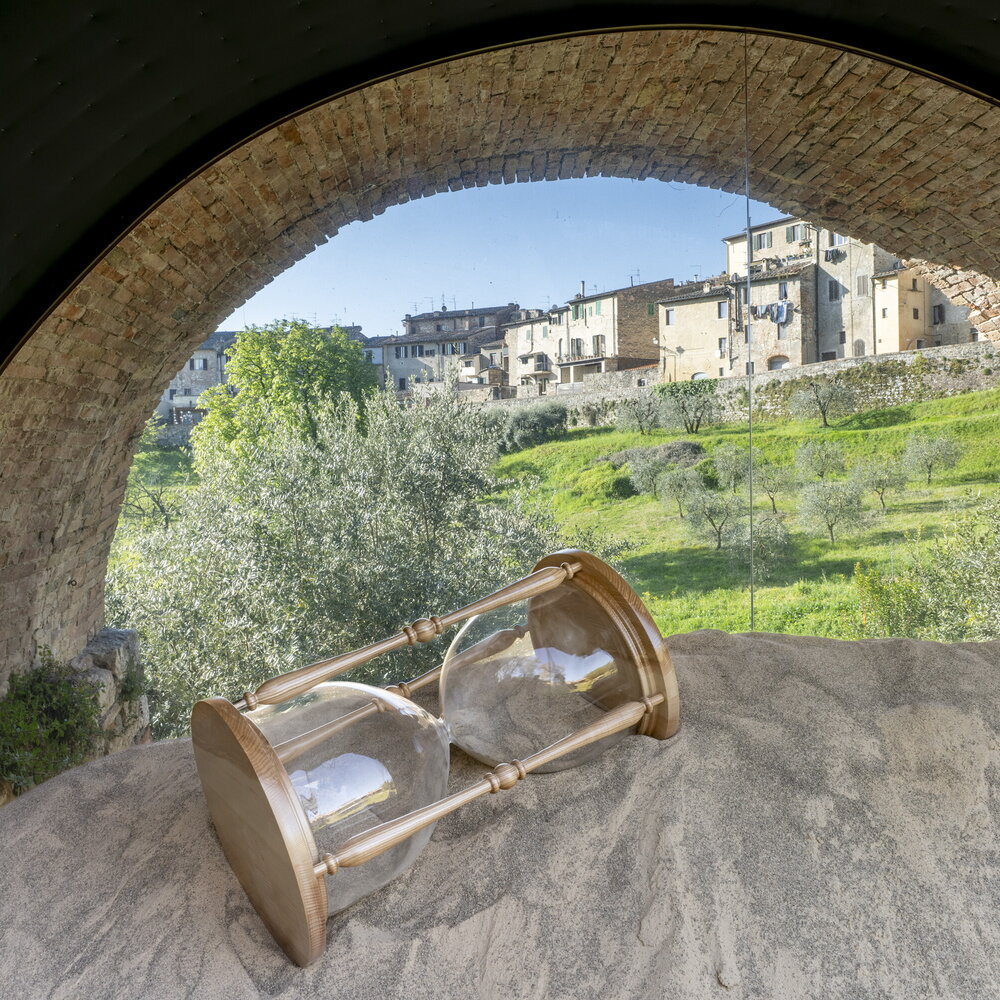
‘Under the Arches of Time‘ is divided into three scenes: from the left in the first arch, an hourglass it rests on a dune. It does not measure time but evokes its immeasurability. The sand that flows inside it dialogues with the sand that builds the other installations, symbolically closing the cycle between memory, present and loss. In the second arc, the sand takes the shape of a mapping: the village of Colle Val d’Elsa appears on a smaller scale, sculpted as if it had been shaped by the wind. The city becomes an ephemeral relief which recalls the transitory nature of every human settlement.
In the third they emerge from a hill of sand miniatures iconic architecture — from Brunelleschi’s dome to the Parthenon, from a Mayan pyramid to Notre-Dame — like an impossible atlas that brings together symbols of distant civilizations in the same fragile geography. In this fragile landscape, heritage reveals its deepest nature: not an eternal stone, but a delicate material — like sand — held together by the responsibility of those who take care of it.
Erlich’s poetics between infinity and fragility
“There is something in the sand that has always caught my attention: since childhood, I have been fascinated by its immeasurable scalefrom the impossibility of imagining or counting the grains on a beach – states the artist Leandro Erlich – in that experience there was already an intuition of the infinite, but also a comparison with time: the sand as the result of millions of years of erosion, and as a fragile surface on which our finite existence unfolds”.
The tension between fragility and the will to last
“Later, Borges’ ‘The Book of Sand’ gave shape to that intuitionrevealing an image of infinity as fascinating as it is disturbing. Sand evokes the ephemeral. Every form constructed with it seems to contain, from the beginning, the certainty of its own disappearance. And yet it is precisely in that act of building – however precarious and fleeting – that it turns out to be something profoundly human. From children’s structures on the beach to the great constructions of history, the same impulse persists: to resist time, to leave a trace, to affirm a will to endure in the face of the inevitable. Maybe it’s in this one tension between fragility and durability which proves to be one of the most profound keys to the human condition,” he concludes.
The role of the Arte Continua Association
The project is conceived and organized by Continuing Art Associationwhich has been promoting projects for over thirty years public art capable of connecting international artists, local communities and landscape. The work is freely accessible to the community, who wanted to share itn the Association the theme of universality and the gratuitousness of art.
Leandro Erlich divided between Paris, Buenos Aires and Montevideo
Leandro Erlich (Argentina, 1973) lives and works between Paris, Buenos Aires and Montevideo. In the last two decades his works have been exhibited internationally and become part of the permanent collections of prestigious museums and private collections, including the Museo de Arte Moderno de Buenos Aires, the Museum of Fine Arts of Houston, the Tate Modern of London, the Pompidou Center in Paris, the 21st Century Museum of Contemporary Art in Kanazawa, the MACRO of Rome and the Israel Museum.
https://500px.com/p/neal_foster1
https://apk.tw/space-uid-7333629.html
https://www.tripadvisor.com/Profile/4nealf
https://www.leenkup.com/Neal_Foster
https://www.ozodagon.com/index.php?subaction=userinfo&user=Neal_Foster
https://www.dailymotion.com/user/neal__fkx288
https://stocktwits.com/Neal_Foster
https://www.nicovideo.jp/user/143802718
https://ameblo.jp/568467/entry-12962189681.html
https://www.senscritique.com/Neal_Foster
https://www.tripadvisor.ru/Profile/4nealf
https://anyflip.com/homepage/jmxpj
https://pikabu.ru/@Neal.Foster
https://www.jigsawplanet.com/NealFoster
https://fliphtml5.com/home/Neal_Foster
https://bsky.app/profile/nealfoster.bsky.social
https://www.deviantart.com/hendrik19/art/Royal-Carribean-Cruises-Oasis-Class-Cruise-Ship-1181333853
https://elcuadernodigital.com/forums/topic/whats-interesting-about-traveling-to-prague/#post-249204
https://balonmano.mforos.com/210810/13229915-what-are-the-best-hotels-for-family-travel/#123559551
https://band.us/band/100828170/post/1
https://fairygodboss.com/community-discussion/SkPwv0vtm/who-here-has-been-on
https://bookclubs.com/books/lonely-planet-cruise-ports-caribbean-1-909336
https://lovestrategies.com/10-essential-steps-to-succeeding-in-life-love-and-business-100k-subs/#comment-3124026
https://www.diigo.com/item/image/bpd2w/67vg
https://www.c-heads.com/2015/07/24/technological-kings-in-space-by-vanessa-matic/#comment-1222003