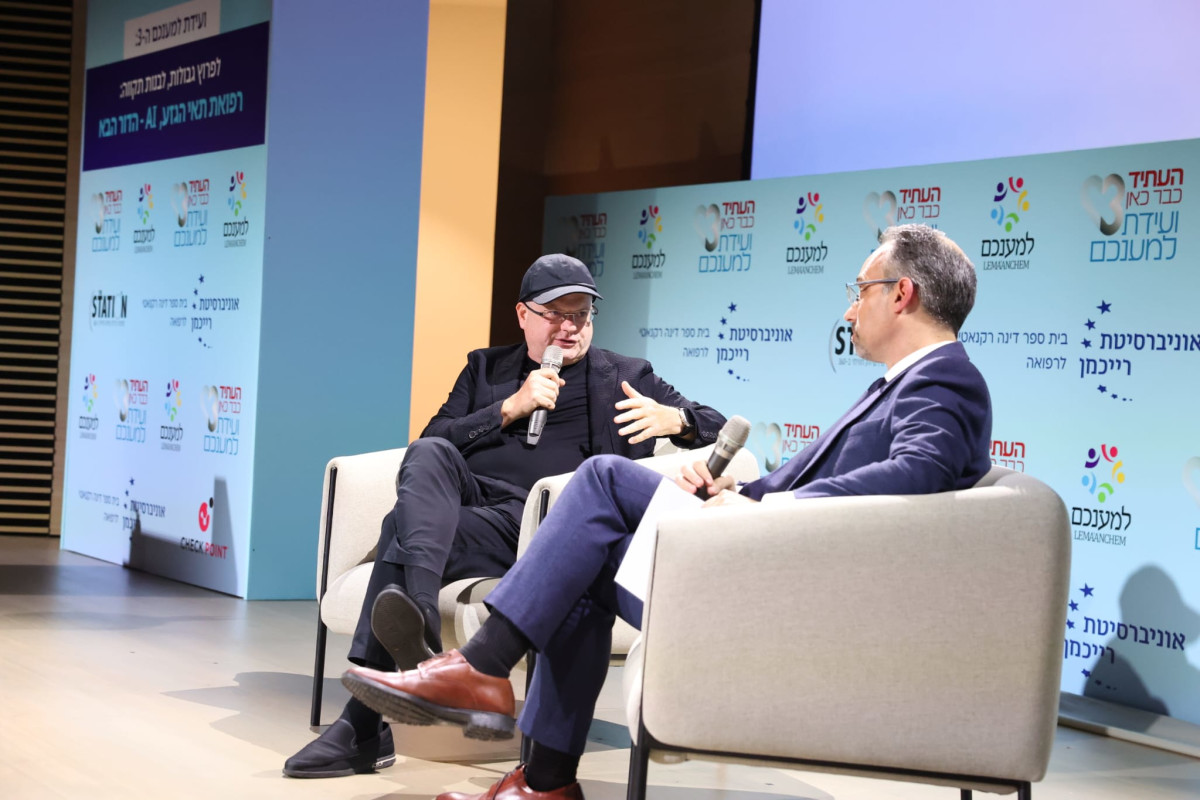
“The next step in the revolution: patients will become their own doctors”
Dr. Wertheim clarified that already today the situation is that “AI is a main decision support tool in the treatment of various diseases”. Prof. Spracher said that the second and dramatic revolution of the new technology is still ahead of us, since “within a short time of a few years the patients will become their own caregivers, and the disturbing question is what will be the place of the health care system then”.
Levy-Daddon said that there are doctors who currently devote 40 percent of their time to documentation, and her organization found an artificial intelligence-based solution for this: “We put in a system that records the visit, processes it and writes the summary, and the doctor only has to approve it and with the push of a button it goes into the file. This dramatically improves the doctor’s burnout and the time he wastes.” Dr. Mekel added: “We have launched a patient management system in the ER that offers the doctor diagnoses and methods of investigation.” She emphasized that this is a “decision support” system, and the goal is not for it to replace the doctors.
“The assistance of Lamene gives you confidence – and also changes the medical outcome”
Shvid pointed out the importance of an organization working for you: “When a person encounters a problem in a field he does not understand, such as medicine, and has no idea what to do and who to turn to – it does not matter if he is a simple and uneducated person or a super-sophisticated person, it does not matter if he is poor or rich, he suddenly reaches a situation where he is helpless and does not know who to turn to. Then when he can turn to an organization for your sake and suddenly someone gives him good advice and tells him ‘it’s okay’ or ‘it’s legitimate To turn to this and that doctor, he is the top – this not only creates confidence and trust, but changes the medical outcome.”
Over 200 disabled IDF students
Prof. Uriel Reichman, the founding president and chairman of the board of directors of Reichman University, the host of the conference and a partner in it, asked to take advantage of the distinguished stage and appealed to the government and the heads of the Ministry of Health, with a request to stop the discrimination against the medical students at the institution he founded – including IDF wounded.
Prof. Reichman first described the challenge of training doctors in Israel: “Israel has become the country that actually consumes doctors who have studied abroad to the extent of about 69%, a more serious scope than all the OECD countries. The public universities currently receive over NIS 80,000 for each medical student. Beyond that, the Ministry of Health grants a loan to students studying abroad in the amount of up to NIS 360,000 – a loan that turns into a grant upon their return to work as doctors in Israel.”
“The realistic cost of training a doctor in Israel is NIS 100,000 per year. This amount is almost fully funded by the Ministry of Health for all medical schools – with the exception of our school,” added Prof. Reichman. “This situation constitutes discrimination and unacceptable harm.”
He emphasized: “We are not demanding funding for our medical school, but only assistance to the students who study with us. Despite the goodwill shown by the former Minister of Health, our students were met with a cold shoulder by the Director General of the Ministry of Health. We demand correction of discrimination of our medical students. It is not possible that students who want to stay in Israel and not study in Budapest, Prague or Amman, will not be eligible to apply for at least the loan that is given to others. It is not possible in the country to be against people who serve the country and who want to stay in the country.”
Prof. Reichman further said: “These students have contributed 13,000 reserve days in the last two years. About a third of them come from the geographic and social periphery of Israel. We have about 155 students who started studying this year and they are severely disabled IDF, and there are another 57 disabled IDF who started studying last year.” Prof. Reichman used the stage to thank the chairman and founder of For You, Yossi Arablich, “for working tirelessly and without profit for the benefit of the public, and also for obtaining a significant contribution to finance medical students, the disabled in the IDF and those in need.”
Abrachs can study medicine and integrate. It’s just a matter of will
Prof. Afek pointed out the most advanced technologies that exist in the medical school, and commented: “Since the Medical College obliged us with this, we also do autopsies here, so that they can be calm, even though in our opinion they are completely unnecessary.”
Yossi Arablich, chairman and founder for your sake and leader of the conference, referred to the state of the nation and the opportunities facing the organization in this area as well, and said: “After two difficult years of war, our people seek hope for unity and the fusion of the rifts in society. In the hospital waiting rooms, all the pieces of the Israeli mosaic sit side by side. There the differences disappear, and there are no partitions and prejudices. Our ambition is to export this special model also outside the walls of the medical centers.” In addition, Arablich thanked POW survivor Noa Argamani who attended the conference as a guest of honor. The audience was excited to see her, stood up and cheered for her.
The country’s President Yitzhak Herzog, who is on a diplomatic mission overseas, sent his blessing to the conference: “For your sake, the collaboration with the best medical institutions, medical faculties and experts in their field is a power multiplier of joining hands and brainstorming.” The association’s name goes before it as an address for professional and dedicated medical support.”