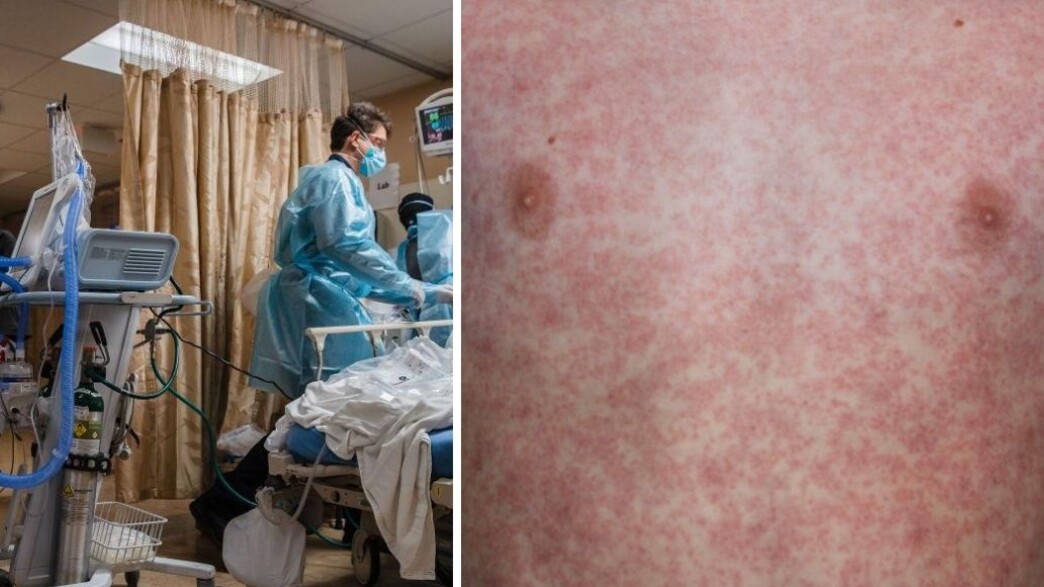
In recent months, the United States has been dealing with one of the worst measles outbreaks it has ever known: Over 1,700 are hospitalized, about 45 centers of active outbreaks in the southern countries and up to the eastern coast. Official warnings say that if the infection does not stop by January – the country will lose the “herd vaccine” status it has held for 25 years. According to official reports, the outbreak that began in Texas has spread to Utah and Arizona. The New York Times reported that a significant number of cases are linked to groups with low vaccination rates, with chains of infection that have been going on for almost a year. In both Texas and New York, several deaths have already been recorded.
Australia is also facing a sharp jump – more than 150 infected in the last year – and this is the highest number of cases since 2019.
“It’s enough that a family doesn’t get vaccinated and spreads the disease – and I already see the articles painting us all as guilty”
While the health authorities in the US are trying to deal with a rapid spread and with unknown sources of infection, within the Jewish and ultra-Orthodox communities there is frustration – a minority that does not get vaccinated is reviving old stereotypes, and making many in the Jewish communities feel that they are the ones paying the price.
“We have no connection with them and they even cause us damage,” he tells Mako today (Wednesday). Health Hasid Satmar. “These are individual communities that live like a cult. They don’t send their children to our schools, don’t pray with us, don’t consume products with our kosher.”
An official from Chabad describes the broad social impact: “We are afraid of this. It is enough that a family does not vaccinate and spreads the disease – and I already see the articles painting us all as guilty. It reinforces ancient anti-Semitic stereotypes. They say that Jews spread diseases – which is simply not true.”
“In the USA there is much more freedom. You cannot force people to get vaccinated”
Another Hasidic in the same community reinforces the words: “There are extremist groups that do not get vaccinated, do not receive anything from the government, do not insert a needle into their body. Moreover, they are in contact with extremist Christian groups that convince others not to get vaccinated. This is not the ultra-Orthodox we know.”
He explains that one of the reasons for this phenomenon is the fact that fringe groups can operate without supervision. “In the US there is much more freedom. You cannot force people to get vaccinated.” According to him, the fear in the community increased especially after the story revealed in Mako Health to the rabbi in Tiberias who ordered his believers not to vaccinate. “It shocked a lot of people here,” he said. “They are afraid that such a case will happen with us and will further strengthen the anti-Semitic claims that we are constantly trying to defend against.”
By the way, according to Chassid Satmar, the ultra-Orthodox institutions require children to be vaccinated with routine vaccinations as part of the admission conditions, which also leads to the isolation of children living in those extremist communities.
One of the factors says that “it’s not just a matter of image or anti-Semitism – it’s simply a matter of responsibility. Sometimes one case is enough for us to be pointed to as guilty again.”
Even in Israel, the spread continues: since the start of the measles wave in April, about 2,000 cases of infection have been reported, and over 650 patients have needed hospitalization. According to the Davidson Institute, about 10,000 people have been infected. As I recall, nine children have died so far – the vast majority of them were not vaccinated or partially vaccinated – the vast majority of them from Jerusalem. The Ministry of Health emphasizes that any area where vaccination rates are low may become a significant center of infection, and urges parents to complete vaccinations as soon as possible. Sources in the health system say that another wave of morbidity is possible in the winter, if the rate of vaccination does not increase.