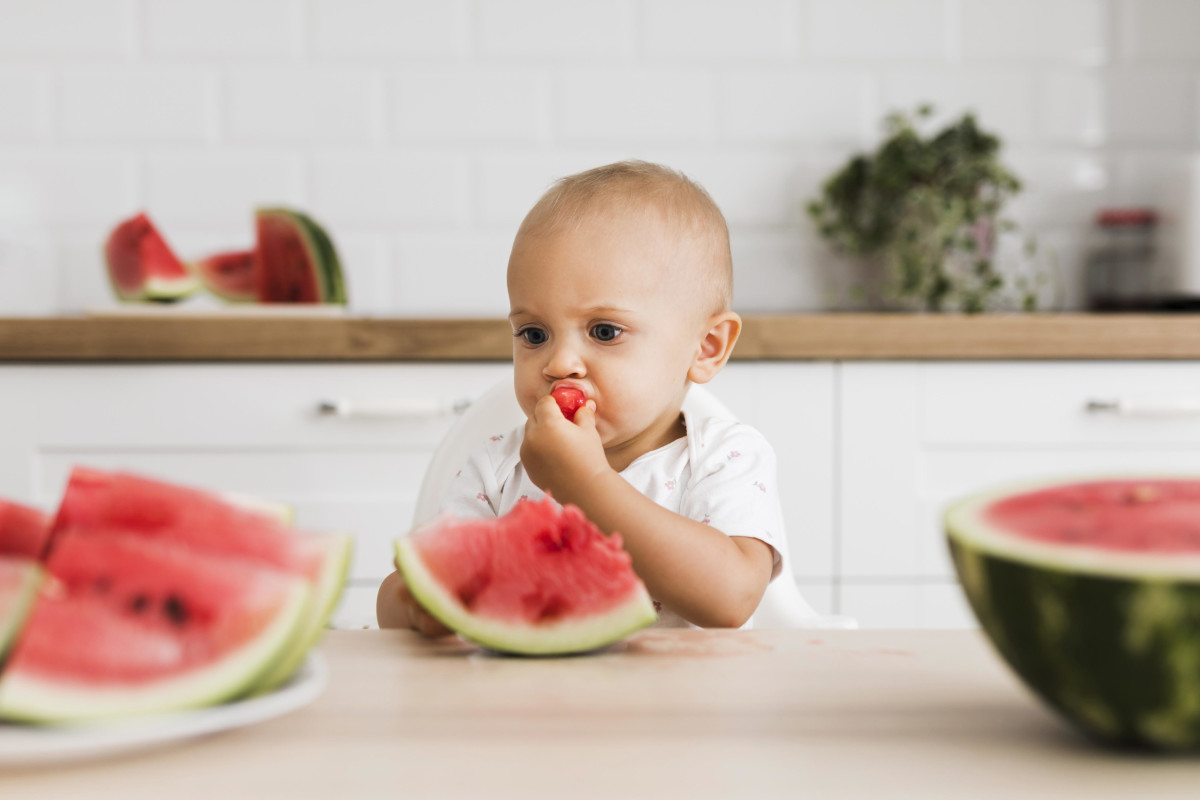
Almost every parent knows this moment: the plate is still half full, the head is already full of worries, and the little thought starts to pop in – “maybe he didn’t eat enough?”. We count spoons, compare to the growth graph, and sometimes also to the neighbor’s child. It’s natural. But precisely here, on the question of how much the baby should eat, modern research offers a surprising and reassuring direction: in most cases, if we just let him, the baby knows how to regulate his eating better than we think.
You decide what, he decides how much
Parents’ role is to offer healthy and varied food. The parents are responsible for what is served and when, but the baby controls the amount and decides if he will eat at all. Does it sound strange to allow a baby to decide for himself? It turns out that this is the way to raise a child who knows how to listen to his body.
From the first months, you should not refer to the hours and amounts on the packaging of the baby food – these are statistical averages. Instead, learn to read the baby: mouth movements, sticking out the tongue, sucking fingers and searching the breast – these are signs of hunger that need a quick response, before he reaches crying. Crying is already a late sign. The signs of satiety? head to the side.
The number of meals in the first months: 8-12 a day, usually not uniformly – and that’s fine. Feeding will be done according to signs of hunger and satiety, vitality and routine monitoring of weight. The baby is expected to wake up and eat at night as well, and there is no need to wake him up. In cases where he does not gain weight, you should wake him up during the day – not at night.
From the age of six months: not only what is eaten – but also how
When you get to complementary feeding around 6 months of age (premature – not before 4 months of corrected age) – “how to give” is much more important than “what to give”. In the initial stage, the quantity is secondary: the goal is sensory learning of tastes and textures, not filling the stomach. The emphasis should be on attentive feeding that creates a positive relationship with the food.
Four guiding principles should guide this process. First, freely touching food is not a “mess” but an essential developmental component – the baby needs to explore, rub and feel textures to build familiarity with food. Second, independent eating should start from the first meals: a spoon for little fingers, finger food – any way that allows the baby to lead the process. Third, a shared meal is an opportunity for learning through imitation – when the parent eats together with the baby, he demonstrates how to chew, swallow and experiment with new foods.
And finally, screens and games should stay off the table – distractions interfere with the eating experience and the shared bond between parent and baby.
In terms of menu composition, it is important to gradually expose the baby to healthy foods from the family menu prepared at home: legumes, grains, seasonal fruits and vegetables, meat, chicken, fish, olive oil and eggs. The foods that the babies will be exposed to with high frequency in infancy – these are the foods that they will continue to prefer even in preschool. Start already from the age of 6 months with meals rich in iron such as meat and legumes, and increase the variety over time.
The window of opportunity that closed earlier than we thought
Between the ages of 9 and 12 months there is a significant developmental window for food textures. First it is recommended to serve ground food, and later mashed or grated food with a coarser texture, depending on the development of chewing ability. Studies show that not introducing these foods at the age of 9-12 months is associated with an increased risk of eating difficulties and a reduced consumption of fruits and vegetables in later life.
Repeated exposure to food is not parental stubbornness – it is a biological process of adaptation to taste. Babies are born with an innate preference for sweet (which signals energy) and a fear of bitter tastes (which could have signaled toxicity in the evolutionary past). That is why 10-15 exposures to foods such as green vegetables are sometimes needed – not because the baby “doesn’t like”, but because his brain needs to build familiarity and confidence around the new taste. Keep offering the broccoli even after it flies to the floor.
At the end of the second year, there is a natural reduction of the preferred foods – this is part of normal development. The key? Continue to offer the foods at family meals, where children learn healthy eating through imitation. However, you should serve in the center of the table, not on the child’s plate, to respect his choices. Don’t insist, don’t persuade, don’t give prizes – these only strengthen the resistance.
Mindful feeding is a marathon, not a sprint. The goal is not for the baby to finish what is on the plate for the day, but that at the age of 10 he will know how to listen to his body better than most adults. As long as the child is vital, developing and the growth indicators are normal – this is the right direction. Sometimes the best gift you can give him is to simply trust him.