If national dietary guidelines had to be summed up in one sentence, it would be something quite simple: eat in moderation, prefer plant-based foods, and stay as far away as possible from ultra-processed, sugary, and alcoholic foods. But nutrition was never just a matter of health. It is also industry, politics, lobbyists, budgets, and above all – a lot of money. That’s why official documents are less sharp than science suggests, and more cautious than the public needs.
Recently, the United States government, through the Department of Agriculture (USDA) and other bodies, published the Dietary Guidelines for Americans. That is, the new nutritional guidelines for the years 2025-2030. A document that does not remain on the shelves of the academy but has practical meanings. School menus, the army and aid frameworks are derived from it. In that sense, it is one of the public decisions that most affects what actually goes on the plate of millions of people.
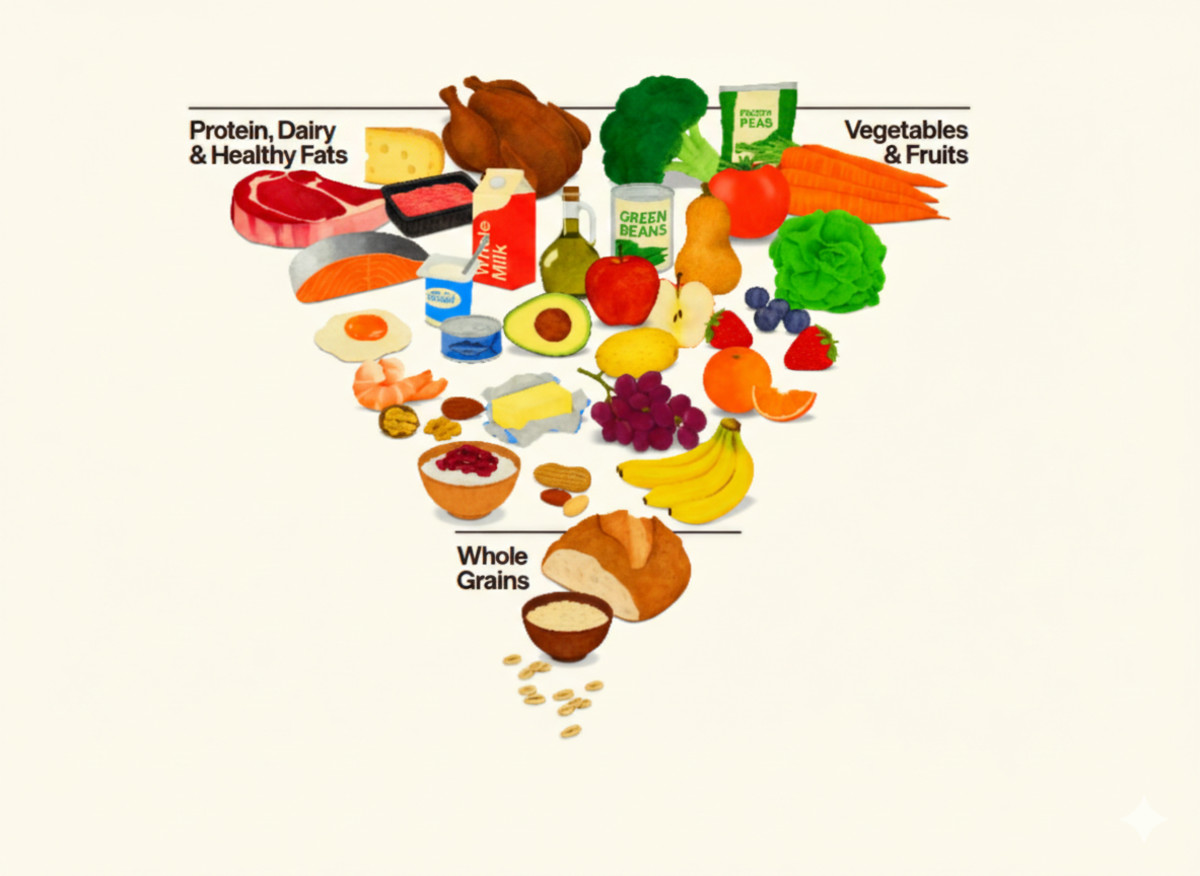
The noticeable change is not only in content but also in form. After years of graphic experiments, some of which moved the model from the pyramid to the plate – the pyramid is back, and this time in an “inverted” edition. What appears above and large should represent what should be given a central place in the menu, and what is pushed down – less. It’s a smart communication solution, which tries to speak in simple language and convey a change in priorities.
The verbal message also strives for simplicity: more “real food”, less ultra-processed food, less added sugar and less alcohol. As a principle, it is hard to argue with the direction. These are exactly the places where the majority of the population struggles over time. But this simplicity is also the source of the problem – because when you start breaking down the document into details, quite a few internal contradictions are revealed.
Graphic simplicity and the complexity of nutrition
One of the main axes in the new guidelines is the emphasis on protein. For the first time, a daily numerical goal in relation to body weight is also presented. This sounds scientific and accurate, but for the general public it can become a chase for grams or, worse, a consumer race for industrialized “protein-enriched” products. In practice, most people don’t need this kind of nutritional accounting. It is much more likely to talk about an eating pattern that contains a quality protein source at every meal, and not about a uniform number that tries to suit everyone.
On the issue of fat, an internal gap was revealed in the message of the guidelines: on the one hand, the guidelines say to prefer oils with essential fatty acids (for example, olive oil), but state that “butter or beef fat is also possible.”
And not only that, at the top of the pyramid animal foods occupy a significant part next to vegetables and fruits, and the clear message is that they should be a significant part of the menu. This is a recommendation that contradicts scientific expert committees that have consistently stated: reduce saturated fat and replace it with unsaturated fat from vegetable sources, and in the context of cardiovascular health also reduce foods such as butter and red meat and ultra-processed meat.
The location of whole grains at the bottom of the pyramid conveys a message of reducing carbohydrates, but along the way may also push aside the issue of dietary fiber, which has an important place in a balanced diet. Not necessarily because of what is written, but because of what the illustration and visual emphasis convey.
It is precisely on the subject of added sugar that one of the strongest parts of the document appears. There is no attempt to “soften” the message – there is no desired amount of added sugar, and there is also a simple rule for daily use: no more than ten grams per meal (which is about 2.5 teaspoons of sugar). It’s not perfect, but it’s a clear behavioral anchor, one that you can really apply when you’re standing in front of the shelves at the supermarket or the drink machine.
On the other hand, on the subject of alcohol, the opposite movement is seen. Instead of clear numerical limits, a general call to “reduce” remains. No definition, no distinction and no practical tool for the public. A vague message, in the end, is sometimes a non-existent message.
Who is responsible for our food?
One of the main criticisms of the new guidelines concerns not only what is written in them but also the premise behind them: the responsibility is placed almost entirely on the shoulders of the consumer. Make the right choice, hold back, ignore the temptations. But in reality where the food industry invests huge sums in aggressive marketing, without significant regulation and without environmental change, this is an expectation that is very difficult to meet over time.
As part of the “fight against childhood obesity” strategy, schools were allowed to provide only skimmed or low-fat milk. Now, for the first time since 2012, it will be possible to serve whole milk (3%), milk containing 2% fat and even flavored versions, such as chocolate or strawberry, provided they do not contain added sugar.
“More real food, less industrialized food” is a statement that can be translated into Israeli cuisine without apps or formulas. It refers to foods that have undergone many processing processes and include synthetic or chemical ingredients, such as food colors, preservatives and artificial sweeteners. High consumption of these foods is associated with various health problems, such as obesity, type 2 diabetes and heart disease.
In the end, the big question also arises: did the previous guidelines really fail, or were they simply never implemented on a wide scale? The calls to reduce ultra-processed food, sugar and saturated fat were not born in 2026. They were there before.
So what do we do with it?
When you clean out the noise, the graphics and the struggles, a fairly simple core remains: cook more, eat less industrial food products, reduce sugar and alcohol, choose mainly high-quality fats (olive oil, avocado, tahini), and incorporate protein without turning it into a religion or a math project. It doesn’t sound innovative, but maybe that’s precisely why it has a chance to work.