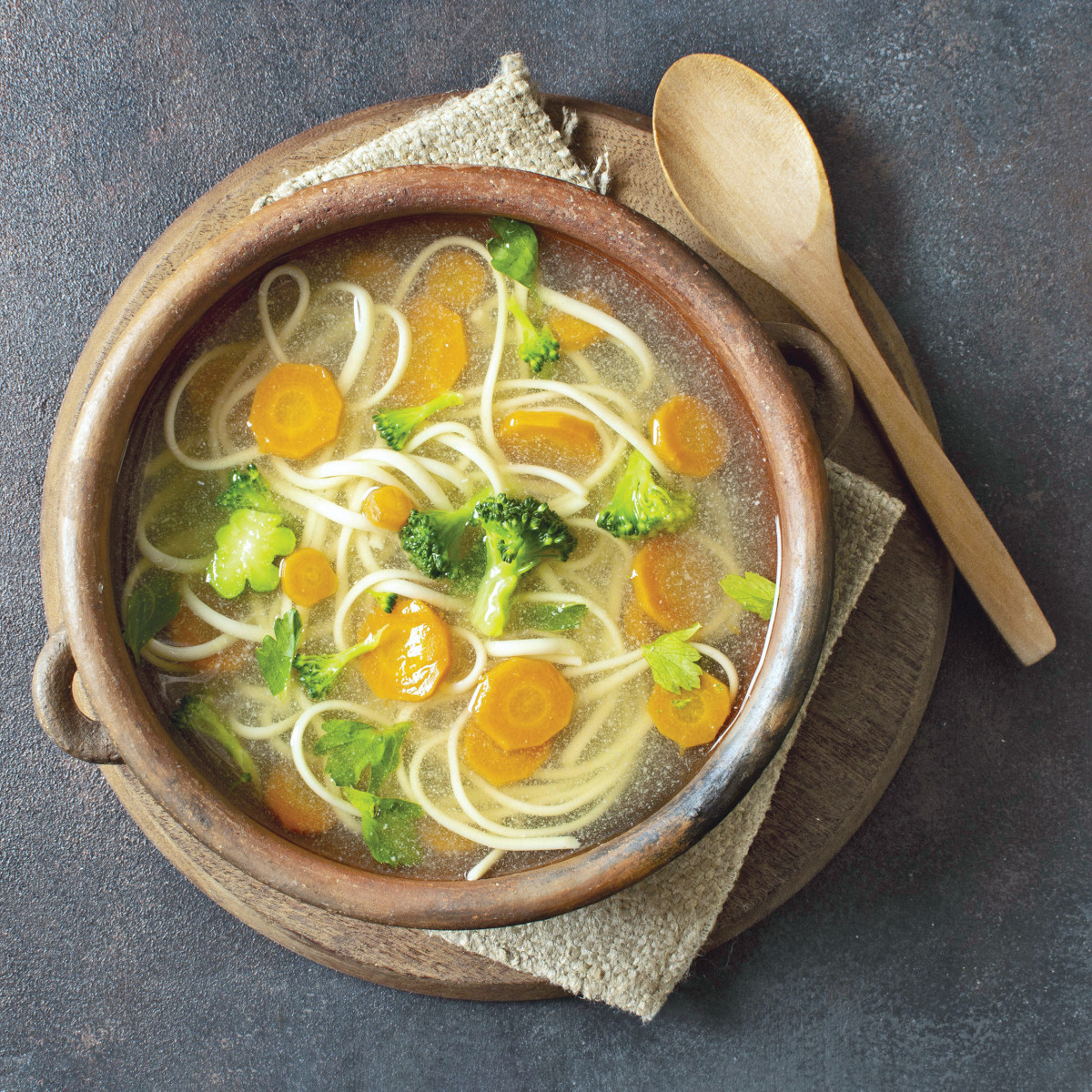
Almost every culture, every season and every age has a soup. And why does an “unimpressive” dish on paper – water, vegetables and a few other additions – manage to be one of the smartest nutritional choices in the home kitchen?
Soups in all the colors of the rainbow
Nutritionally, soup can be used as a complete and balanced meal for everything. In the meat version, the protein sources can be chicken (recommended without skin), turkey or lean beef. In the vegetarian or vegan version, the role of the protein is fulfilled by the legumes: lentils, chickpeas, beans, dry peas or soy (tofu). The carbohydrate sources can be combined using rice, potatoes, sweet potatoes, grits, couscous, corn or noodles. And besides all these, the constant ingredient is almost always a generous amount of vegetables.
This is where one of the most beautiful and effective nutritional combinations comes in: a combination of legumes with grains, for example hummus or beans together with couscous or rice. This is a classic example of 1+1=3. Each of these combinations creates a more complete protein profile than either component alone. That is, it is not only an addition of satiety or texture, but also a real nutritional upgrade.
Beyond the quality of the protein and carbohydrates, the soup excels mainly in the ability to combine a large and varied amount of vegetables. This is not trivial: although vegetables are a regular part of the Israeli menu, their consumption among children (and many adults as well) is lower than recommended. Soup makes it possible to combine vegetables in an accessible way, sometimes even grind them to a uniform texture, thus increasing consumption without encountering resistance.
Vegetables have another advantage: the color. Each color brings with it a different family of active ingredients:
Why is the soup satisfying?
Added to this nutritional richness is another fact: soup contributes to a feeling of fullness in the short term, mainly thanks to the liquids that quickly reach the stomach and expand its walls. Eating itself is usually done relatively slowly, also because the soup is usually served hot. In the longer term, the dietary fibers that come from vegetables and legumes are digested slowly, so the feeling of fullness continues even after the meal.
Hence the recommendation to combine soup as a first course. It helps to advance the feeling of fullness and thus reduce the amount of food later in the meal. However, there are situations in which it is better to serve it at the end: children with a poor appetite, the elderly or the sick, who have difficulty reaching a sufficient amount of food. For them, starting with the soup may cause satiety too soon and affect the consumption of the main course.
How do you choose soup?
It is worth mentioning that not every soup is similar to another, and the difference between homemade soup and industrial soup is not only culinary but also nutritional. Prepared soups, powders or instant dishes often contain large amounts of salt and sometimes also additional components that have no real nutritional advantage.
Miso soup, for example, enjoys a healthy image thanks to tofu and the fermentation process, but its high amount of sodium (600-900 mg per serving) should be taken into account. For those dealing with high blood pressure or limited sodium, this is a point to pay attention to. In the home kitchen, on the other hand, there is full control over the amount of salt and it is possible to enrich the taste with root vegetables, spices and herbs.
Additions such as cream, coconut milk, croutons or soup almonds are a matter of an informed choice. These additions do improve taste and texture, but also add calories, saturated fat (in cream and coconut milk) and sodium (in croutons and soup almonds). If there is no health limitation, there is no need to give them up completely, but it certainly makes sense to use them in moderation, if at all.
Beyond all the nutritional considerations, soup has a practical advantage that is hard to argue with: it is simple to prepare. You can also use frozen vegetables, which are usually picked at their peak, undergo a short infusion and are quickly frozen. One large pot can be enough for several days, for a family or even for one person.
To maintain the nutritional value, it is recommended to avoid cooking for too long. Some of the vitamins are sensitive to heat, and when the vegetables soften, there is no real advantage in continuing long cooking.
In the end, soup is much more than a nostalgic winter soup, and perhaps this is its charm: it does not promise miracles, does not pretend to be a “superfood” (and in any case, there is no such thing as a “superfood”), and does not require special skills. It simply allows, again and again, to put a lot of good nutrition in one bowl. And in a time when it’s so easy to get involved with food, it’s sometimes exactly the smartest choice.
https://pin-up-casinoaz.com/
https://pinup-yukle.org/
https://casino-pinup.az/
https://pinupcasino.az/
https://victoriaforcongress.com/
https://az-casinopinup.com/
https://pin-upcasinogiris.net/
https://pinupcasinoaz.cc/
https://pinupcasino-az.pro/
https://pinupcasinoyukle.net/
https://pinupaz-yukle.com/
https://pinupkazinoyukle.com/
https://pinup-yukle-az.com/
https://pinupcasinoyukle.org/
https://charlesnelsonreilly.com/
https://pinup-casino.zone/
https://aplikacja.ceidg.gov.pl/CEIDG/CEIDG.Public.UI/SearchDetails.aspx?Id=8cdbd288-2560-4f02-9af4-05eabc9d7174
https://docs.kongregate.com/discuss/696d6236f9780efc8ebcb5f0
https://www.martview-forum.com/dev/index.php?threads/67219/
https://magic.ly/SegunOladipo/Play-Chicken-Road-and-Win-Real-Cash-in-India
https://profit.ly/user/PankajSaxena/blog/exciting-real-cash-wins-with-chicken-road-india
https://idol.st/user/122695/ArjunMehta/
https://comicvine.gamespot.com/profile/joydeepbose/
https://ecency.com/hive-197554/@walterhansen/chicken-road-india-play-and
https://quicknote.io/ed3399a0-f4c2-11f0-a7ec-773513ca3c38