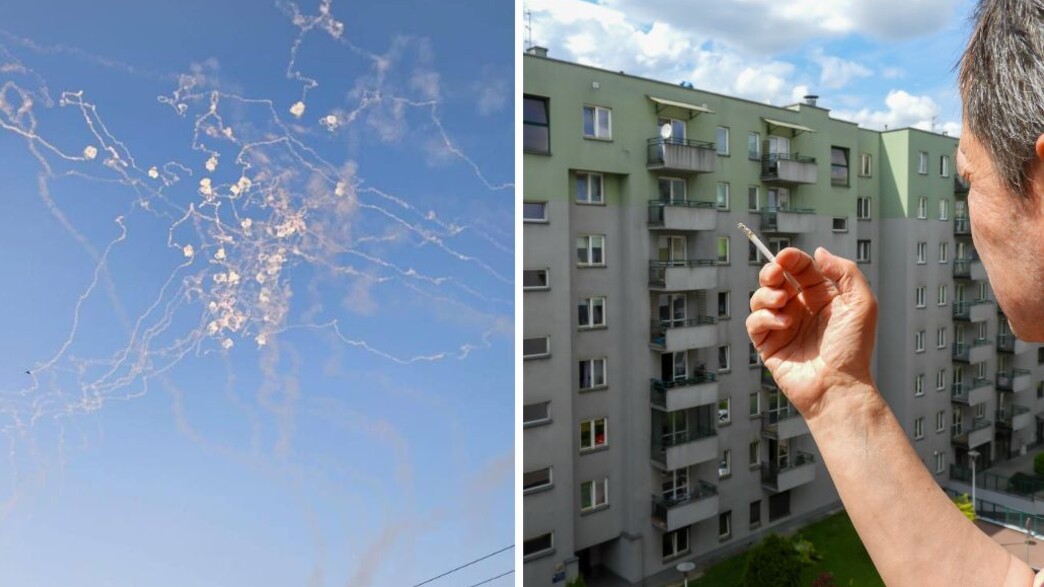
Israel at war: Following the firing of missiles from Iran and Lebanon into Israel, many alarms are being heard these days in Israel. According to the directives of the Home Front Command, in the event of an alarm, one must enter a protected area, close and lock the outer steel window and the inner glass window and wait for about ten minutes.
Despite this, there are those who prefer to ignore the known guidelines, and not enter the protected spaces. In an interview with Mako Health, they talk about the reasons that led to the extraordinary decision.
“The chance that something will actually happen is small”
Mika, a household worker who lives in the Netanya area, refuses to enter the protected area during an alarm. “It just takes up unnecessary time from me,” she explains. “Instead of being in a room for ten minutes and doing nothing, I can clean the house in that time.” When asked if she wasn’t afraid, she answered: “No, there are scarier things and I know that the chances of something really happening are small. It’s clear to me that most people choose to defend themselves and that’s fine, but if a missile decides to hit the house where I’m cleaning – then come on, it’s probably from heaven. The chances are so small that it’s worth not wasting my time on it.”
“Neither excited nor afraid”
Moshe, 76 years old, father of three children and grandfather of 4 grandchildren, is already known among his family and friends as a person who does not tend to be moved by alarms and missiles, or to protect himself when entering a shelter or shelter. As a resident of Tel Aviv, he remembers well the Gulf War, when the area where he lives in the north of the city was hit by long-range missiles from Iraq. Even then, he used to go up to the roof and watch the interceptions of the American Patriot missiles.
“I’m not excited and I’m not afraid,” he says with a smile. “My children yell at me that I don’t go into the emergency room when there’s an alarm, but I’m really not afraid and many times when they’re with us and there’s an alarm, I go in with them just to instill in them a sense of security so that they won’t be afraid of me. “Even in the two attacks by the Iranians, I sat in the living room and watched TV. I believe that what needs to happen happens.”
“Not even Nasrallah will interrupt my sleep”
Noya, a pilates trainer from the Sharon area, is also in no hurry to run to the emergency room when an alarm sounds. “It has happened several times while I was sleeping, and I decided not to get up because I had no strength. I work hard from morning to night, and with all due respect to the desire to scare, no one will interrupt my sleep.”
For years she lived in Jerusalem, at a time when there were countless terrorist attacks carried out by explosive terrorists. “I think it forged me in a way,” she says. “Even then, I remember that a lot of people didn’t leave the house, but I always thought in a logical way and everything – what is the statistical chance that something will happen in the exact place and time I am there? Besides, no one will beat us, and maintaining a routine is the most important thing you can do in a time like this in my opinion.”
“The alarms were designed in a way that was intended to provoke an immediate reaction for self-defense”
Dr. Adit Gutman, psychologist and lecturer in the Department of Psychology at Tel Aviv University, tries to provide an explanation for the phenomenon. First, she explains the difference between fear and anxiety. “Fear motivates us to beware of real, tangible danger. The alarms were designed in a way that was intended to provoke an immediate reaction for self-defense – that is, to allow us to defend ourselves from the danger of the missiles. In some cases people react to this with defiance. This is similar to situations where people are attracted to risky behaviors, preferring challenging and dangerous routes such as mountain biking or jumping off a cliff. In fact, these are people who try to deny the horror of death, and be active in challenging it.”
Another group of people she mentions in this context are those who do not respond to alerts, but for other reasons. “These are people who feel such a fatalistic feeling, according to which it doesn’t really matter what we do, in the end it is fate that decides. Sometimes it is the result of exhaustion, after the prolonged pressure has consumed the mental resources to cope effectively.”
In any case, she points out that in both cases our mobilizing to take an interest in others – neighbors, friends, or family – can psychologically ‘recharge’ forces to continue doing what we can in order to face the fear as effectively as possible.