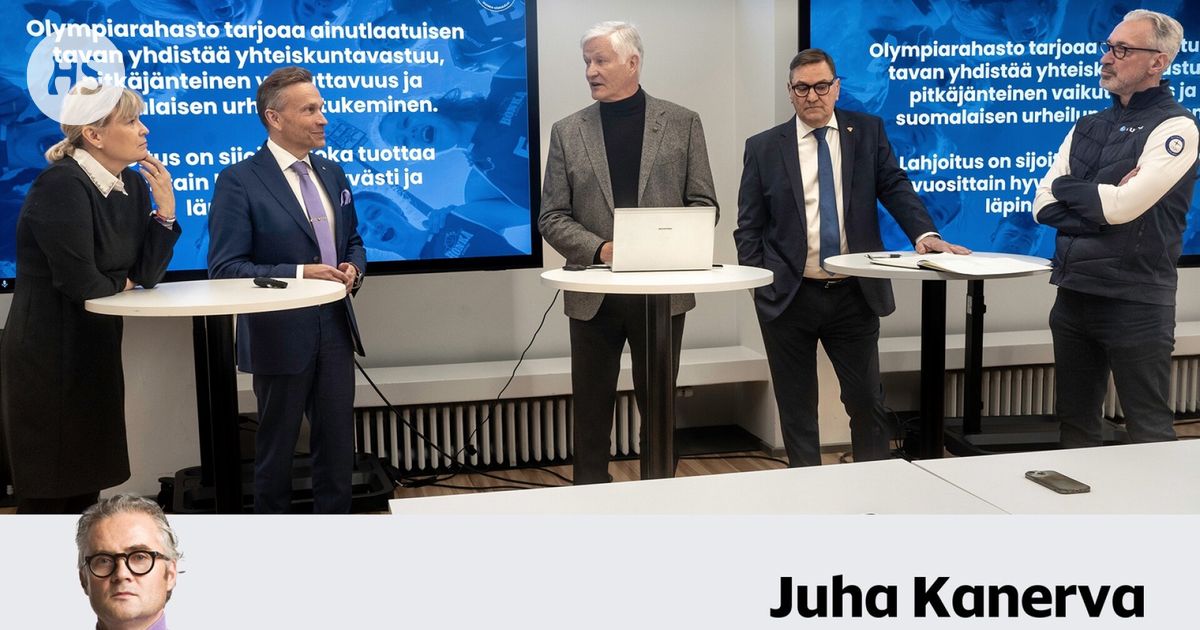
Comment|The Ice Hockey Federation and the Athletics Support Foundation saved the Olympic Fund with their large donations.
Finland The Olympic Committee had some happy things to say on Friday. After the Kurakeli, the sun shone through the window of the Olympic Stadium, and the faces of the sports influencers who arrived there also shone in the flashes of flash lights.
An experienced athletics man Antti Pihlakoski arrived in gold-rimmed shoes, reflecting palatial splendor.
At the press conference, it was said that the Olympic Fund had come back to life after years of silence. The fund, which was launched in 2017, has accumulated more than two million euros thanks to the donations of the last few weeks, which means that the threshold requirement announced by the government has been met.
The state has promised to double the capital of the fund up to 20 million euros, but the minimum was therefore two million.
The whole fund project would probably have collapsed if two major sports federations had not come to the rescue.
For a long time, the balance of the fund was 1.4 million euros, but when the Finnish Ice Hockey Association and the Athletics Support Foundation decided to participate with a contribution of more than 300,000 euros, we got over the painful threshold of two million euros.
An idea of the five-ring fund was already presented in 2012 by the then general secretary of the Olympic Committee Mika Sulin.
It became concrete in 2017, when Harry Harkimon led working group submitted its report. The purpose of the working group was to think of new ways to strengthen the financial base of sports, and the Olympic Fund was seen as a brilliant idea.
The vision was to collect capital of 45 million in three years, so that 15 million is collected from the business world and the state puts “Kolkyt miltsi” on.
At the time, not everyone was convinced of the reasonableness of the project.
“If you think about the market, I don’t see collecting 15 million as very realistic,” sports manager Jukka Virtanen said recently in September 2017.
”
In the future, the donor had the option to allocate the support amount to a specific sport.
Virtanen the button feel turned out to be correct. The Olympic Committee was chaired by the CEO of OP Pohjola at the time Timo Ritakallio. Osuuspankki joined the talks, but other large companies – with the exception of Broman Group – were not enthusiastic about supporting elite sports.
In 2023, only 1.14 million euros had accumulated in the fund. The three-year timeline threatened to end in a cliff, and the government’s unique Black Friday offer is melting down the drain.
The Olympic Committee was able to negotiate a three-year extension, and the project remained alive.
Because the top sports corner did not appeal to the business world, the rules of the fund were changed so that the distributed support euros are also directed to children’s and youth sports.
Another essential rule change was passed in the spring of 2025. While previously the donations had gone into a common pot, in the future the donor had the option of allocating the support amount to a specific sport.
The third and decisive violation of the regulations was resolved three weeks ago, when the state government approved the donations made by the foundations.
It is hoped that the new model will inspire different parties to loosen their purse strings during the next year. The government’s doubling promise is only valid until the end of 2026.
So the fund wouldn’t just get dusty in the bank vaults, the Finnish Sports Support Foundation, which administers it, opened a call today for a grant of 10,000 euros for “young athletes training with a goal in mind” who were born between 2005 and 2011. Athletes in both individual sports and team sports can apply for support.
In addition, grants of 7,500 euros are available for “active sports clubs”.
The total amount of grants applied for now is around 100,000 euros. In the future, the fund will also distribute grants from the income accumulated on the capital.
“Capital is not eaten,” assures the financial director of the Olympic Committee Perttu Pajukoski.
https://fosteringsuccessmichigan.com/member/414027
https://bato.to/user/3185097
https://www.notebook.ai/users/1205833
https://www.renderosity.com/users/id:1801603
https://forums.maxperformanceinc.com/forums/member.php?u=229712
https://www.trackyserver.com/profile/208065
https://www.doppel-wobber.de/cms/index.php?user/53603-spinofglory/#about
https://staredit.net/profile/133379/
https://www.tkaraoke.com/forums/profile/onecasinonl/
https://myanimelist.net/profile/OneCas1noNL
https://www.roboterforum.de/user/46407-casombiee/#about
https://www.smitefire.com/profile/spilnucasino1-241338
https://www.overclockers.at/user/nvcasino
https://apptuts.bio/mrbit-1-226139
https://files.fm/boomsbet/info
https://kress.de/mein-kress/profil/edit/42536-winspirit-casino.html
https://www.klamm.de/forum/members/nvcasino.162659/#about
https://hto.to/u/3196669-winspirit1
https://www.dubbellucht.nl/forum/user/10907-one-casino
https://www.schwalbennest.de/user/47026-nvcasino/?editOnInit=1
https://www.tkaraoke.com/forums/profile/winspirit/
https://osbot.org/forum/profile/436953-betsomnia/
https://able2know.org/user/happysp1ns/
https://onlinesequencer.net/forum/user-224691.html
https://my.omsystem.com/members/happyslotscasino