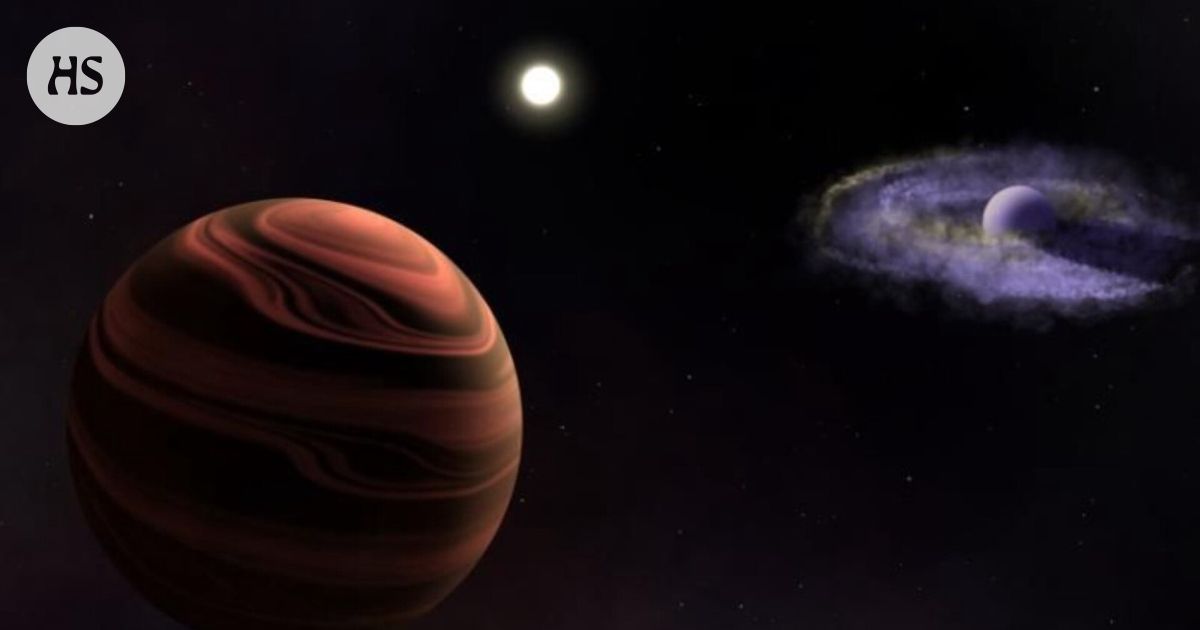
Astronomy|The images of the space telescope shed light on two exoplanets near the unprecedented.
The abstract is made by artificial intelligence and checked by man.
Space Telescope James Webb has taken pictures of exoplanet gas and cloudy.
A study published in Nature found signs of water, carbon monoxide, carbon dioxide and methane.
There were also references to the exoplanets around YSES-1 stars about silicate particles and olivine granules 306 light years from the ground.
Astronomers They have taken a step forward in their attempt to see a glimpse of the heavenly worlds outside our solar system.
At least sand clouds, perhaps even jewels, were distinguished from the gas frames of remote exoplanets. An exoplanet is a planet that circles the star other than the sun.
Pictures of distant clouds and gas frames were taken by the space telescope James Webb. It described the spectrograff exoplanets that circulate a star called Yses -1. The study appeared science magazine in Nature.
Fresh images are depicting gas frames near unprecedented.
“In the results, everything is exciting,” Webb’s discoveries describe the astrophysician and the research editor Language Hoch Online Service for Science Alert.
Hoch works at the Space Telescope Science in the United States, which also houses the Space Telescope Webb Control Center.
Webbin Nirspec received pictures of the planets at one time at thousands of wavelengths. The images can be reduced to spectrals that indicate the heat radiation from the planet.
“As the light passes through the ex -planet’s throttle, some of the light is absorbed into molecules. We can determine where the gas frames are made,” Koch says.
Images The exoplanets and their surroundings are granular, but the researchers received indications of what the ingredients consist of.
Exoplanets had signs of water, carbon monoxide, carbon dioxide and methane. All are relatively common in air and gas frames. Sand clouds were also observed around the other.
The differences in the ring make them interesting.
Laboratory models show that the Gas of YSES-1c-Eesoplanet may contain small silicate particles. They may contain small amounts of iron that rain down from the clouds.
The puck around YSES-1B neighboring planet found signs of olivine granules. Olivin is a greenish mineral known on Earth, which can also form a gemstone peridot. However, rock material should not appear as dust around the exoplanet.
Researchers believe that dust may come from the collisions of the nearby songs of YSES-1B.
The composition of the planetary gas frames and clouds was also measured from pixels.
The Telescope of the Southern Observatory VLT described the exoplanets studied directly in the early 2020s. The planets marked the picture with arrows.
Star system YSES -1 is about 306 light years away from us. Two large planets are known around it.
YSES -1B is closer to the parent star, at a distance of about 160 astronomical units. The second, YSES -1C, rotates the parent star at the distance of the 320 astronomical unit.
The Astronomical Unit (AU) corresponds to the average distance of the earth from the sun. The distance is almost 150 million kilometers.
YSES-1C has about six times the mass of Jupiter and YSES-1B already has about 14 times.
So far, nearly 6,000 exoplanets have already been confirmed. Most of them have only been detected and measured indirectly. Only about 80 exoplanets have been seen directly.