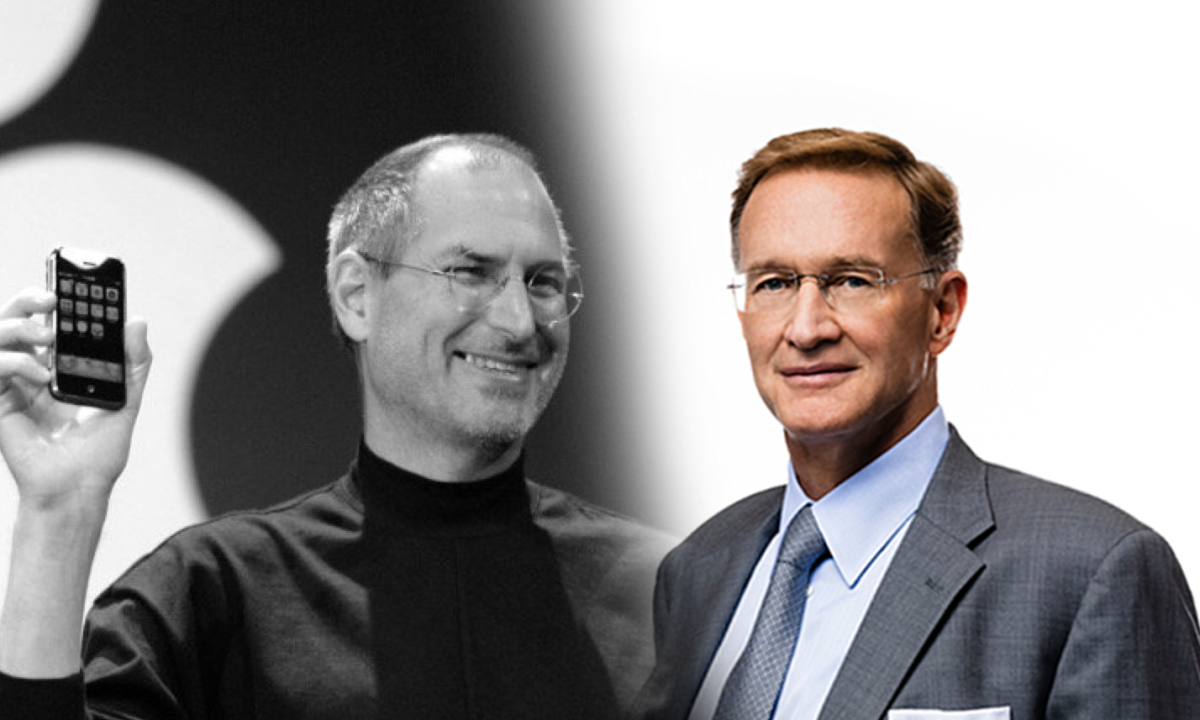
When Steve Jobs needed tempered glass for the iPhone 2G in 2007, he ordered Corning but with a “challenge”.
In the podcast “Leadership Next” by Fortune broadcast on October 23, Wendell Weeks, CEO and Chairman of Corning, revealed how the late Apple CEO Steve Jobs “manipulated” and pushed him to perform a “seemingly impossible” task nearly 20 years ago.
Steve Jobs (left) and Wendell Weeks. Image: Apple/Corning
After taking over as CEO of Corning in 2005, Weeks introduced Jobs to one of his innovations: a laser system that turns phones into projectors. However, Jobs bluntly denied: “It’s the stupidest idea in my life.”
But Jobs saw other potential for Corning in making tempered glass for the new smartphone that Apple was developing. In late 2006, he contacted Weeks again about his plans.
Jobs wanted large quantities of scratch-resistant glass within six months in time to launch the iPhone in June 2007. Weeks said Corning has created a material that meets the criteria, called Gorilla Glass, but lacks the capacity to mass produce it.
He met with the board of directors, then proposed adding a second supplier to Apple due to concerns that his company could not meet the requirements. “Steve and I sat alone. After a moment of silence, he said: No, he will do it all. I replied: I really can’t“, Weeks kể.
“Do you know what your problem is?”, Jobs challenged. “You’re afraid! You know, you’re afraid I’ll launch the greatest product in history. But I can’t do it if you fail and I’ll come to you first.”
The Apple co-founder continued: “The truth is, I would still do it. Even if you fail, I would still do it. Look at what you are doing. You put your reputation on the line, worrying about how bad you will be if you fail, but you are hindering your employees from reaching greatness. Think about what it will be like for the employees, the investors, the people working in the factory. You are putting yourself above them and your company.”
That statement almost changed the perspective of the head of Corning. “At that time, I had to admit he was right. I was scared and should fix that,” Weeks said.
In the end, the “gamble” of producing tempered glass for the iPhone paid off handsomely. According to Fast CompanyCorning converted its Harrodsburg, Kentucky (USA) facility into a factory serving tempered glass specifically for Apple phones, and has played a central role in Apple’s supply chain to date with billions of iPhones sold.
Theo TechCrunchApple used tempered glass right from the first iPhone version, creating a spillover effect that caused many other companies to follow suit, expanding the market for Gorilla Glass beyond the “borders” of the iPhone, enhancing the position of American suppliers in the supply chain.
In August, Apple committed $2.5 billion to produce all iPhone and Apple Watch protective glass at its Harrodsburg facility, marking the first time 100% of the protective glass on Apple products is made in the US. This investment will triple production capacity and increase the workforce by 50%, adding at least 200 hourly jobs and technical positions to the facility. Apple and Corning will also establish an Apple – Corning Innovation Center to develop advanced materials for future products.
Mentioning Weeks’ greatest success at Corning, many people think of his role as a tempered glass manufacturer for iPhones. As for him, the most important thing is to receive lessons from Steve Jobs. “Most of us are afraid of the risk of looking like a fool,” he said. “But Jobs looked at things very directly and without fear.”
He added: “Basically, every creative act is an act of passion, not an act of dry logic.