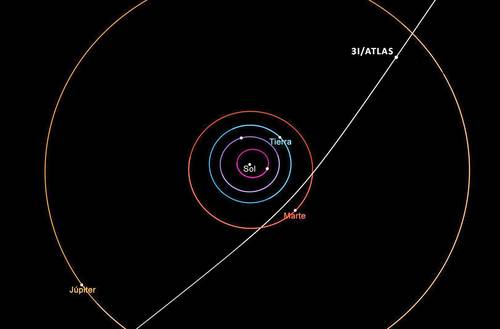
Madrid. The interstellar comet 3I/Atlas has an estimated nucleus between 10 and 30 kilometers in diameter, travels at a speed greater than 68 kilometers per second, about 245 thousand kilometers per hour, during its passage through the interior of the solar system and its orbit is hyperbolic (it does not belong to the solar system).
This is an exceptional scientific event that offers a unique opportunity to understand the origins of the universe and reinforces Spain’s role in international astronomical research.
3I/Atlas (C/2025 N1) is the third confirmed object from outside the solar system. It was discovered on July 1 by the Atlas (Asteroid Terrestrial-impact Last Alert System) network in Chile.
Its study allows us to observe material that formed in another star system.
It is considered an interstellar comet because its hyperbolic orbit demonstrates that the asteroid is not part of the solar system, but rather comes from space, to which it will return after quickly passing through our system. Before 3I/Atlas, only two visitors of this type had been detected: Oumuamua (2017) and 2I/Borisov (2019).
Comet 3I/Atlas does not pose any risk to Earth, since its closest approach will be 270 million kilometers, a safe distance.
It will reach its perihelion (the closest point to the Sun) when it passes 210 million kilometers, close to the orbit of Mars. At that time, it will show its greatest activity and brightness, being visible with professional telescopes.
The monitoring of comet3I/Atlas is the result of a broad international collaboration in which the European Space Agency (ESA), NASA, the International Asteroid Warning Network (IAWN) participate, of which several Spanish observatories are part: Institute of Astrophysics of the Canary Islands (IAC), Montsec Astronomical Park; La Cañada Observatory; Paus Observatory and Light Bridges SL.
The IAWN network, coordinated by the United Nations, has organized a global observation campaign between November 25, 2025 and until January 27, 2026, in which Spain actively participates through the Spanish Space Agency and different national centers.
The IAC plays a leading role in 3I/Atlas research.
From the Teide and Roque de los Muchachos observatories, it uses telescopes such as Atlas-Teide, TST, TTT and the Gran Telescopio Canarias (GTC) to confirm its orbit and characterize the asteroid, analyzing its composition and measuring its activity. In addition, it collaborates with the Complutense University of Madrid in the interpretation of spectral data.
The study of its spectrum and dynamics will allow us to know its age, chemical composition and possible galactic origin. According to preliminary estimates, it could come from a star system formed several billion years before ours.
Studying this type of comet is important because they contain primitive material from other star systems, formed even before the Sun. Their analysis offers clues about how planets and stars are born in different regions of the galaxy, and helps to understand the diversity of the cosmos.
The 3I/Atlas reinforces the capacity of the international scientific community to collaborate on unique phenomena and demonstrates how Spanish science contributes to global knowledge of the universe.
Each new interstellar visitor expands our understanding of the origin, evolution and diversity of the universe.