Tähtitiede|Astronomers from the University of Turku discovered a bright object already in the 1980s. Astronomer Mauri Valtonen is the lead author of the now published study.
The summary is made by artificial intelligence and checked by a human.
Astronomers have photographed two black holes orbiting each other for the first time, reports the Astrophysical Journal.
The observation was made with a radio telescope and it confirms the black hole pair. The target is the bright quasar OJ287. It brightens regularly about every 12 years.
Astronomers from the University of Turku discovered this bright object already in the 1980s. They’ve been studying it ever since. Astronomer Mauri Valtonen was the lead author of the now published study.
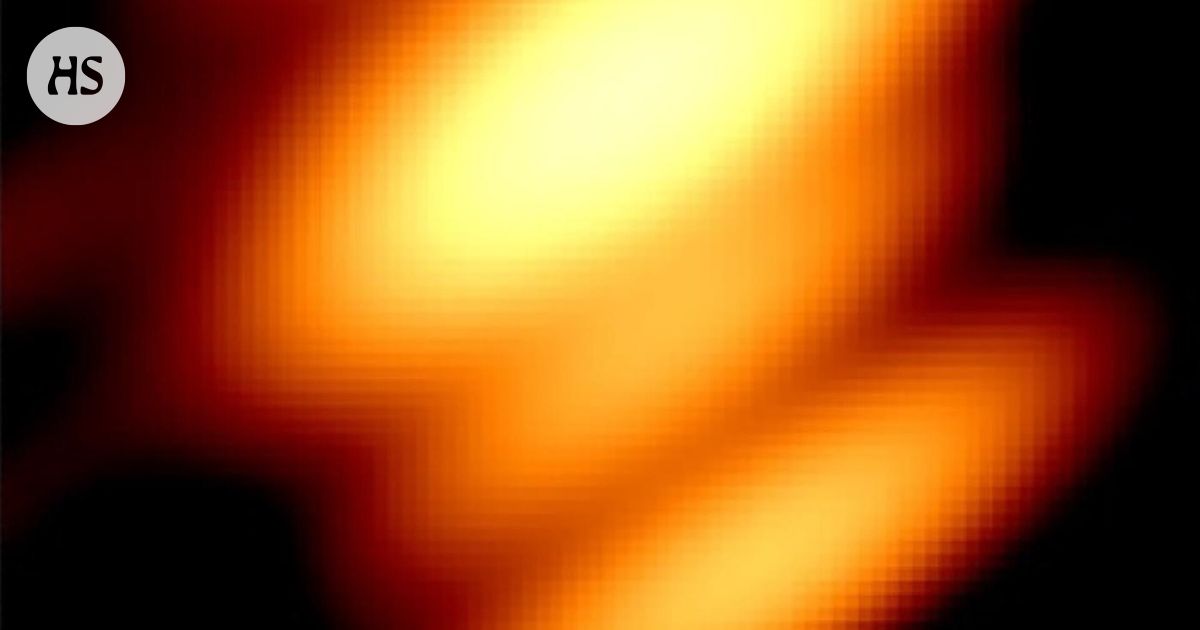
Researchers have succeeded for the first time in taking a radio image showing two black holes orbiting each other.
The observation brought confirmation that black hole pairs exist at all. In the past, astronomers have only managed to image single black holes.
Astronomical science magazine reports on the discovery Astrophysical Journal. The first author of the study is Mauri Valtonen from the University of Turku.
“The object OJ287 is so bright that even astronomy enthusiasts can see it with their own telescopes,” says Valtonen In the announcement of the University of Turku.
Black holes themselves are completely dark. They can be detected by the jets of particles or the hot gas surrounding the hole.
Target is bright because it is a quasar.
Quasars are extremely bright galactic nuclei. The bright light is created when the supermassive black hole at the center of the galaxy eats the cosmic gas and dust surrounding the hole.
“The peculiarity is that the object has two black holes in orbit around each other. As a result, the quasar brightens regularly every 12 years or so. It is also the rotation period of these black holes around each other.”
In the past, astronomers have managed to image the black hole at the center of the Milky Way and the black hole in the nearby galaxy Messier 87, but only one at a time.
Astronomers have been describing OJ287 since the 19th century. That’s when they started taking photos of that area of the sky. Back then, however, it was not yet possible to imagine that black holes existed – not to mention quasars.
Object OJ287 happened to be in the pictures “accidentally” along with other studies.
In 1982, then a Master’s student at the University of Turku Aimo Sillanpää noticed that the object’s brightness changes regularly in 12-year periods.
Sillanpää continued to study OJ287 as a university researcher. He assumed that the variation in brightness would be caused by two black holes orbiting each other.
After the discovery, numerous astronomers around the world have followed the quasar.
One goal was to find out if Sillanpää’s explanation was correct. The researchers therefore found out what the mutual orbits of the black holes would be like.
Orbit the riddle was finally solved four years ago by a doctoral researcher at the University of Turku, from Mumbai, India Lankeswar Dey.
Then the only question left was whether both black holes are detectable at the same time.
This was answered by the US Space Administration’s NASA Tess satellite. It detected light around both black holes. However, they were still visible as a single point.
This was because the images using normal light are not sharp enough. They cannot show black holes separately.
That’s why an image up to a hundred thousand times sharper was needed. You can get one by using a radio telescope.
Astronomers compared the previously made theoretical calculation with the images taken by the radio telescope system. They included With the Radioastron satellite taken radio pictures.
Black holes were found exactly where they were estimated to be.
In this way, the answer to the 40-year-old question of whether black-hole pairs can exist at all was obtained.