Nobel|Porous materials can be used, for example, to collect water from the desert air, recover carbon dioxide or store gases.
The summary is made by artificial intelligence and checked by a human.
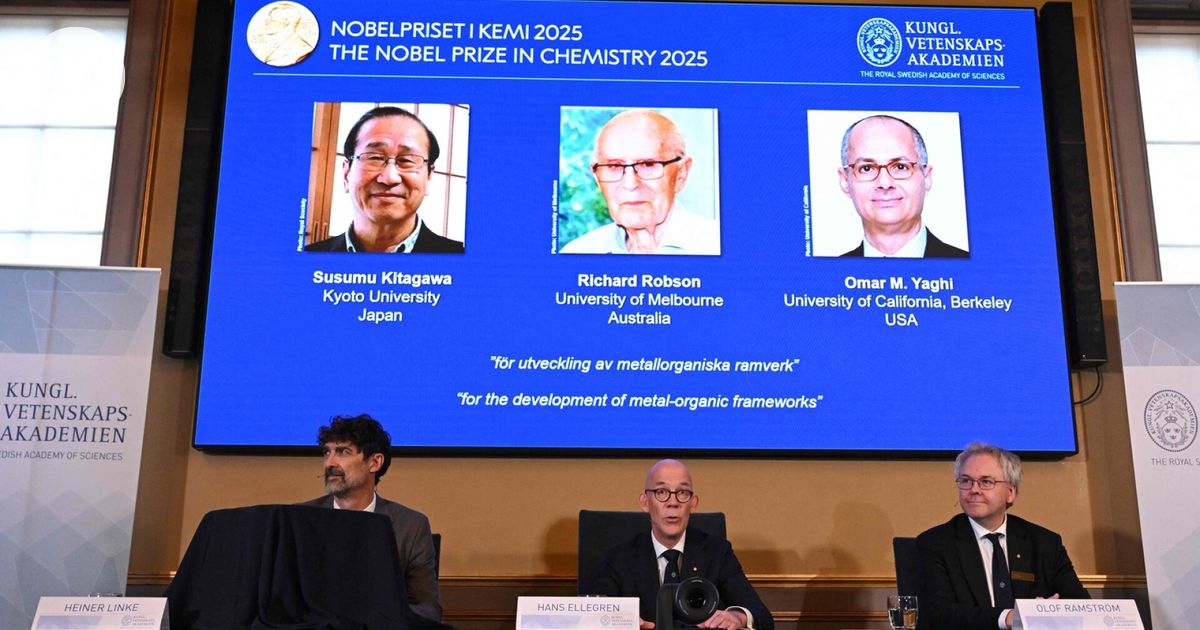
Susumu Kitagawa, Richard Robson and Omar M. Yaghi will receive the Nobel Prize in Chemistry in 2025 for the development of porous molecular structures.
Nobel laureates have created metal-organic frameworks (MOFs) that can collect water from the desert or capture carbon dioxide.
MOF structures can be modified to capture and store certain substances, and they can also catalyze chemical reactions.
CHEMISTRY They will receive the Nobel Prize in 2025 Susumu Kitagawa, Richard Robson and Omar M. Yaghi.
The prize winners have created molecular structures with a lot of space.
For example, gases and other chemicals can flow through them.
Such structures can be used to collect water from the desert air and capture carbon dioxide, tells The Nobel Foundation on its The Nobel Prize website.
Their can also be used to store gases or catalyze chemical reactions, says the professor Mikko Ritala from the University of Helsinki.
According to Ritala, these are very porous substances, where porosity is part of the crystal structure.
When organic molecules are used as structural parts of metal ions, i.e. as linkers, the pores become larger. And since the pores are part of the crystal structure, they are the same size, says Ritala.
“It’s great that the award went to traditional chemistry,” commented Ritala.
Chemistry Nobelists have developed a completely new kind of molecular architecture.
Common to these metal ion structures are long organic hydrocarbon-based molecules. The sites at their ends bind to metal ions.
The metal ions and molecules are arranged together to form crystals that contain large voids.
These porous materials are called metal-organic frameworks (MOFs).
When MOF structures are modified, they can be designed for the recovery and storage of certain substances.
MOF structures can also catalyze chemical reactions or conduct electricity.
“They bring new possibilities for customized materials”, says In the Nobel Foundation’s press release Heiner Linke. He is the chairman of the committee that decides on Nobel Prizes in chemistry.
MOFien history goes back to 1989, when the British-born Richard Robson tested the utilization of the natural properties of atoms in a new way.
He combined positively charged copper ions into a four-branched molecule. Here was a chemical group that attracted copper ions at each end of the branch.
When the branches were combined, they formed a well-ordered crystal containing empty space. It was like a diamond filled with countless cavities.
Robson immediately recognized many possibilities in the molecular structure. However, the structure was unstable. It collapsed easily.
The Nobel Susumu Kitagawa and Omar Yaghi, who also received it now, however, created a solid foundation for the molecule.
In 1992 and 2003, they separately made revolutionary discoveries.
The Japanese Kitagawa showed that gases can flow in and out of structures. He predicted that MOF structures could be made flexible.
Born in Jordan, Yaghi created a very stable MOF structure. He showed that it can be modified. New features could be added to it.
Since the pioneering discoveries, chemists have built tens of thousands of MOF structures.
They can be used, for example, to separate harmful compounds from water or break down drug residues in nature.
The Nobel the prize’s monetary value this year is 11 million Swedish kronor, or slightly more than one million euros, if you calculate the amount at Wednesday’s exchange rate.
Nobel week continues on Thursday. Then it’s time for the Nobel Prize for literature.
The week culminates on Friday with the peace prize. The Nobel Prize for economics will be announced next Monday.