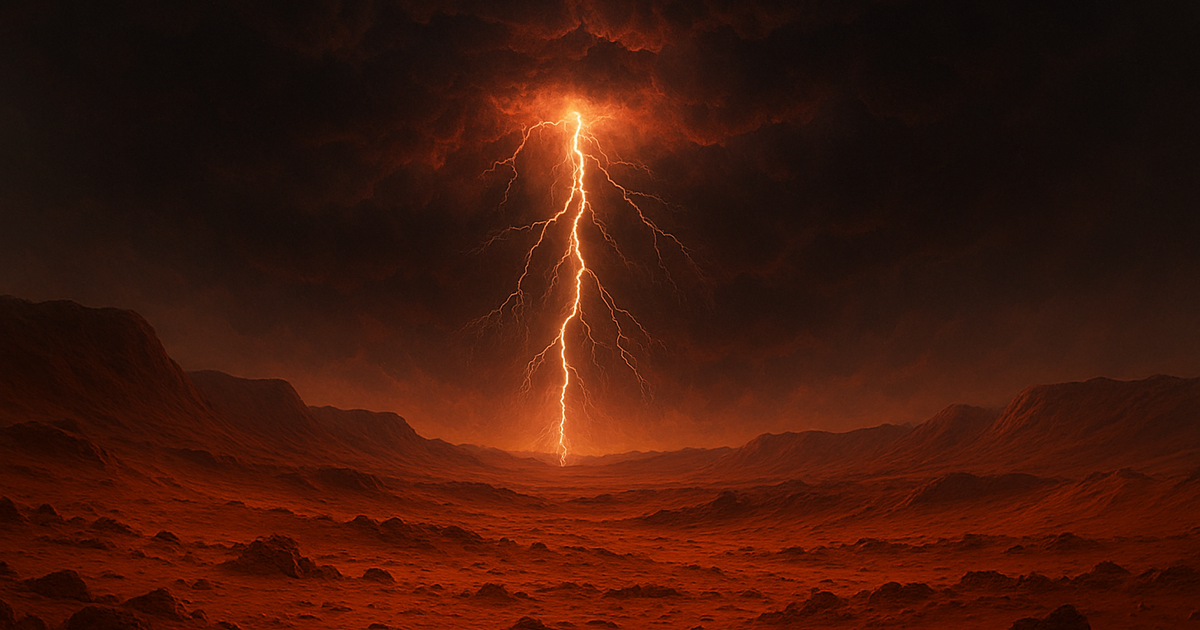
A lone rover that has been making its way through the cold sands of Mars for years has finally answered an age-old question: If lightning cracks on the Red Planet, and no one is there to hear it, does it make a sound? The answer came from the surface of the Jezero crater and it reads – yes, and it sounds like the crackling of a bison, writes Science Alert. Scientists have confirmed that NASA’s Perseverance rover has detected what they believe to be lightning on Mars by eavesdropping on the swirling wind on the planet’s surface. This is the first time that “earthlings” have received concrete evidence of electrical activity in the rare atmosphere of our neighbor, a phenomenon that has been theorized for decades, but has never been directly proven.
The crackling of electrical discharges was picked up by a microphone on the rover, the team led by French experts reported. Researchers have documented 55 cases of what they call “mini-lightnings” during two Martian years, primarily during dust storms and the passage of so-called “dust devils”.
Accidental discovery
It is interesting that the instrument credited with this discovery was not intended for lightning hunting at all. Riverč is about the microphone on the SuperCam instrument, which is designed to listen for the sound of lasers as the rover “shoots” rocks to analyze their chemical composition.
– It is indeed an accidental discovery, to prove that something else is happening nearby, and everything points to the fact that the word about Martian lightning – said Daniel Mitchard from Cardiff University, who was not involved in the study but followed the results.
Scientists are looking for electrical activity and lightning on Mars more. half a century. Baptiste Chide from the Institute for Research in Astrophysics and Planetology in Toulouse, the main author of the study, did not hide his enthusiasm.
– This opens up a completely new field of research for the science of Mars. It’s like finding a missing piece of a puzzle,” Chide said.
Electric arcs, only a few centimeters in size, occurred within two meters of the microphone located on the rover’s high mast. The sparks from the electrical discharges – not unlike static electricity here on Earth – are clearly audible amid the boisterous gusts of wind and dust particles hitting the microphone. NASA’s Perseverance thus added the sound of electrical discharge to its collection of sounds, after the screeching of wheels and the whirring of the propellers of the Ingenuity helicopter.
How are Martian lightnings formed?
Unlike spectacular thunderstorms on Earth that tear the sky with kilometers of lightning, the Martian version is more subtle, but scientifically just as fascinating. The phenomenon is called triboelectricity.
– Imagine a sunny, dry day when you walk on a carpet or rubber surface and bring your hand closer to the door handle. The small spark you could create, and thereby feel, is the same type of electrostatic discharge that we detected with the SuperCam on Perseverance – explained Franck Montmessin, co-author of the study from the French laboratory LATMOS.
The atmosphere of Mars is much more prone to electrical discharge and sparking through contact between dust and sand grains than Earth’s. Since the atmosphere is rare and rich in carbon dioxide, it absorbs a large part of the sound, making some of these crackles barely noticeable.
– It is like a thunderstorm on Earth, but barely visible to the naked eye and with many weak shocks – added Chide, noting that the discharges caused by quick sand devils lasted only a few seconds, while those caused by sand storms lasted up to 30 minutes.
Although the lightning is moreć confirmed on Jupiter and Saturn, and suspected to exist on Venus and Uranus, Mars has long been an enigma. Laboratory experiments back in the 70s of the last century suggested that the swirling of volcanic sand in conditions similar to those on Mars should create a glow visible in the dark, but until now we had no confirmation from the field.
Danger to future missions?
This discovery has major implications for future human and robotic missions to the Red Planet. Understanding electrical activity is key because it informs our understanding of planetary surface chemistry and could affect equipment safety.
However, experts are allaying fears that the first humans on Mars could be struck by lightning.
– Current evidence suggests that it is extremely unlikely that the first person to walk on Mars, while sticking a flag into the surface, could be struck by lightning – Mitchard wrote in č journal Nature.
However, he added that “small and frequent discharges similar to static could be problematic for sensitive equipment”. This sheds new light on a historical mystery. Namely, the Soviet Mars 3 mission landed on the surface during a sandstorm in 1971 and operated for only about 20 seconds before it suddenly and mysteriously stopped transmitting.
– Something changed in those 20 seconds. Could it have been an electrical shock event? I don’t think we can rule it out – said Ralph Lorenz, planetary scientist from Johns Hopkins University.
Debate in the scientific community
Although the evidence is strong, scientists remain cautious. Electric discharges were heard, but not seen. The rover’s cameras did not record a visual flash to accompany the sound, which leaves little room for doubt.
– I think there will continue to be debate among some scientists about whether this was really lightning until new instruments are sent to verify the findings – noted Mitchard.
Most of the recorded events occurred during the windiest days on Mars, which confirms the thesis that wind plays a key role in initiating the electric charge. Scientists are now calling for dedicated instruments to be placed on future missions to precisely quantify these phenomena. While NASA plans to return rock samples to Earth, which is currently on hold while the agency looks for cheaper options, Perseverance continues its lonely patrol. His “ears” are now more open than ever, listening for quiet cracklings that could be the key. for understanding not only the weather on Mars, butć and the very chemistry that could support – or destroy – traces of life.