Evolution|Scientists reanalyze an early human skull found in China. A new study changes the estimate of how long modern humans, Homo sapiens, have lived on Earth.
The summary is made by artificial intelligence and checked by a human.
A million-year-old skull found in China may change our understanding of the early stages of modern humans.
According to a study published in the journal Science, Homo sapiens began to develop earlier than thought.
Researchers estimate that modern humans, Neanderthals and Denisovans had a common ancestor more than a million years ago.
However, not all researchers accept the new claims and await further research.
Million a year-old early human skull may change our understanding of when modern humans A wise man developed and originated.
The development of our species could have started at least half a million years earlier than has been thought. This is what a publication in the authoritative Science magazine claims research.
According to it, modern humans, Neanderthals and Denisovans would have a common ancestor who would have lived more than a million years ago.
It has previously been estimated that wise man Neanderthal and Denisovan diverged from each other approx 500,000 to 700,000 years then.
Now a new study suggests that modern humans lived on Earth side by side with other sister species much earlier than previously thought. It also links Denisovan as the closest relative of our species, even closer than Neanderthal.
Fresh the interpretation of the separation of species is based on an analysis in which a group of leading researchers of human prehistory reexamined two skulls.
They were found in China’s Hubei province in 1989 and 1990.
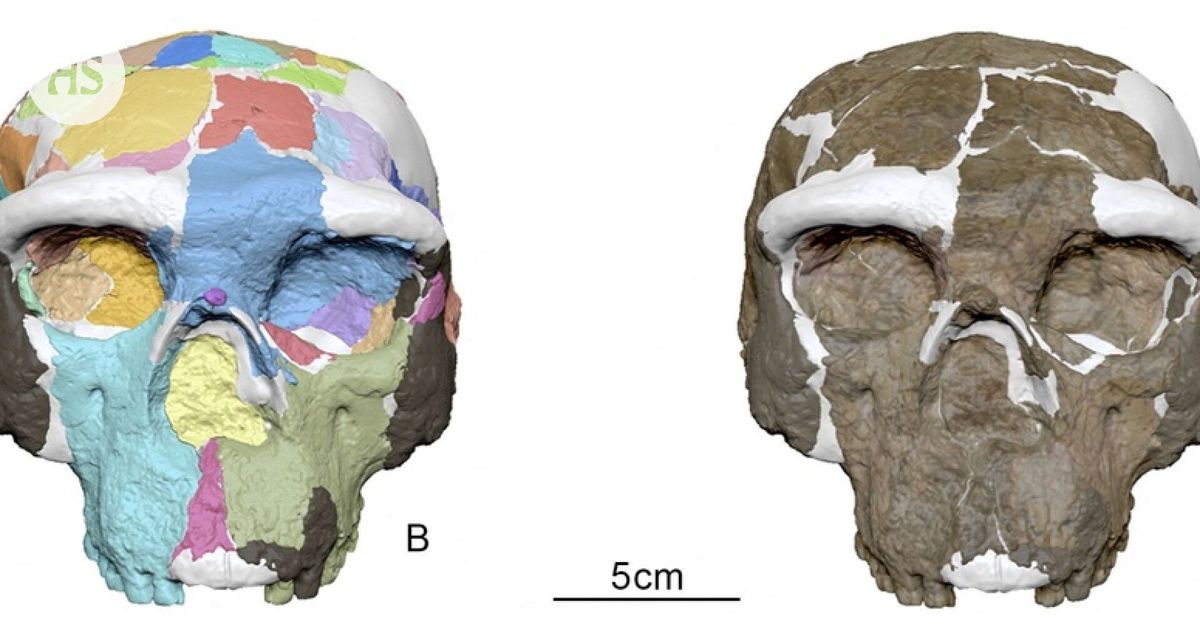
The second skull was named Yunxian 2. Researchers previously assumed that it represented an early The man stood up -human species.
The skull is estimated to be about a million years old. According to the previous understanding, there were no more advanced human species living on Earth at that time.
The man stood up appeared in Africa more than two million years ago. It also spread to Asia but has since become extinct.
New however, skull analysis suggests that Yunxin 2 is not The man stood up.
The skull doesn’t fit Homo erectus profile, says a professor who is one of the authors of the recent study Chris Stringer for New Scientist magazine. Stringer works at the Natural History Museum in London.
Aivokopan the size and shape as well as the teeth strongly suggest that the skull actually belongs A long man -to a person, says The Guardian -newspaper.
A long man belongs to the group of Denisovans.
The illustrator’s view of a man who lived in Hubei, China, about a million years ago.
In modern peoplethe Neanderthals and the Denisovans seem to have had a common predecessor or ancestor already more than a million years ago.
The new study of the Yunxian 2 skull is based on the analysis of both skull shape and genetic information. The skull was estimated to be 940,000–1.1 million years old.
The team compared the skull to 56 other fossils.
“We tested again and again all the models, we used all the methods, and we are now sure of the result,” says the second leader of the study, Professor Xijun Ni from Fudan University For the British Broadcasting Corporation, the BBC.
According to Stringer, there are millions of years old somewhere on Earth Homo sapiens fossils. They just haven’t been found yet.
All Homo sapiens prehistory researchers do not swallow research claims without biting them.
An evolutionary geneticist at the University of Cambridge, Ph.D Aylwyn Scally reminds the BBC that there are always problems with dating fossils.
Researcher of human evolution Frido Welker The University of Copenhagen tells The Guardian that it is worth waiting for new studies. Information can be obtained with the help of paleogenetics.
Paleogenetics dates discoveries with data obtained from the molecules of fossils.