Space|At the edges of galaxies there is a halo, where dark matter may be melting.
The summary is made by artificial intelligence and checked by a human.
NASA’s Fermi space telescope may have detected traces left by dark matter, claims Japanese astronomy professor Tomonori Totani.
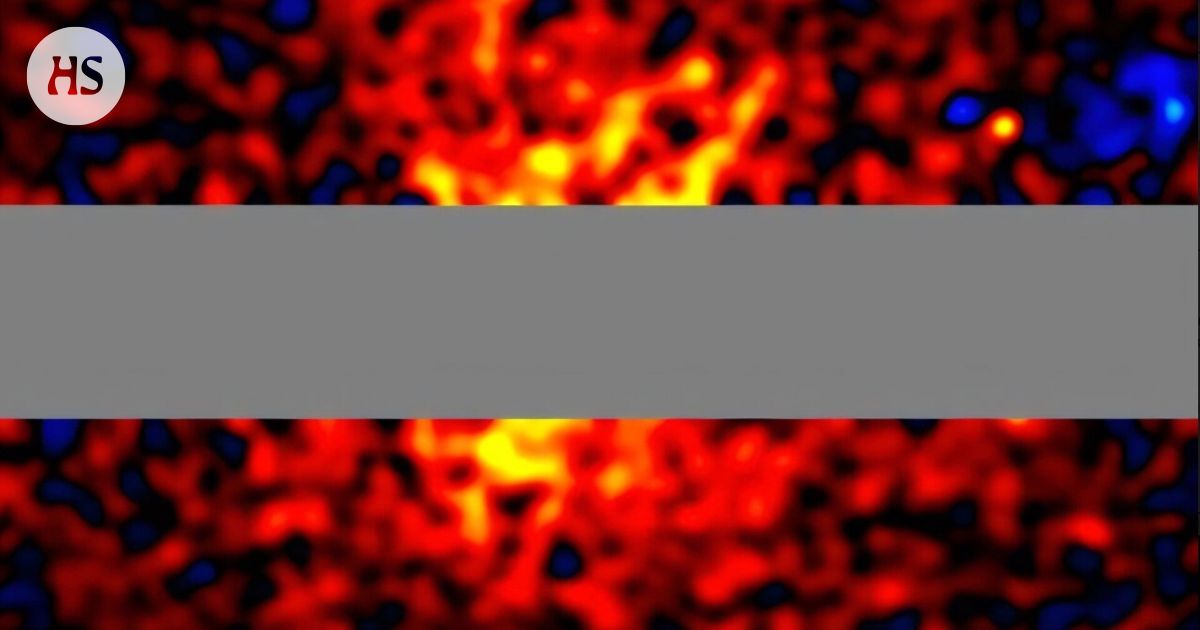
Traces of dark matter were found in strong gamma radiation, which was measured in our Milky Way.
Other researchers need to verify Totan’s group’s measurement. If similar gamma radiation could be found, for example, in dwarf galaxies, it would support Totan’s measurements.
Astronomer Fritz Zwicky discovered in 1933 that in space in the Coma cluster of galaxies galaxies move fast. Faster than their mass allowed.
A Swiss scientist speculated that some kind of dark matter holds galaxies together.
Other signs of dark matter in space have been found over the decades, but dark matter has not been directly proven.
The problem is that dark matter is made up of particles that don’t emit, reflect or absorb ordinary light. They apparently feel gravity.
Now nearly a century later, the US space agency NASA space telescope Fermin observations may lead to dark matter.
Fermi observed space electromagnetic radiation in a specific region, the gamma ray region.
Gamma radiation is produced when the nuclei of atoms decay radioactively. They interact with other particles.
Professor Tomonori Totani The Department of Astronomy at the University of Tokyo has interpreted and measured certain types of gamma rays, he says university press release.
Totani focused on studying the regions where the dark matter of space would be concentrated.
According to Totan, Fermi would have observed the kind of gamma rays predicted by the destruction of dark matter particles.
Gamma rays may therefore provide indirect evidence of dark matter.
One assumption is that dark matter consists of weakly interacting WIMP particles. WIMP is an abbreviation of the English words weakly interacting massive particle.
It is predicted that when two such collide, they will destroy each other. At the same time, they release other particles, for example light particles or photons, in this case gamma photons.
“We observed gamma rays, whose photon energy was very high, about 20 billion electron volts. The photons extended in a halo-like structure towards the center of the Milky Way.”
Related Astronomer Vera Rubinin findings in the 1970s. He noticed that the outer edges of ordinary spiral galaxies rotate at the same rate as the centers of the galaxies.
It only occurs if the large mass of the galaxy is spread over a wide area, not just in the center.
Since it has been calculated that large galaxies would have massive dark matter halos.
A galactic halo is the vast outer shell of a galaxy. The halo extends beyond the arms of the visible disk of the galaxy.
The halo consists not only of old stars, but also of dark matter, it has been calculated. The mass of the halo would essentially affect the mass of the galaxy and explain the galaxy’s steady rotation.
Gamma radiation In Totani’s measurements, the shape corresponds exactly to the shape assumed for a dark matter halo, Totani claims.
Totani sees this data as strong evidence that gamma rays provide data on dark matter.
One argument is that gamma measurements cannot be explained by other astronomical phenomena.
Now Totan’s measurement must be verified by other researchers. Quite a few times in the history of dark matter, it has been claimed that dark matter or its traces have been observed.
The researchers want more evidence that the radiation found is actually the result of dark matter being destroyed. It can also be caused by some other phenomenon in astronomy.
Evidence is needed from new places. If gamma rays of the same energy level were found in dwarf galaxies inside the Milky Way’s halo, it would support Totan’s findings.
Totan’s results were reported at the beginning of the week tiedelehti Journal of Cosmology and Astroparticle Physics.