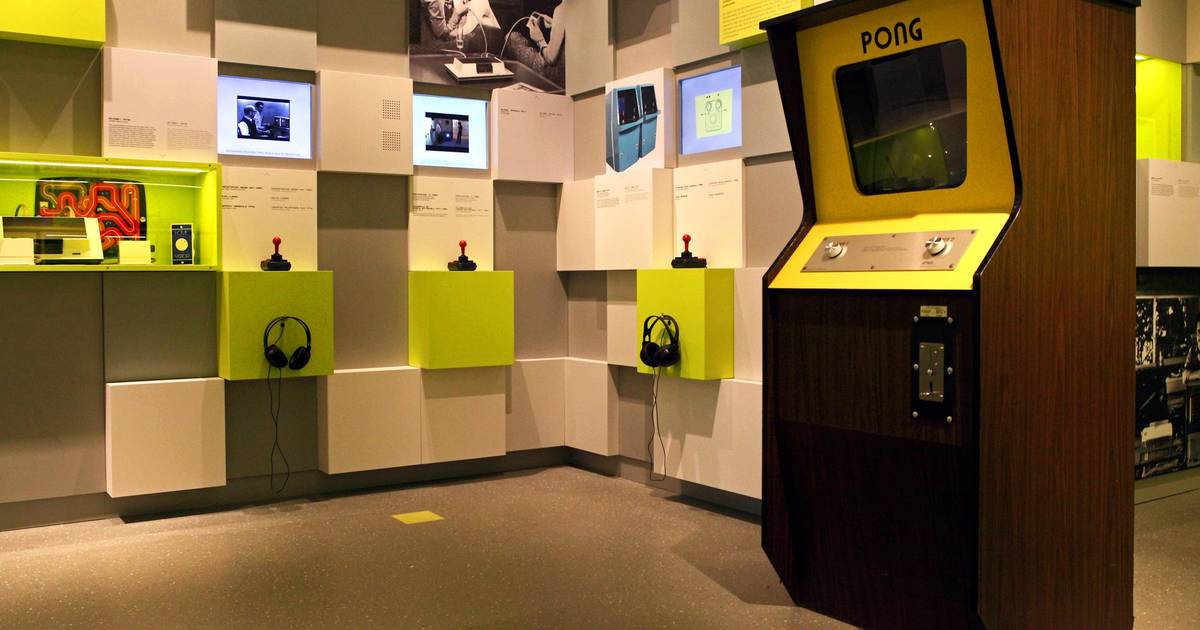
On November 29, 1972, Atari introduced Pong, its first product and the first commercially successful video game, and that little machine in a bar in California practically laid the groundwork for modern video games. Behind everything are Nolan Bushnell and Ted Dabney, the founders of Atari, who are the biggest had one disappointment: their earlier game Computer Space was too complicated and didn’t sell well. Bushnell therefore gave new engineer Allan Alcorn “exercise” – a simple game of table tennis on the screen, inspired by electronic ping pong on the Magnavox Odyssey console. The game was supposed to be just a training task, but it turned out so well that they decided to turn it into a real product, even at the risk of suing Magnavox over the patent.
Watch a commercial for the Pong arcade game from 1976:
The first Pong didn’t end up in a video game parlor, but at Andy Capp’s Tavern, a local bar in Sunnyvale. Atari set up a prototype in a wooden box there in mid-1972, to see if people would actually insert coins into the screen with white lines. After a little more than a week, the owner of the bar called Alcorn and complained that the game was broken. When he opened the machine, Alcorn realized that the machine had “broken down” because it was literally jammed with coins – the quarter container was full to the brim.
There were only a couple of white lines and squares on the screenć who refused, but that was enough. Pong simulated table tennis: everyone playsč it has its own “plate” that it moves up and down, and the goal is to deflect the “ball” and not let it pass behind you. Wired later described it as a game “any drunk bar guest could play”, which was actually a compliment – no instructions needed, just pick up the joystick and go.
When Atari went into production, it turned out that Pong was earning four times more than other machines in the same locations. It is estimated that one machine brought in 35 to 40 dollars a day, which means 140 to 160 inserted coins per day, and that only in one location. Orders began to arrive from all over America, and by the end of 1974, Atari had sold more than 8 thousand Pong machines and began exporting the machines to other countries as well.
Of course, čim the game became a hit, and copies began to appear. Numerous companies have simply drawn their two lines and squaresć and released their own “ping pong” arcades on the market, so a real wave of Pong clones arose. In the meantime, Magnavox sued Atari for patent infringement on the idea of a television game, and the case was settled with a settlement: Atari paid the license and continued to make its games, while Magnavox received money and confirmation that the Odyssey was the first, but not the most popular console.
The next big step was moving from a cafe to a living room. For Božić In 1975, Atari together with the Sears chain released Home Pong, a small console that connected to a TV and offered the same game that you used to play in the supermarket. It was sold for around one hundred dollars and was such a hit that it inspired a whole wave of home consoles, often with a dozen variations of the same idea: tennis, football, hockey, all in three lines and one dot.
Pong looks banal today, but its banality was the perfect entry point for millions of people who had never touched a joystick before. There was no story, no characters, no spectacle, only reflexes and a competition of who could “punch” whom with one more dash. Historians of video games therefore often say that Pong, together with Magnavox Odyssey, laid the foundations of the entire industry – it showed that not only movies and news had to be shown on the screen, but that the screen could also be a game.
The extent to which the game left its mark can be seen from the fact that today it is part of the permanent collection of the Smithsonian Museum in Washington and regularly appears on lists of “the most important games of all time”. Along with Pac-Man, Space Invaders and Tetris, Pong is one of those titles that even someone who has never held a gamepad will recognize.
If we compare it to today’s games, Pong looks like linesž on the margins of the herbarium. But without that line, we might never have gotten Super Mario, or PlayStation, or Fortnite on a mobile phone in the tram. The story reminded Pong that sometimes you don’t need photorealistic graphics to create something new – two rectangles, one square are enough. and a good idea at the right time.