The educational model of the World Innovation Organization (WIPO) was first implemented in Vietnamese high schools.
Trang, a 7th grade student, talked about the first time she attended a class where “everything starts with a real invention”. I said I like the feeling of assembling a greenhouse model myself, trying out ways to increase light for the plants and then debating with friends to find the optimal design. “I feel like I understand the lesson faster because I get to do it, not just listen to the lecture,” Trang said.
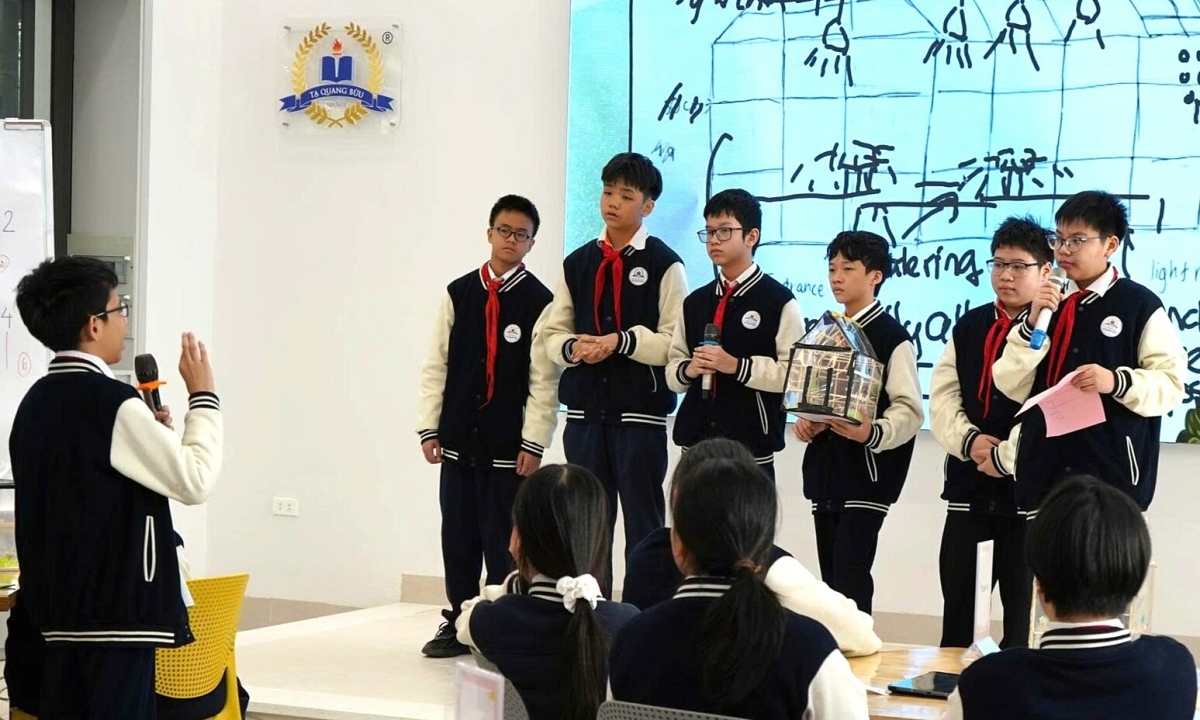
The lesson Trang mentioned took place at Ta Quang Buu Secondary School, Hanoi, on the morning of November 28, and was also the first lesson in Vietnam designed according to WIPO’s innovative education model. Instead of starting with theory, students approach a real Vietnamese invention of a smart greenhouse system, analyze its novelty, evaluate innovation points, and propose improvements suitable to domestic climatic conditions.
The class was lively. Groups discussed ways to optimize lighting, save water, increase productivity and test directly on the model. The results show that this approach clearly stimulates students’ creativity, while helping them understand the lesson more deeply and become more interested.
The first lesson in Vietnam was designed according to WIPO’s innovative education model, at Ta Quang Buu Secondary School, Hanoi. Image: Pham Nga
Attending and watching the teaching session, Mr. Nguyen Ngoc Son, Principal of Phuc Loi Secondary School, felt the change reflected in his learning attitude. Students actively ask questions, analyze, discuss in groups and make suggestions. “The difference is very clear,” he commented.
The model implemented by Vietnam follows WIPO’s structure: instead of teaching knowledge, the program directs students to innovative thinking associated with intellectual property – an important factor in the knowledge economy.
Each topic is designed as a complete cycle: identifying practical problems, discovering patented solutions, analyzing novelty, designing – criticizing – perfecting ideas, manufacturing and displaying products, and then developing business ideas.
The set of learning materials and equipment for the model was developed by Smartschool, the first unit in Vietnam. The structure includes five parts: books, documents, and textbooks according to international standards; software, electronic learning materials; STEM teaching equipment set; teacher training programs and movements honoring creative products. Thanks to this ecosystem, the model does not just stop at a sample lesson but has the ability to expand on a nationwide scale.
Ms. Altaye Tedla, Head of the online training department of WIPO Academy, commented that the model smoothly integrates innovation, intellectual property and entrepreneurship, not only equipping students with technical knowledge but also business thinking and awareness of intellectual property protection from an early age.
The program focuses on practical activities, helping students apply knowledge to solve real-life problems. “This is a strong transition from just learning STEM theory to mastering the innovation process, towards creating intellectual property – the foundation of startup and business activities,” said Ms. Tedla.
Ms. Altaye Tedla, Head of online training department of WIPO Academy. Image: Giang Pham
Bringing the WIPO model into schools not only brings new teaching methods but also builds a culture of creativity and respect for intellectual property, improves the competitiveness of human resources, and brings Vietnam closer to the goal of developing a knowledge economy.
To form a culture of innovation, Mr. Pushpendra Rai, WIPO’s international intellectual property consultant, said that the key factor lies in a dynamic education system with a positive mindset in accepting new initiatives. According to him, Vietnam can become a bright spot in innovative education in ASEAN thanks to a methodical approach following this model.
The WIPO standard class is an activity in a series of events promoting intellectual property education and innovation for young generations in Vietnam and the ASEAN region, organized by the Intellectual Property Office – Ministry of Science and Technology in coordination with WIPO Academy and Smartschool. The program aims to empower teachers, lesson developers and educational policy makers.
Vietnam is currently ranked 44/139 economies, according to the GII 2025 Index Report published by WIPO last week, in which three component indexes including High-tech Imports, High-tech Exports and Creative Goods Exports are the top in the world.
Vietnam is one of nine middle-income countries with the fastest rate of improvement in rankings, with innovation results exceeding development levels for 15 consecutive years. In the period 2014-2024, Vietnam is in the group of three countries with the fastest labor productivity growth, along with China and Ethiopia.