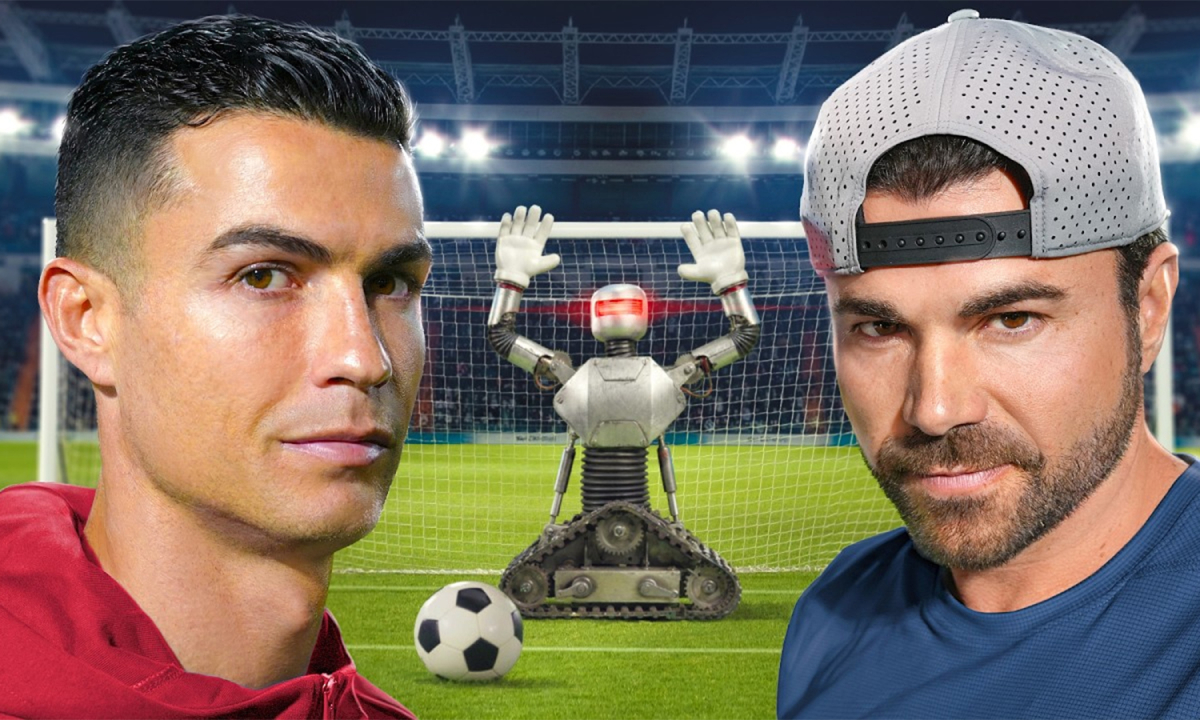
Superstar Cristiano Ronaldo was invited to participate in the penalty kick challenge in front of a goal protected by a robot goalkeeper created by former NASA engineer Mark Rober.
Mark Rober is an American engineer and YouTuber famous for his videos about innovative science and large-scale engineering projects. Before becoming a full-time content creator, he worked for 7 years at NASA’s Jet Propulsion Laboratory (JPL), contributing to the development of the Curiosity rover.
In the latest project, Mark Rober and his colleagues want to research and create a robot goalkeeper to challenge football legend Cristiano Ronaldo. The video about this process quickly reached more than 13 million views and nearly 10,000 comments after less than a day of posting.
Rober’s initial goal was to create a machine that could block shots at speeds of up to 80 mph (about 128 km/h), which only allowed the robot just 250 milliseconds to react.
Ronaldo and former NASA engineer Mark Rober (right). Image: Mark Robert
Rober’s team started by developing a high-speed monitoring and response system. The heart of the technology is 12 (later increased to 22) high-speed infrared cameras, working in tandem with the reflective stickers on the ball. This optical system allows the computer to accurately predict the 3D trajectory of the ball at a speed of 500 times per second, and this is done just 6 milliseconds after the ball leaves the kicker’s foot.
The goalie mount is mounted on a horizontal propulsion system, powered by a pair of 50 horsepower motors. These motors can accelerate the robot to 66 km/h in a split second, bringing the goalkeeper to the exact spot where the ball will go. To ensure the stability of the response speed, the team uses a control system via the 5G network with signal processing latency always below 10 milliseconds.
During testing, despite successfully blocking many strong shots, the robot still revealed weaknesses in durability. The impact force was too great after a number of shots, causing structural damage to the robot. To fix it, Rober applied a technique from the aerospace industry when using a carbon fiber structure sandwiched with a thick layer of foam in the middle, creating a light-weight shield but still ensuring high durability, while also reinforcing the attachment points to resist shear forces when moving at high speed.
Subsequent tests showed that the robot goalkeeper was almost invincible against the strongest players’ shots the team could find. This proves the combination of speed, sensor precision and physical durability ready for the biggest challenge.
Ronaldo faces a goalkeeper robot created by Rober’s team. Video: Mark Rober/YouTube
The final challenge took place in Portugal, where Ronaldo agreed to face a completed robot goalkeeper. In the first shots, the robot goalkeeper completed the task excellently. Ronaldo’s powerful, highly difficult shots were all blocked, causing the Portuguese superstar to exclaim in surprise.
When he realized he couldn’t overcome the robot with pure strength, CR7 began to change his strategy by trying to find loopholes in the system instead of thinking like a regular real goalkeeper. Finally, he succeeded with a shot close to the edge of the goal, the ball bounced off the robot goalkeeper and into the net.
According to Rober, the reason for failure partly comes from unintended mechanical “defects”. During transport to Portugal, one of the robot’s transport rails was slightly bent, causing it to occasionally become unstable when it needed to move all the way to the right angle. This physical flaw was then thoroughly exploited by Ronaldo.
Despite being defeated, Mark Rober’s robot still received praise from Ronaldo, affirming that this was one of the biggest opponents he had ever faced.