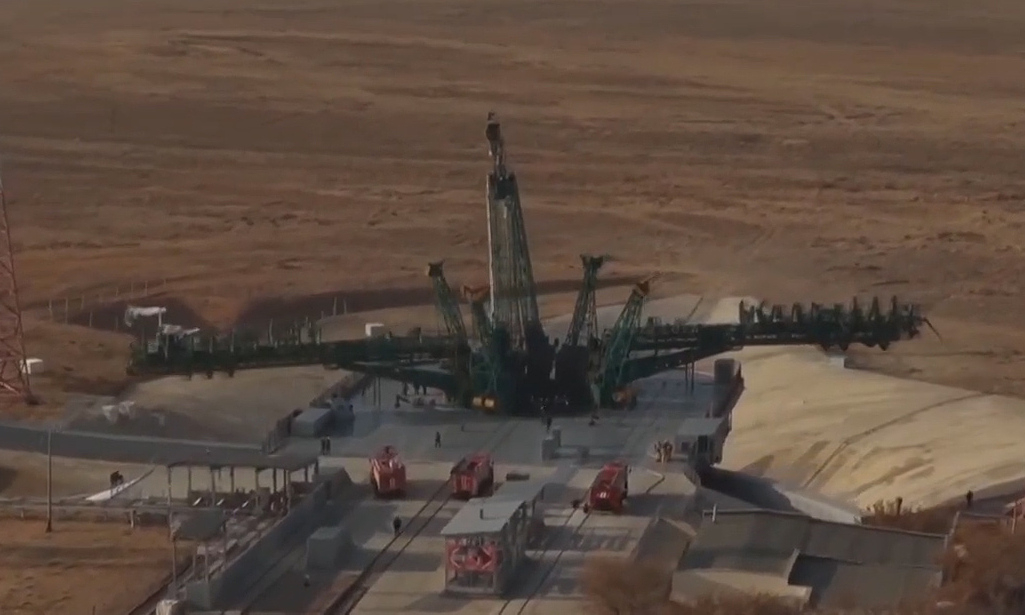
Russian space agency Roscosmos confirmed that the launch of a human carrier to the International Space Station (ISS) on November 27 was successful but caused damage to the launch pad.
On November 27, the Soyuz 2.1a rocket carrying Russia’s Soyuz MS-28 spacecraft took off from Area 31/6 of the Baikonur Cosmodrome (Kazakhstan), carrying three astronauts Sergey Kud-Sverchkov, Sergei Mikaev (Roscosmos) and Chris Williams (NASA) to the ISS. The maintenance chamber, or service platform – located in the fire escape trench of Area 31/6 and essential during launch preparations – is believed to have collapsed after the launch. This is Russia’s only operating launch complex for flights carrying astronauts to the space station.
“The launch area is inspected as usual after each rocket launch. Some parts of the launch pad were found to be damaged,” Roscosmos said. “The condition of the launch complex is being evaluated. All necessary parts for repair are available and we will repair the damage in the near future.”
The Soyuz MS-28 spacecraft carrying three astronauts launched into space from the Baikonur Cosmodrome. Video: Roscosmos
Area 31/6 first operated in January 1961, and has now supported more than 400 launches. This place has been used exclusively for Russian flights carrying people and goods to the ISS since 2020, after Area 1 stopped operating due to lack of funding to upgrade. Area 1, also known as “Gagarin’s Beginning”, was the site of the world’s first human spaceflight with astronaut Yuri Gagarin in 1961.
Theo Russian Space Webit is likely that some hardware will be borrowed from the abandoned Area 1 at Baikonur or from similar facilities at other launch sites. According to preliminary estimates, repairs to the service platform could take up to two years.
It is unclear whether Russia can use another launch pad for flights to the space station. Roscosmos planned to launch the Progress supply ship to the ISS in December. Meanwhile, the Soyuz MS-28 crew is all safe on the station and expected to stay and work for 8 months.