Decree 268 of the Government grants autonomy to higher education institutions in exploiting intellectual property, encouraging the implementation of the university-based business model (spin-off).
The information was given by Mr. Chu Thuc Dat, Deputy Director of Innovation, Ministry of Science and Technology, at the discussion on the University Innovation and Startup Center Model organized by the University of Science and Technology Hanoi (USTH) on the morning of November 28. The discussion was held in the context that Vietnamese universities are facing many challenges in innovation, the gap between research and application is still far, the business cooperation mechanism is not flexible enough, technology testing infrastructure is limited, while students need more practical experiences.
Accordingly, Mr. Dat highly appreciated USTH for building and promoting the model of innovation and startup centers in universities – an important component of the national innovation ecosystem.
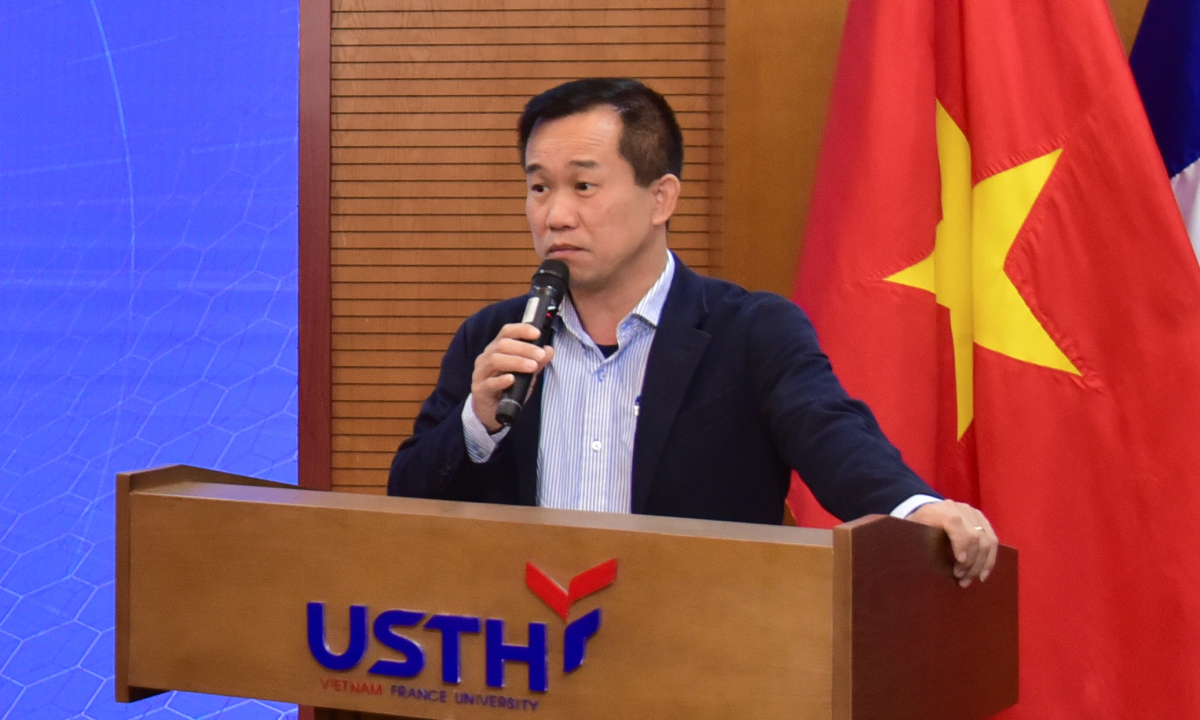
Deputy Director of Innovation Department Chu Thuc Dat spoke at the event. Image: Hoang Hieu
He said that Decree 268, just issued by the Government on October 14, guiding the implementation of a number of articles of the Law on Science, Technology and Innovation, has concretized a series of new mechanisms. These include instructions for perfecting the organizational model of innovation centers; Expand socialization mechanisms and mobilize resources for innovation. In particular, the Decree stipulates granting autonomy to science and technology organizations and higher education institutions in exploiting intellectual property; Encourage the formation of innovation center networks at universities associated with businesses and localities.
According to Mr. Dat, the new policies also aim to promote the commercialization of intellectual property in universities. Specifically, the Law on Science, Technology and Innovation 2025 has given schools the right to value, transfer and exploit intellectual property. The innovation center acts as a focal point to support technology improvement and testing; connecting businesses to buy – receive transfers as well as organize a school-level technology exchange…
Prof. Dr. Dinh Thi Mai Thanh, co-principal of USTH, said that in the new context, the school decided to establish the Center for Innovation and Entrepreneurship. “This is the focal point connecting the resources of lecturers, students and businesses,” Ms. Thanh said.
In addition, the school can implement open innovation programs, establish research groups and businesses to co-develop technology solutions, and expand cooperation with specialized research institutes, the National Innovation Center, universities and businesses across the country.
Prof. Dr. Dinh Thi Mai Thanh, co-principal of USTH, talked about the establishment of the Center for Innovation and Entrepreneurship. Image: Hoang Hieu
According to Mr. Dat, for this model to operate effectively, universities need to develop a central model in the direction of multi-function and autonomy, especially financial autonomy and human resources autonomy; Build a mechanism to mobilize capital and share resources with other schools and businesses to optimize investment and increase innovation efficiency; promote commercialization of intellectual property in schools; develop ecosystems for innovation such as incubators, support funds, and angel investment funds; and connect the national innovation network.
In particular, Mr. Dat mentioned the spin-off business model, emphasizing that this is an orientation strongly encouraged in Decree 268.
At the conference, Associate Professor Dr. Phan Tien Dung, Head of Technology Application and Deployment Department, Vietnam Academy of Science and Technology VAST, said that building an innovation and entrepreneurship center in the school, in addition to commercializing research, also helps serve as a bridge to promote the research university model according to international standards.
VAST representatives pledged to accompany the center in connecting businesses in the Academy’s ecosystem, supporting testing, technology evaluation and application deployment, while increasing co-sponsorship, ordering research and promoting the formation of businesses originating from scientific knowledge.