The Shenzhou 20 spacecraft, whose windows were cracked by space debris, will leave the Thien Cung station and land on Earth without a crew.
Ji Qiming, spokesman for the China Manned Space Agency (CMSA), said on December 1 that on the way back, Shenzhou 20 will “collect the most authentic test data”.
Jia Shijin, the designer of the Shenzhou, revealed more about the small crack that changed China’s crewed spaceflight schedule. “Our preliminary assessment is that the piece of space junk is smaller than one millimeter but moving extremely fast, creating a crack more than one centimeter long. But we cannot directly check in orbit, so we will study it thoroughly when Shenzhou 20 returns,” Jia told CCTV.
Jia also said that the decision to postpone the previous return trip of the Shenzhou 20 crew was made based on the worst scenario, when the window crack spread, leading to a decrease in cabin pressure and high-speed airflow. This situation could quickly overload life support systems, threatening the astronaut’s life.
Previously, the Shenzhou 20 ship was scheduled to bring its crew back on November 5, ending a 6-month mission on Thien Cung station. However, astronauts discovered cracks in the capsule window, delaying the return trip. This is the first time this situation has happened in China’s manned spaceflight program.
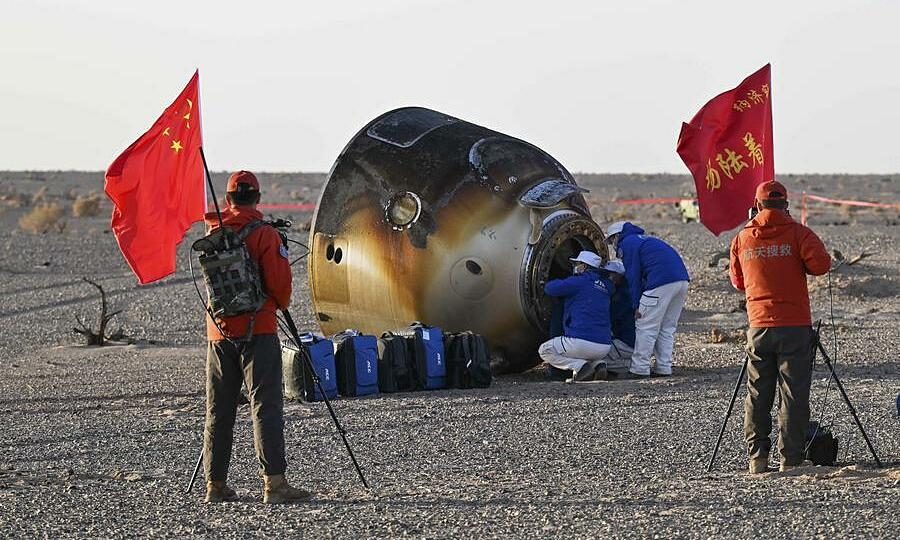
The passenger compartment of the Shenzhou 21 ship carrying the Shenzhou 20 crew landed at the Dongfeng landing site in the Inner Mongolia Autonomous Region on November 14. Image: Xinhua
On November 14, the Shenzhou 20 crew landed safely on Earth using the Shenzhou 21 spacecraft. However, this forced the Shenzhou 21 crew to stay at Thien Cung station with no means of transportation if a problem occurred. China raced to eliminate that risk, emergency launching the Shenzhou 22 as a “lifeboat” on Thien Cung station on November 25. The entire process took place just 20 days after the original return trip of the Shenzhou 21 crew was postponed.
This is not the first time in the world that astronauts have encountered problems with spacecraft. Last June, two NASA astronauts Butch Wilmore and Suni Williams flew to the International Space Station (ISS) on the first human mission of the Starliner manufactured by Boeing. Starliner leaked helium and had problems with its thrusters, causing NASA to decide to fly the ship back without carrying a crew.
Wilmore and Williams then continued to live on the ISS until March, turning the expected 10-day trip into nearly 9 months. Finally, they returned to Earth on SpaceX’s Crew Dragon spacecraft with NASA astronaut Nick Hague and Russian astronaut Alexandr Gorbunov.