Children’s science questions|And how was it possible to find out what dinosaurs looked like millions of years ago?
The summary is made by artificial intelligence and checked by a human.
Tiina Paunio, professor of psychiatry at the University of Helsinki, says that sleepwalking is common in children and often hereditary.
Sleepwalking occurs during deep sleep if the areas of the brain that control movement are partially activated. The mind is not fully awake then.
The problem usually goes away with age. Regular bedtimes and calm evening routines reduce the likelihood of sleepwalking.
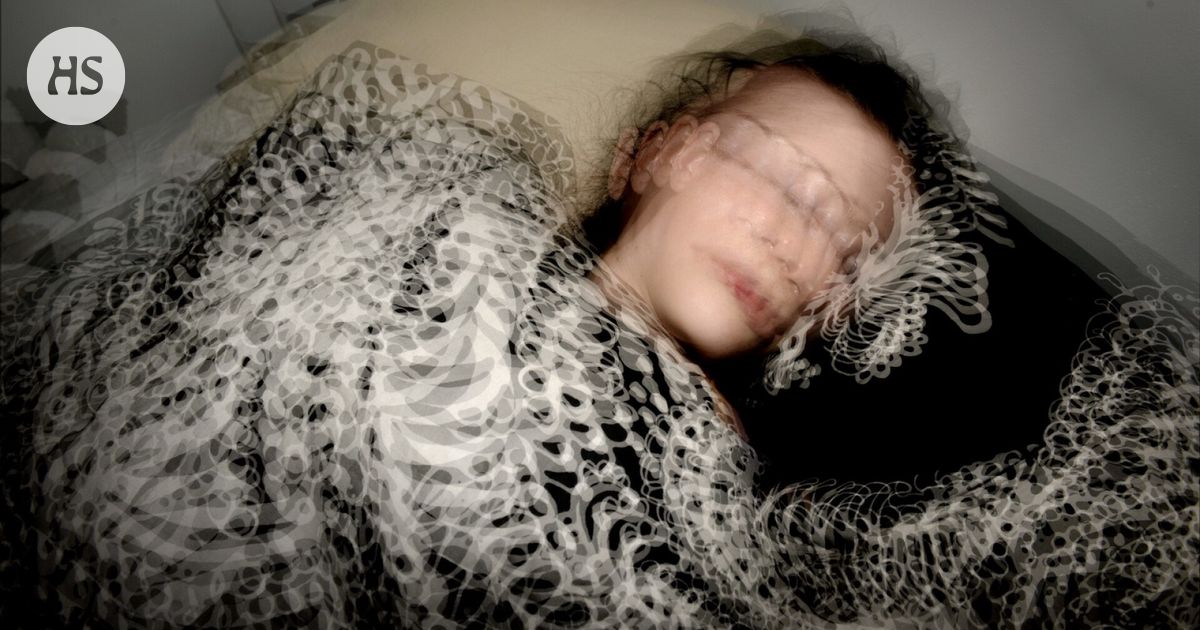
Why am I walking in my sleep?
Arvo Peura, 11
With children sleepwalking is common. Hereditary factors have an effect: if someone else in the family has also sleepwalked, the probability of sleepwalking is higher. Lack of sleep, going to bed too late, stress or fever can also increase the risk of sleepwalking.
Sleepwalking most typically occurs at the beginning of the night during deep sleep. When a person is in a deep sleep, some parts of the brain may partially wake up. If the brain areas that control movement and action are activated, they can initiate movement and action, even when the mind is not fully awake. Therefore, a person can get out of bed and walk without properly understanding what is happening or remembering the event in the morning.
The condition is usually harmless and goes away with age. Over the years, sleepwalking has not been beneficial to humanity, but it has not caused significant harm either.
The probability of sleepwalking decreases when you go to bed and wake up at the same time every day and keep your evening routine calm. You should avoid heavy eating, caffeine, such as cola drinks, and exciting games, programs or other activities late at night. If you are in pain or stressed, it is good to rest more than usual.
Just to be sure, you should also take care of the safety of the environment if you have a tendency to sleepwalk. It is good to keep floors and corridors empty, doors and windows locked and move sharp objects away. The family can be told that the sleepwalker does not need to be shaken awake, but can be calmly guided back to bed.
If sleepwalking occurs very often or if it lasts for a long time, you should talk to your doctor about it. If sleepwalking also causes injuries, great concern, or if it is accompanied by pauses in breathing, it is also a good idea to consult a doctor.
Tiina Paunio
professor of psychiatry and chief physician
University of Helsinki and HUS
The image of the Sun by the US space agency NASA is compiled from 25 images taken within one year.
How much water would be needed to extinguish our central star, the Sun?
Elias Manner, 7
Sunshine wouldn’t be able to extinguish it, even if you poured, for example, all the water on earth on it. Even a huge amount of water would not be enough, because the Sun does not burn in the same way as, for example, a campfire.
When water is poured onto a campfire, it cools the fire and thus robs it of the heat it needs to burn. The sun, on the other hand, is the super-hot star closest to us, and instead of burning, a so-called fusion reaction takes place in its interior, where small nuclear particles are compressed together and release enormous amounts of heat. The temperature in the core of the sun is about 15 million degrees Celsius.
If you tried to throw water on the Sun, the water would immediately turn into steam due to the Sun’s heat, and would not cool the star significantly. In reality, the Sun could even be heated by water!
Namely, water consists of hydrogen and oxygen, and the Sun uses hydrogen particles as its fuel in fusion reactions. Adding water would thus only give it more fuel.
Joonas Nättila
assistant professor of astrophysics
University of Helsinki
Another year, an imaginary kingdom of dinosaurs was built in the Tampere building. The exhibition presented, among other things, Spinosaurus.
How has it been possible to find out what dinosaurs looked like millions of years ago?
Kerttu Holopainen, 5
Our information about the appearance of dinosaurs is mainly based on fossil, i.e. petrified, bone discoveries. It is rare to find complete skeletons, but a large part of the bones is known from many species. Based on the bones, it has been possible to accurately deduce the appearance of dinosaur species.
For example, the shape of the head can be determined based on the preserved parts of the skull. The shape of the bones, on the other hand, refers to the size of the muscles and tendons. The shape of the missing body parts can be inferred to some extent from closely related species.
In some conditions, such as low-oxygen waterbeds or very dry deserts, other evidence, such as fossilized remains of skin and feathers, has sometimes been rarely preserved. Based on them, it has been found that large dinosaurs typically had small scales or bony plates on their skin, while smaller carnivorous dinosaurs often had feathers.
Sometimes fossils of skin and feathers have even preserved remains of color-producing cells, which have been used to infer the color of some dinosaurs.
Based on them, it has been found that small feathered dinosaurs could have, for example, light and dark stripes on their feathers like birds. Large dinosaurs were apparently often more uniformly gray or brown, as large animals usually are today.
It has therefore been possible to deduce a lot about the appearance of dinosaurs, but not everything is known with certainty.
Juha Saarinen
assistant professor of evolutionary paleontology
University of Helsinki
On the Seurasaari trail in Helsinki, you can marvel at an exceptionally large pine tree.
Why don’t trees grow bigger and bigger?
Arni Ilmasti, 3
Wood just like other plants, they make the sugar they need by connecting to which they need sunlight, water, carbon dioxide and nutrients. At the same time, oxygen is also produced. The trees grow big so that they would get more light and not be overshadowed by other plants.
However, the higher the trees have to transport water and nutrients from the ground, the heavier it is for the tree. Growing hugely tall is usually not worth it, because trees want to use some of their energy to reproduce. At high altitudes, you are easily exposed to more damage caused by wind and snow.
However, trees grow to different heights in different parts of the world and in different places. Humidity, rainfall and temperature also affect how tall a tree can be and how tall it should grow.
Over time, natural selection determines what is the most suitable size for trees in each environment. There are hereditary differences between tree species in how big and how fast they grow. Offspring of large trees grow larger than average.
Tanja Pyhäjärvi
professor of forest genomics and forest breeding
University of Helsinki
Send the question, the questioner’s full name and age to lasten.tiedeskö[email protected]. The column is provided by Touko Kauppinen.