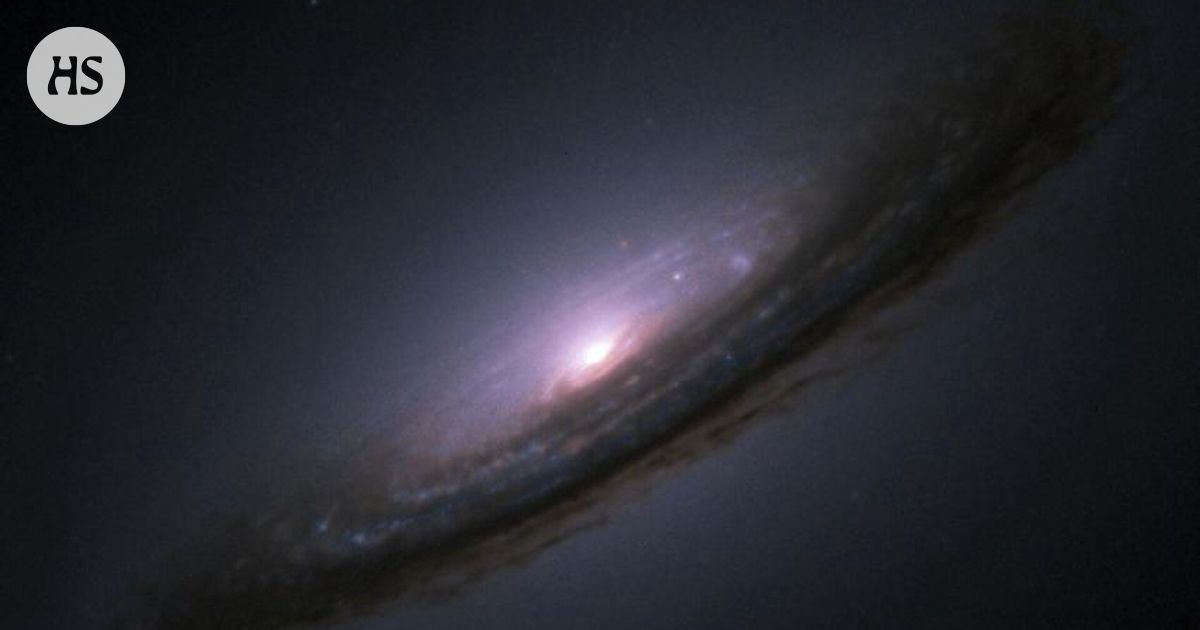
Universe|For about thirty years, there has been a perception that the universe is always expanding at an accelerating rate.
A new study shows that the expansion of the universe is slowing down and not speeding up as previously thought.
Researchers from South Korea’s Yonsei University discovered that the brightness of supernovae is affected by their age.
If the result is confirmed, it will fundamentally change our understanding of the universe and dark energy.
Seppo Mattila, professor of astronomy at the University of Turku, says that the accuracy of the results will become clear in the coming years with new observations.
The universe the expansion is no longer accelerating but slowing down, says a surprising new research result. If the result is confirmed to be correct, it will fundamentally change the perception of the universe.
“Our research shows that the universe has entered a phase where the expansion is slowing down and that dark energy is weakening and changing over time faster than previously thought,” says the research leader, Professor Young-Wook Lee from Yonsei University, South Korea in the bulletin.
Dark energy has been called the force that accelerates galaxies away from each other, even though gravity pulls them towards each other. It has not been possible to find out the essence of this power.
About For thirty years, the idea that the universe is expanding is always accelerating. In 1998, it was discovered for the first time that distant galaxies are moving away from each other faster and faster. The discovery was awarded the Nobel Prize in Physics in 2011.
The speed of receding is measured based on the brightness and redshift of the light emitted by such distant supernovae. Type 1a supernovae used as help are called standard candles.
The distance of a supernova can be calculated based on its brightness, and the redshift of the light spectrum tells how much the universe has expanded during the time the light has traveled.
Thursday in their published study, Yonsei University astronomers present evidence that these standard candles are affected by the age of the star exploding as a supernova.
According to the study, supernovae in younger star clusters appear regularly dimmer and brighter in older ones. The survey data included 300 galaxies.
When the effect of age is taken into account, the data from supernovae no longer match the previous model, the researchers say.
Instead, the observations match the acoustic oscillation of baryons, i.e. the traces of the pressure waves of the Big Bang, and the information provided by the cosmic background radiation.
The data obtained from these three sources together indicate that the expansion of the universe has started to slow down.
Research appeared Thursday in the scientific journal Monthly Notices of the Royal Astronomical Society.
Down university astronomy professor and supernova researcher Seppo Mattila says that observations of supernova differences make sense. It is known that star systems and supernova properties can be different.
According to Mattila, the accuracy of the results will become clear in the coming years, when NASA’s Nancy Grace Roman space telescope and the American Vera Rubin Observatory in Chile begin to systematically observe distant supernovae.
One of the main goals of the multi-billion-dollar projects is to measure a huge number of supernovae “over the last one” and solve the mystery of dark energy.
If it turns out that the expansion of the universe is really slowing down, it will fundamentally change our understanding of the universe, says Mattila
In the dark the strength of the energy and the expansion rate of the universe also have a decisive effect on how the universe is doing.
If dark energy weakens enough, it can happen as was considered possible in cosmology until the 1990s: gravity starts to pull the universe together. The universe born in the Big Bang ends in the final collapse.
If the expansion only accelerates, all distances will grow and the bodies of space will eventually end up in complete, cold solitude.
https://www.monetwork.org/group-page/monetwork-group/discussion/0472a753-2831-40fe-9997-5a9f65a273a7
http://www.bisound.com/forum/showthread.php?p=2953150#post2953150
https://karaganda.en.cx/Guestbook/Messages.aspx?page=1&fmode=gb&topic=382356&anchor#7977483
https://gorod.kr.ua/forum/showthread.php?p=313027#post313027
https://zolochiv.catsboard.com/t3242-topic#12819
https://most.forum2x2.com/t5624-topic#25941
https://www.rolandus.org/forum/viewtopic.php?p=138845#138845
https://ukrinfo.actieforum.com/t2884-topic#6240
https://forum.i.ua/topic/26441
https://vlada.forumotion.me/t2844-topic#6750
https://gortransport.kharkov.ua/forum/index.php?showtopic=10452
https://www.kinofilms.ua/forum/t/5214606/
http://www.bisound.com/forum/showthread.php?p=2952115#post2952115
https://magistr.actieforum.com/t4248-topic
http://footwear.ua/forum/index.php?act=morelist&id_parent=97763&id_group=7&offset_detail=0
https://idei-i-obmen.forumotion.com/t2162-topic#4098
https://kharkov.forumotion.com/t2868-topic#10277
https://ukraineforumm.forumotion.com/t2280-topic#6796
https://zdrav-bydi.forumotion.me/t824-topic#4232
https://razgovory.actieforum.com/t1775-topic#6744
https://mamuli.club/forum/topic/44323/
https://ludi.actieforum.com/t1862-topic#3678
https://almaty.en.cx/Guestbook/Messages.aspx?page=1&fmode=gb&topic=382359&anchor#7977486
https://kharkov.forumattivo.com/t6730-topic#21331
https://politika.forum2x2.com/t11241-topic#28952