Research conducted by the National Institute for Astrophysics (INAF) has provided significant evidence linking these elusive particles to flat-spectrum radio quasars (FSRQs), a specific class of supermassive black holes. The results appeared in the magazine Astronomy & Astrophysicsoffer a higher level of statistical significance than previous hypotheses, while maintaining the necessary scientific caution.
Neutrinos: imperturbable messengers of space
Neutrinos are defined as “incomparable cosmic messengers” due to their physical nature: without electric charge, they are not deflected by the magnetic fields that permeate the Universe. This feature it allows them to travel in a straight line from the most remote sources to Earth, bringing with them direct information on the most violent phenomena in the cosmos.
However, their identification is extremely complex. “Neutrinos are incomparable cosmic messengers“, explain Alberto Moretti and Alessandro Caccianiga, INAF researchers and authors of the study“but there are considerable uncertainties about the extent of their direction of origin. The results of our research, although very promising, do not put an end to the debate. In addition to the direction of arrival, the major uncertainties are also due to selection effects and the limited number of events analyzed“.
The role of FSRQ blazars as cosmic accelerators
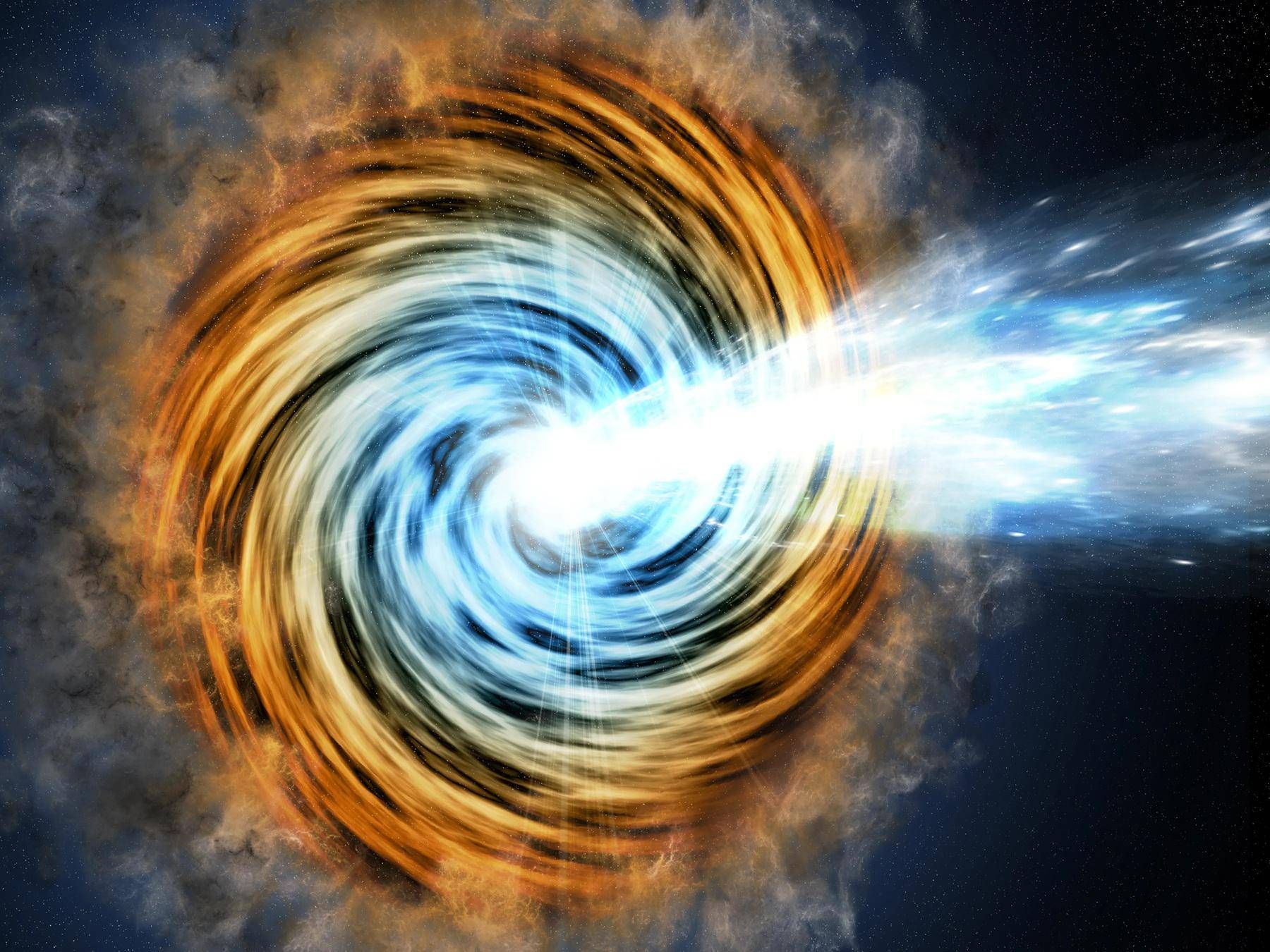
Blazars are active galactic nuclei (AGN) characterized by a central supermassive black hole that emits powerful jets of plasma and radiation at speeds close to the speed of light. When one of these jets is pointed almost perfectly at Earth, the object is classified as a blazar.
Specifically, FSRQ blazars have an electromagnetic spectrum with broad and intense emission lines. The environment inside their jets, where electrons and protons interact with a dense field of photons, is considered the ideal place for the generation of neutrinos with energies higher than those achievable in any terrestrial accelerator.
IceCube and data analysis at the South Pole
To reach these conclusions, the team analyzed the IceCat-1 catalog, derived from the IceCube experiment. Located at the Amundsen-Scott base at the South Pole, IceCube is an observatory made up of over 5,000 optical sensors immersed in a cubic kilometer of Antarctic ice.
The system detects the Cherenkov radiation produced when a neutrino interacts with ice. The researchers selected 30 high-energy events with particularly precise spatial location, comparing them with data from the Sloan Digital Sky Survey (SDSS). Cross-referencing of the data revealed a marked correlation between the position of the detected neutrinos and the distribution of FSRQ blazars in the sky.
Despite the high significance of the results, the research remains open. Final confirmation will depend on the accumulation of new data and the ability to reduce instrumental uncertainties. As Moretti and Caccianiga observe, “The ongoing collection of data by the IceCube experiment opens the prospect of a decisive future confirmation of the link between very high-energy neutrinos and the population of FSRQ blazars“.