First launched at CES 2006, the Blu-ray disc format still maintains its place in modern life thanks to its image quality that far surpasses that of online platforms.
20 years ago, the CES 2006 consumer electronics exhibition in Las Vegas exploded with the appearance of Blu-ray, the successor to DVD. The new technology creates a revolution in storage by using a blue-violet laser diode with a wavelength of 405 nm instead of the traditional red laser, allowing for more accurate data reading at greater density.
A single-layer Blu-ray disc has a capacity of 25 GB, five times the 4.7 GB of a DVD. Not stopping at capacity, transmission speed also increased from 11 to 36 Mbps, combined with AVC (H.264) compression standard to help enjoy high-resolution movies become smoother.
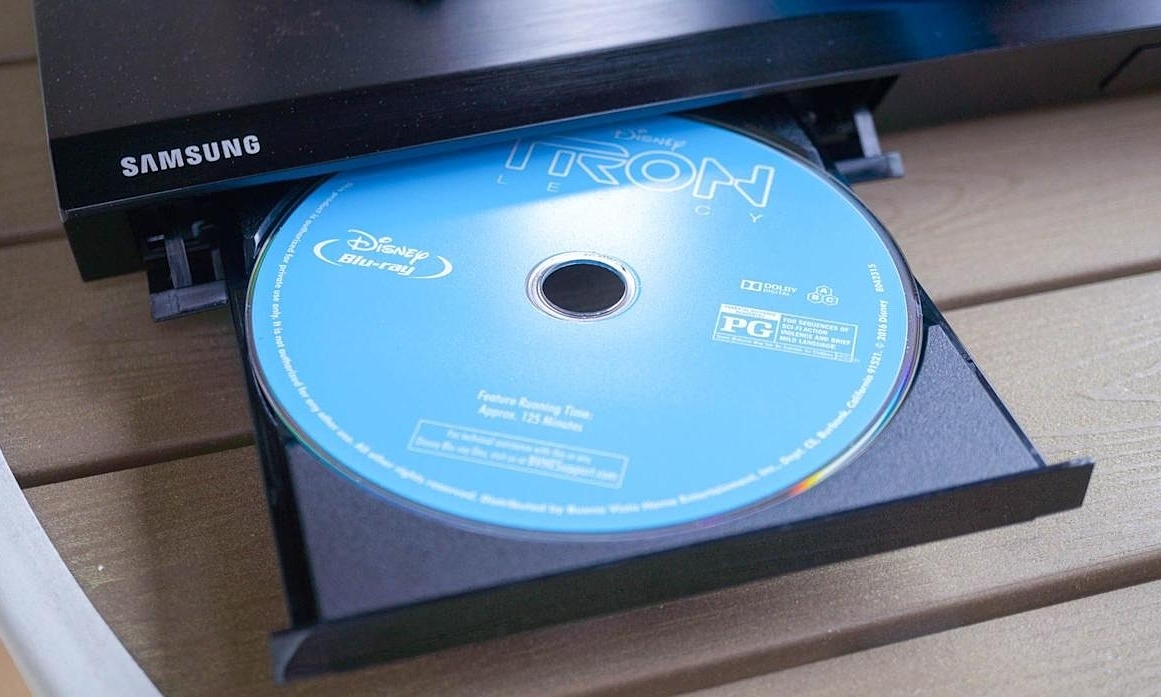
Samsung Blu-ray player and Disney movie disc. Image: Howtogeek
As soon as it was born, Blu-ray entered a fierce confrontation with the HD DVD format, similar to the previous war between VHS and Betamax. While Sony bet on Blu-ray, integrating the format directly into PlayStation consoles, the Xbox “side” sided with HD DVD.
Thanks to overwhelming support from major studios in Hollywood, along with the advantage of capacity and security, Blu-ray quickly won. In early 2008, Toshiba, the developer of HD DVD technology, officially announced its withdrawal, making Blu-ray the standard for high-definition optical discs.
Over the years, streaming platforms have dominated the market, and the market share of disc players has gradually shrunk. However, entering 2026, Blu-ray is considered to still hold an important position, when 4K Blu-ray discs with HEVC and HDR compression standards have bandwidth and image quality far beyond online platforms. For collectors and home cinema enthusiasts, physical discs are the only way to fully enjoy a work without worrying about compressed images. In particular, Blu-ray discs still dominate content distribution for modern gaming consoles.
However, Tom’s Hardware Quoting experts, if you look at industry trends, the Blu-ray era may soon end. Game console manufacturers are gradually abandoning the distribution of physical game content, no longer having disk drives, only supporting downloading games via the Internet. Sony announced that it will stop producing Blu-ray discs in 2025, and LG will stop producing Blu-ray players from the end of 2024. Laptops and PCs are also no longer equipped with optical drives, except in the Japanese market, where demand is still increasing as users upgrade their systems after Windows 10 support is discontinued.
Although new optical storage solutions are still being researched with capacities of hundreds of TB, for common users, Blu-ray is predicted to be the last famous storage format of the physical disc era.