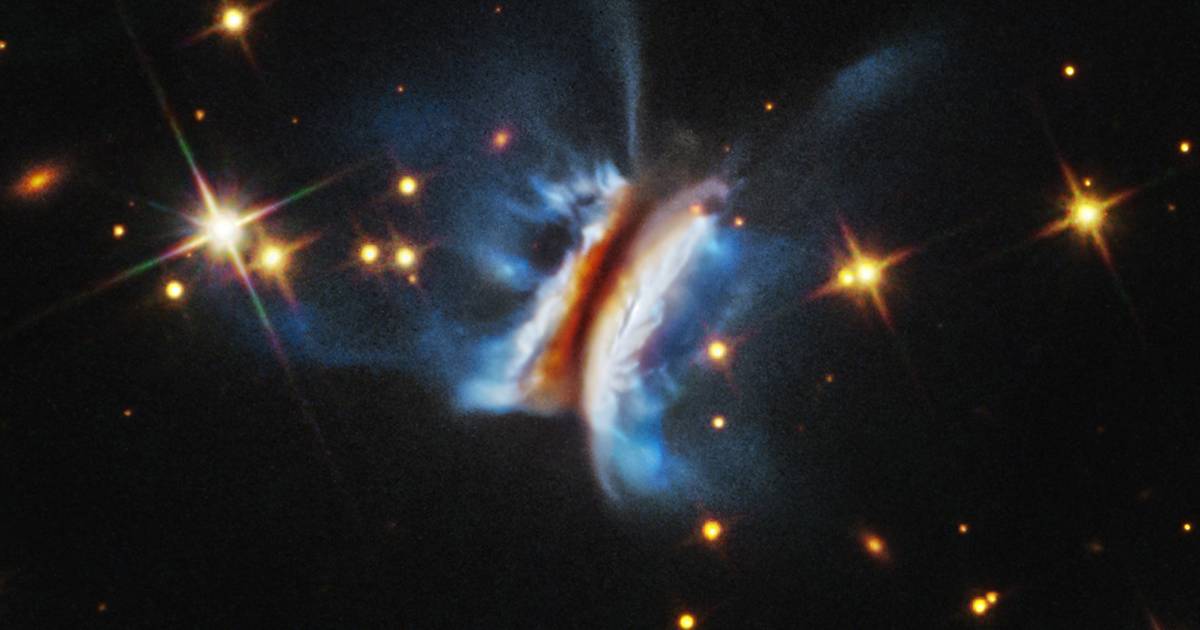
As the young star develops, a protoplanetary disk of dust and gas forms around it, ready for the birth of new planets. Scientists have just discovered new, startling details about the IRAS 23077+6707 system, the largest such disk ever observed by a telescope. New images from the Hubble Space Telescope reveal that this huge “birthplace of planets” is unexpectedly chaotic and turbulent, which changes previous ideas about the origin of planetary systems, writes Science Alert.
A giant celestial body with an unusual nickname
The IRAS 23077+6707 system, located approximately one thousand light years from Earth in the star Cepheus, is truly monumental. Its diameter extends to almost 644 billion kilometers, which is about 40 times larger than the diameter of our Sun system, all the way to the outer edge of the Kuiper belt.
Due to its size and appearance, the system was given a cute nickname – “Drakulin Chivito”. The name is a playful dedication to the heritage of the two researchers who discovered it: one is from Transylvania, the other from Uruguay, where the national dish is the sandwich. called “chivito”.
Seen from our position, the disk is tilted almost sideways, so it resembles a hamburger. The dark central band of dust represents “meat”, while the blurred layers of gas and dust above and below it look like “pastry”. This very position enabled the Hubble telescope to peer into its structure with an unprecedented level of detail in the visible spectrum of light.
Enigmatic asymmetry and unexpected chaos
What surprised astronomers the most was not only the dimensions of the disk, butć and its chaotic nature. The images reveal strands of material that extend much further above and below the disk’s center plane than seen in any similar system. Its pronounced asymmetry is even more unusual.
Elongated, fibrous filaments are visible only on one side of the disc, while the other side has a much sharper and smoother edge.
This strange, warped structure suggests that dynamical processes are at work shaping the disk, such as recent intrusion of gas and dust from the surrounding space or interactions with interstellar winds.
- The level of detail we see is rare in imaging protoplanetary disks, and these new Hubble images show that the birthplaces of planets can be much more active and chaotic than we expected – said research leader Kristina Monsch from the Center for Astrophysics | Harvard & Smithsonian (CfA).
Her colleague and research associate, Joshua Bennett Lovell, was also amazed by the discovery.
- We were shocked to see how asymmetrical this disc is. Hubble has given us a first-hand look at the chaotic processes that shape disks as they create new planets. These are processes that we do not yet fully understand, but now we can study them in a completely new way – added Lovell.
All planetary systems are formed from disks of gas and dust orbiting young stars. Over time, material collects and forms planets. IRAS 23077+6707 could represent an enlarged version of our early Sun system.
It is estimated that the mass of its disk is between ten and thirty times the mass of Jupiter, which is more than enough material to form several gas giants.
- In theory, IRAS 23077+6707 could host a huge planetary system – noted Monsch.
- Although planet formation in such massive environments may differ, the underlying processes are likely similar. At the moment we have more questions than answers, but these new images are a starting point for understanding how planets form over time and under different conditions – the head of research added about this discovery.