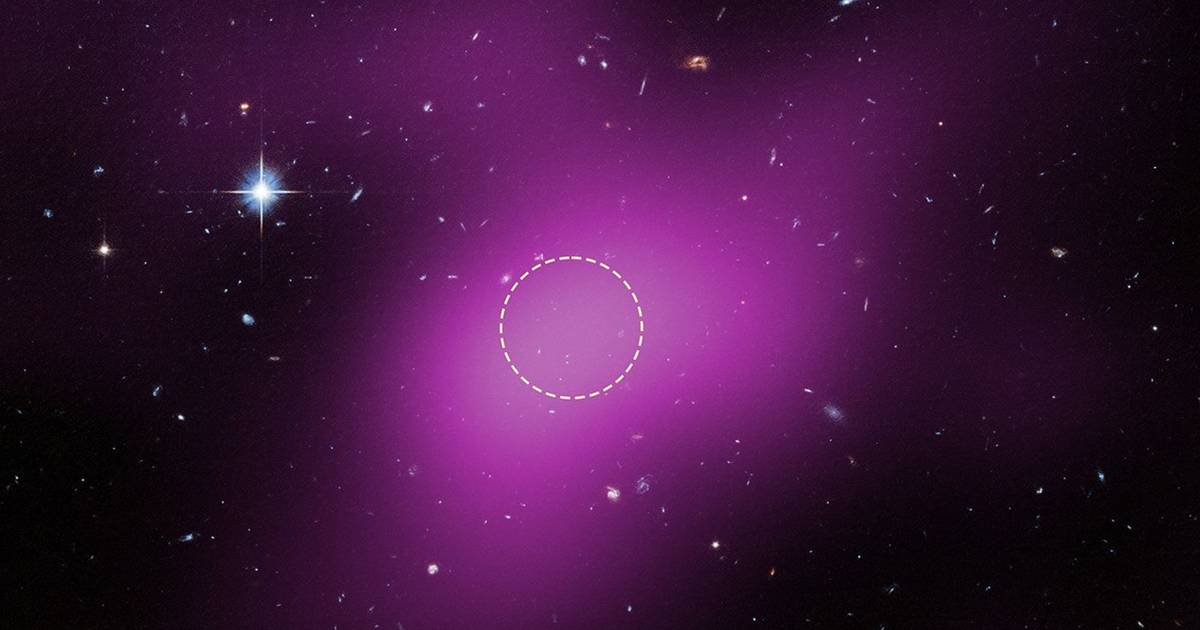
Astronomers have described two unusual new discoveries in papers and accompanying publications: one is a huge cluster of galaxies that is “too hot” and very early after the Big Bang, and the other is a cloud of gas that looks like a galaxy that never managed to form stars. The first case is related to the protocluster SPT2349 56, observed when the universe was about 1.4 billion years old. They found traces of hot gas in it, which, according to simpler models, should have formed more slowly and later.
How did they “see” it at all? The team used the ALMA telescope and measured the effect in the cosmic microwave background, in short, the hot gas leaves a recognizable signature in the background radiation. In the paper, they write that the signal points to a huge amount of heat energy, more than would be expected if everything was heated only by gravity and the normal growth of the cluster. One of the ideas is that additional energy is injected into the environment by active black holes and extreme star formation in that dense area.
The second discovery is called Cloud 9 and it sounds even stranger: it is an object near the galaxy M94, about 14.3 million light years away, which looks like a cloud of hydrogen wrapped in dark matter, but with no visible stars. Scientists present it as the first confirmed example of what was long expected in theory: a “dark” small halo that retained gas but never began serious star formation. That is exactly why it is described as a kind of “bones” of a failed galaxy, something left halfway.
Cloud 9 was first observed in radio observations by the FAST telescope, and then it was further checked by other radio instruments and Hubble. The key part is Hubble: the deep images found virtually no star trail that would be expected if it were a classic dwarf galaxy. In the paper, the team even states how “certain” they are that there is no stellar population above a very low threshold, which further pushes towards the idea that this is really an object without stars.
Why is it interesting outside of astronomy forums? The first result suggests that massive structures in the early universe may be able to heat up faster than we thought, which affects models of cluster development. The second result provides a rare “pure” example of a system where you can study dark matter and gas without starlight obscuring everything. In both cases, the message is the same: the universe is full of details that make us re-examine the rules.