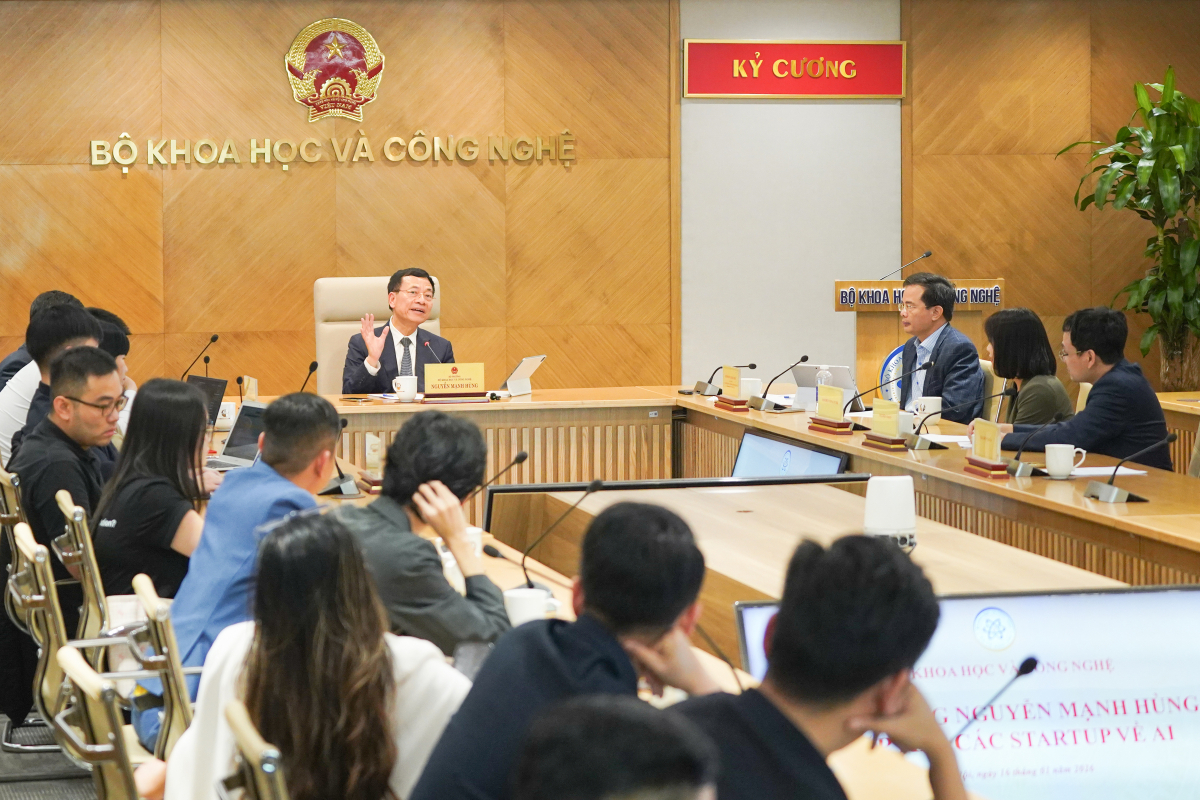
It is difficult to compete with foreign countries in terms of capital, human resources or technology, the “door” for Vietnamese startups, according to Minister Nguyen Manh Hung, is to find a big enough, difficult enough social problem and innovate to solve it.
The message was stated by Minister of Science and Technology Nguyen Manh Hung at a discussion with about 20 startups operating in the field of generative AI in Vietnam, with the participation of large business representative Tasco, on the afternoon of January 16.
During the meeting, which was held in the form of an open dialogue, with a close address and direct sharing, the Minister raised his concerns about the fact that Vietnam does not have many large startups aiming to solve the country’s big problems, and at the same time gave suggestions to help overcome difficulties for startups in the process of starting a business and developing their businesses.
Minister of Science and Technology Nguyen Manh Hung during a meeting with AI startups in Vietnam, January 16, 2026. Image: Luu Quy
For startups, the issues raised are largely related to the ability to receive support, access to capital from state funds, mechanisms to participate in public projects, the path to bringing Vietnamese technology products to the international market, as well as the supporting role of the State in the context of global competition.
From experience in building and developing businesses in Vietnam and then going global decades ago, combined with the perspective of the state management agency on science and technology, the Minister has clarified the startup world’s questions about support mechanisms, and at the same time inspired to find big problems, big problems associated with practice to solve.
“Don’t be a small startup asking for a few hundred thousand dollars and then sell yourself. Own great problems,” he said.
“Startups should not consider themselves businesses”
At the beginning of the discussion, Minister Nguyen Manh Hung spent a lot of time talking about how to position startups, something he believes is widely misunderstood. According to him, one of the basic misunderstandings is considering startups as a form of small-scale businesses or working for large businesses. This understanding can cause startups to “lose from the beginning”.
According to the Minister, if they put themselves in the position of a business, startups will have to compare on criteria where they have almost no advantage, such as capital, products, and customers. While businesses already have a market, cash flow and optimal operating goals to increase profits, startups are looking for something that “doesn’t exist yet”, such as a business model, market and solution to a new problem. These two approaches go in opposite directions.
From that perspective, the Minister said that the biggest advantage of startups lies in being “not a business”. Not being bound by traditional operating rules allows startups to be more flexible, willing to experiment and accept unprecedented ways of doing things.
He also emphasized the difference in risk perception between startups and large enterprises. For startups, mistakes are data to learn and adjust. Launching products when they are not perfect is considered an inevitable part of the testing process, contrary to the cautious, optimal and risk-limiting approach of large corporations.
In return, in terms of profits, while large businesses often grow linearly and at a stable level year after year, startups can spend many years struggling in the early stages to find a suitable model, but once the direction is determined, growth needs to take place exponentially. According to him, this is the characteristic that makes startups unable to be evaluated or managed by the same metrics as traditional businesses.
“You are born to overcome big businesses, not to work for them,” he said.
Minister Nguyen Manh Hung shared at the AI startup meeting on January 16, 2026. Image: Luu Quy
However, he also sees business as an important factor for startups to develop. But instead of hiring or acquiring, businesses should be the “guinea pig”, or “first customer” of the startup. According to the Minister, what startups need most in the early stages is not necessarily capital, but a real environment to test products, where they can deploy, collide, make mistakes and correct on real data. When the product solves specific problems of large enterprises, the startup will have practical proof to continue to improve and expand to other markets, domestically and internationally.
Right at the event, he also asked agencies in the Ministry to consider adjusting mechanisms, including the requirement that large businesses when establishing funds to invest in startups require provisions to become the startup’s first customers. This approach not only helps startups have a “springboard” to develop, but also forces large businesses to open their systems for innovation, instead of waiting for improvements from within the already cumbersome apparatus.
This request received an enthusiastic response from the startup team in the auditorium.
In addition, the Minister noted that many Vietnamese startups have not gone far enough because they choose problems and dreams that are too small. According to him, if the startup only aims to sell the company soon for a few million USD, it will be difficult for startups to create motivation to pursue big, long-term problems. On the contrary, targeting problems that have a wide impact, big enough on society or the economy is what keeps startups going in the long run, instead of shrinking themselves into a “small business” working for the big guys.
“Don’t be proud just because there is a better solution than Google”
Listening to a startup’s sharing about developing a voice recognition AI solution “better than Google” and hoping for support to replicate, the Minister frankly acknowledged that technical development is good, but is not the deciding factor in the startup’s value.
According to him, the real measure of a technology product does not lie in being better than anyone else, but in its ability to solve a specific pain of society and the level of market acceptance. The more important question to ask is whether the product helps people’s lives, is chosen and used regularly by users, and can be expanded to a large enough scale.
From there, he emphasized that startups need to shift their focus from taking pride in algorithms to focusing on products. A technology solution is only truly meaningful when people hold it in their hands and use it every day. If a startup can build a product with many times more users than Google products, that is something to be proud of, because user acceptance is the most accurate measure.
Representatives of some AI startups shared in a discussion with Minister Nguyen Manh Hung on January 16, 2026. Image: Luu Quy
Faced with the fact that many startups often start with the questions “where is the fund”, “what is the core technology”, “where is the human resources”, he believes that these questions are “not wrong”, but if they are set as a starting point, Vietnamese startups will immediately fall into a disadvantageous position. Vietnam cannot compete in terms of capital with foreign funds, and it is also difficult to compete in fundamental technology when developed countries have accumulated basic research for decades. Regarding human resources, the best individuals are often attracted to markets with better conditions.
From practical experience and drawing from the research process, the Minister believes that the “door” of Vietnamese startups does not lie in money or technology, but in finding the right problem.
“The person who grasps a big enough and difficult enough social problem is the one who masters the game,” he said, emphasizing that once the problem has been found, technology and capital will only play a role in serving the solution of that problem.
From the orientation of considering “problems” as core assets, Minister Nguyen Manh Hung proposed a way to define startups as not doing things that hundreds or thousands of other units are also doing. A true startup needs to solve problems that have existed for a long time but no one has been able to solve them, or open up completely new problems that no one has thought of before, such as conflicts in legal documents, accumulating knowledge in the organization instead of depending on individuals… are problems that are being encountered around the world but there is no effective solution.
For startups that want to go global, according to him, it is necessary to find and solve domestic problems because “most of Vietnam’s problems are also common problems of the world”. When solving problems well in Vietnam, it means that the startup has a ticket to bring solutions to the international market.
Regarding how to choose problems, according to the Minister, problems that sometimes do not receive trust from others are opportunities for success. An idea that is agreed upon by everyone, from management agencies to investment funds, is likely to have a breakthrough value that is no longer high, or is too obvious to create long-term advantages. On the contrary, not being trusted and having difficulty raising capital are sometimes signs that a startup is taking a different direction.
With the challenge of capital that most startups are concerned about, he emphasized that recent changes in Vietnam’s science and technology institutions will help solve the problem. For example, the Law on Technology Transfer allows technology to be considered property. However, he also advised startups to consider “hungry” as a condition to find breakthrough solutions, instead of successfully raising capital but then losing motivation or being controlled by the company.
Closing the conversation, the Minister advised startups not to wait for perfect conditions, but to take advantage of available resources, overcome the initial period of loneliness and prove their value with products accepted by the market. For large businesses like Tasco, he recommends starting with using technology to solve their own problems before expanding to the market, and becoming the first customers for startups.