Children’s science questions|We also tell you what kind of dreams we can’t see and where the word wisdom tooth comes from.
The most common ways in which an animal can die from the poison of its own species is a bite or contact.
Dogs are not color blind, but they cannot tell red from green.
The name of the wisdom tooth is related to the fact that the wisdom tooth does not usually appear until adulthood, around 19–20 years of age. In this case, a lot of school has already been attended.
Does an animal die from the poison of its own species?
Aarni Mutanen, 8
In most of them in these cases, a basically healthy adult animal survives the poison of its fellow species living in the same habitat. That’s because they usually have an innate resistance to it.
The most common ways to get poisoned are by bite or contact. In the sometimes fatal bites between species, the most common reasons are a large dose of poison, an awkward point of poisoning, for example in the area of the head or internal organs, the weakness of the poisoned animal, or the size difference between individuals.
Often situations like this are related to predation. For example, elapids, or venom garden snakes, generally also prey on conspecifics. In this case, the poisons in the prey animal break down during the predator’s digestion.
Another possible risk of receiving a fatal dose of venom from a fellow species occurs if the venom of the animal species is spread through the skin. In this case, the poison effect comes through ingestion or contact.
The composition of the poison is then usually formed according to the prey animals.
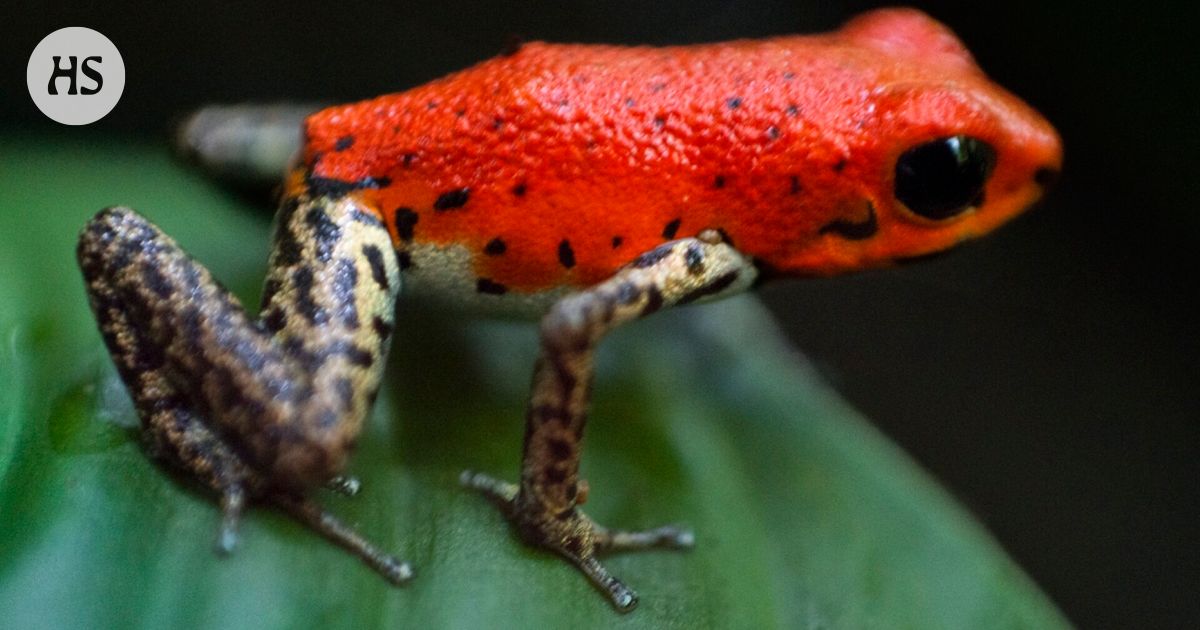
For example, the poison of poison dart frogs consists of some of the termites and similar small insects they eat. A poison dart frog of the same species that is from a different habitat and eats slightly different prey insects does not necessarily have the same resistance as its counterpart, in which case there is a risk of dangerous poisoning in connection with a territorial dispute, for example.
In the end, however, the world’s animal species are so diverse that there is no unequivocal answer to Aarn’s question that applies to all animal species. There are always exceptions somewhere in the world. Even in Finland, the poison of some animals, such as spiders, ants, wasps and vipers, can be fatal to fellow species if they happen to spread the poison to each other. They, too, use poison for defensive purposes or for predation.
Niko Selin
Chairman of the Finnish Herpetological Association, nature mapper
A dog cannot tell red from green and green from red. It’s still not color blind.
How do we know dogs are color blind?
Hugo Väkimies, 8
Color vision enabled by sensory cells located on the retina of the eye. Humans have three types of cells in the eye that sense different wavelengths of light, i.e. color – they distinguish between red, green and blue. With those cell types, we can distinguish all the colors we see.
Other animal species may have different sensory cells. For example, birds have more cell types in their eyes than humans, so they probably distinguish a more varied color scheme.
There are only two different types of cells in dogs’ eyes. One of them is similar to the human blue light sensory cell, and the other senses wavelengths between red and green, i.e. yellowish light. So the dog is not color blind, but it cannot distinguish red from green and green from red.
The sight of dogs has been studied, for example, by showing them various cat videos made with colored balls, observing behavior and measuring nervous system responses, i.e. reactions.
For example, dogs have been taught to always choose the lighter or red of the two options, for example by going to the right option, looking at it or poking the touch screen with their snout. At that point, when the choices of the sides become a matter of guesswork, it is stated that the dog’s vision is no longer sufficient to distinguish between the options.
A small percentage of people have it too red-green vision disorderi.e. their color vision is probably at least somewhat similar to that of dogs. However, we cannot be absolutely sure of the color scheme experienced by dogs, because it cannot be directly measured or otherwise studied.
Miiamaaria Kujala
academy researcher and docent of comparative cognitive neuroscience
University of Jyväskylä
In a dream, things often come together in an imaginative way.
What kind of dream can’t you dream?
Seppo Joutsijärvi, 6
Se what we dream is connected to what we know about the world. When we know what a Saimaa grouse looks like, for example, it can appear in our dreams. In a dream, the mind also combines things and creates imaginative new creatures and events from them.
Dreams are not only seen, but also experienced. For example, we can experience what it feels like to fly lightly without wings. Blind people from birth experience more sensations and hear sounds in their dreams.
In a dream, you cannot experience something that is completely foreign to you. For example, we cannot follow in our dreams in detail how a space rocket is actually built if we do not have accurate information about it.
However, sometimes in a dream you can solve a problem that was bothering you while you were awake. In a dream, small pieces of memories can come together in a new way and the result can be the key to, say, a new invention or a work of art. We can thank, for example, the birth of the sewing machine and the theory of relativity for dreamlike insights.
Anu-Katriina Pesonen
sleep researcher, professor
University of Helsinki
Wisdom tooth eruption often causes pain, and wisdom teeth removal is common.
Where does the name wisdom tooth come from? Why doesn’t it break out as a child?
Kerttu Holopainen, 6
Wisdom tooth is not only a Finnish language expression. The name is the same in many other languages of the world: for example, in Swedish it is wisdomstand, in English wisdom tooth, in German weisheitszahn, in French dent de sagesse, in Italian dente del giudizio, in Spanish Muela del juicio and in Latin dens sapientiae.
The development of wisdom teeth starts later than other teeth. It has been observed that the beginning of the crown of the wisdom teeth, i.e. the visible part, can be seen in the x-ray of the jaws at about 8 years of age.
In Finns, the wisdom tooth peeks out from the gum for the first time only at the age of 19–20. By that time, we have already gone to a lot of school and we are already adults. The name wisdom tooth is related to it.
The jawbone of a child aged around 6 years and younger is so short that no more than 20 baby teeth can fit there. However, the jawbone of a six-year-old can also accommodate the so-called sixth teeth, i.e. the permanent teeth that erupt roughly at that age.
As you get older, the jawbone grows in length and height. By the age of 12, all milk teeth have usually fallen out. In this case, the mouth starts to fit all 32 permanent teeth that develop in their place.
However, nowadays wisdom teeth often do not fit completely into the mouth. Eruption problems often cause pain, which is why the teeth in question are often removed. Over time, however, it has been useful that the jaw becomes more usable chewing equipment as an adult. In addition to humans, many other mammal species grow new teeth as adults.
Irja Venta
docent of oral and maxillofacial surgery
University of Helsinki