China successfully conducted the first metal 3D printing experiment in space, marking a major step forward in production capacity.
The Chinese Academy of Sciences (CAS) announced on January 24 that this groundbreaking experiment was carried out using a set of equipment developed by the Institute of Mechanical Engineering under CAS. Lihong-1, a commercial spacecraft from CAS Space, carried a set of equipment and some other cargo to the edge of space from the Jiuquan Satellite Launch Center in northwest China midway through this month.
After Lihong-1 crossed the Karman line, the boundary between Earth’s atmosphere and outer space, reaching an altitude of about 120 km, the experimental set automatically printed metal parts in a microgravity environment. According to CAS, this success marks the transition of China’s space metal additive manufacturing technology from the “ground-based research” stage to “space technical verification”, helping to promote the development of future space infrastructure.
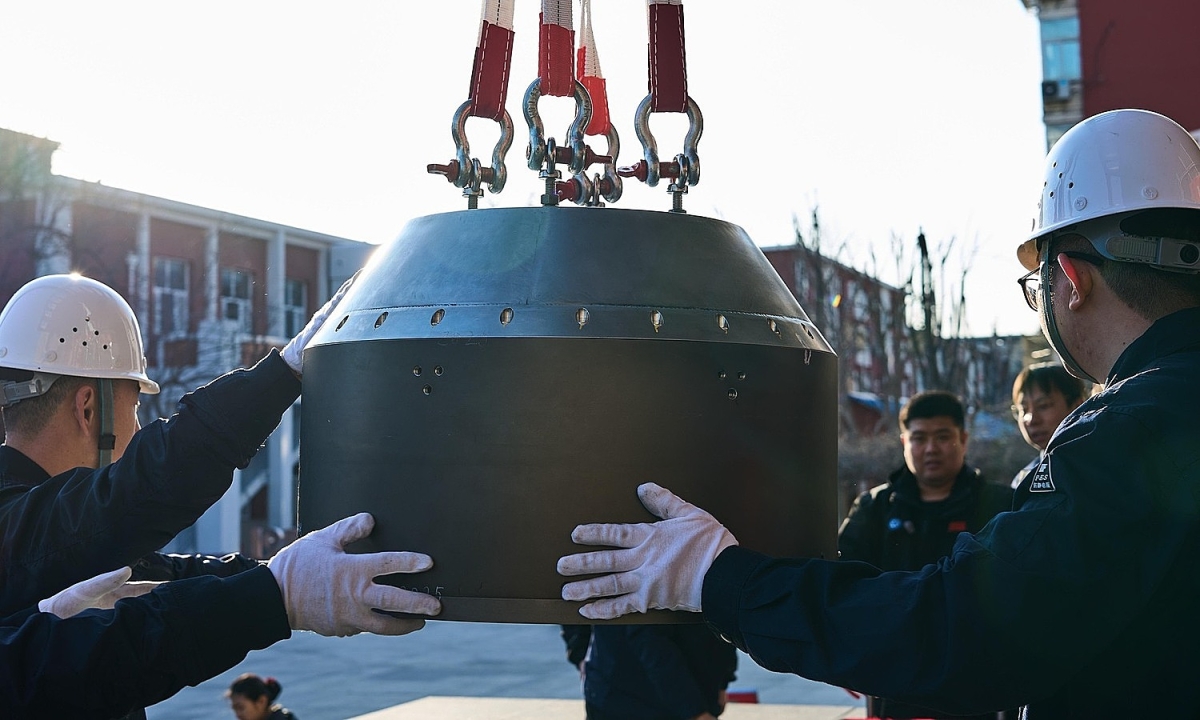
The rescue team recovered the cargo compartment of the Lihong-1 Y1 ship after landing. Image: CAS Institute of Mechanical Engineering
Metal additive manufacturing in space is much more complex than on Earth. The research team overcame a series of challenges such as transporting and forming stable materials in microgravity conditions, controlling the entire process, and performing skillful coordination between the experiment set and the launch vehicle.
After the experiment, Lihong-1’s cargo compartment landed safely thanks to a parachute and was quickly recovered. Scientists have now collected valuable experimental data, including the dynamic properties of the molten zone, material transport and solidification processes, geometric accuracy, and mechanical properties of 3D printed parts.
CAS Space said that Lihong-1 has low launch costs and high flexibility, and can provide a microgravity testing environment of more than 300 seconds for samples or equipment inside. Microgravity provides unique conditions that cannot be replicated on Earth, allowing materials to crystallize more evenly, biological cells to grow differently, and additive manufacturing to be free of defects caused by gravity.
Lihong-1 was developed to be reused many times. According to Wang Yingcheng, the project’s deputy designer, the team is conducting extensive testing to add crew life support systems and high-reliability escape technology on board. This will help China improve its capacity to conduct low-cost suborbital scientific experiments and commercial space tourism.